Wall Street Isn't Just Investing in AI Anymore — They're Building It
By Ali Sadikin Ma · · Updated
Category: Technology
Wall Street isn't just buying AI stocks anymore.
They're building their own AI companies.
On May 4, 2026, the Anthropic Wall Street joint venture worth $1.5 billion was officially announced. Blackstone, Hellman & Friedman, and Goldman Sachs teamed up with Anthropic to build a new enterprise AI company — one that targets mid-size businesses and private equity-backed companies.
But hold on.
There's one detail that makes this deal different from every AI investment before it — and almost every media outlet missed it.
And if you think this is just news for Wall Street people — there are direct implications for your business, no matter the size.
Why the Anthropic Wall Street Joint Venture Is Different from Normal AI Investment
94% of global financial firms are already piloting or deploying generative AI in their core businesses in 2026, according to the 2026 Global AI in Financial Services report from Cambridge Judge Business School (CCAF). But at the same time, SCNSoft Q1 2026 data shows 65% of AI adopters still rely on off-the-shelf tools. Most businesses are using AI — they just don't own the implementation layer. That's exactly what Wall Street just grabbed.
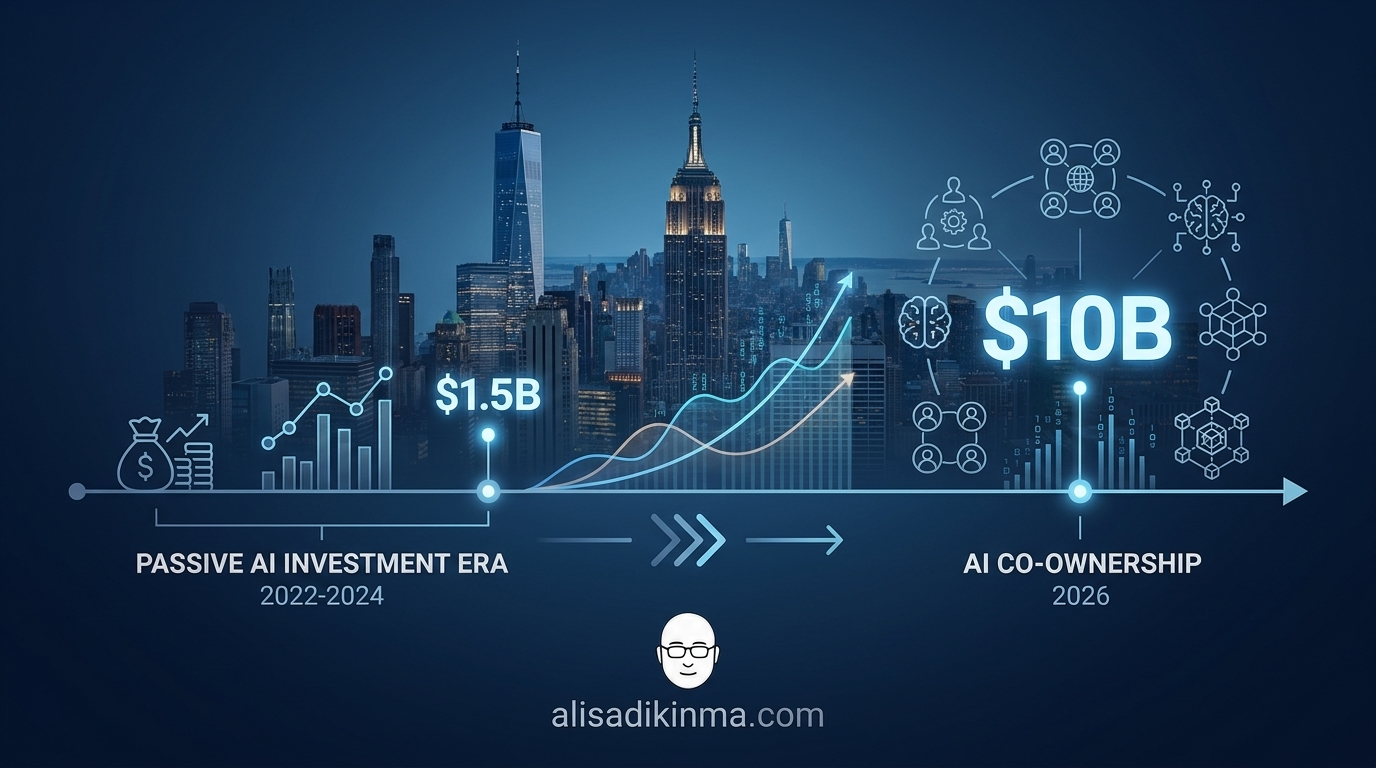
If you compare the AI investment cycle from 2022–2024 to what's happening now, there's a fundamental shift:
Before, investors would fund AI companies and wait for returns. Now?
They're helping build the infrastructure itself.
And this isn't the only deal. OpenAI is building something similar — they're calling it The Deployment Company, a $10 billion joint venture with $4 billion already raised from 19 investors, according to Fortune.
The race to own the AI implementation layer has officially started.
This Isn't an Investment — It's a Takeover of the AI Implementation Layer
This isn't just a financial deal. It's a move to control who gets access to enterprise-grade AI, where AI runs, and how it's priced. With $527 billion in AI capex projected by Goldman Sachs throughout 2026, whoever owns the implementation layer owns the market.
Everyone's calling it an investment.
I'd call it something else:
An infrastructure takeover.
Here's why that distinction matters:
When you invest in AI, you buy a ticket and wait for returns. When you build an AI company with the best model provider — you control the gate: who gets in, where AI runs, what it costs.
And there are concrete effects that are already showing up:
FIS, one of the world's largest financial technology companies, just announced an agentic AI partnership with Anthropic. The result? Anti-money laundering (AML) investigations that used to take hours — now done in minutes. AI automatically collects evidence across core banking systems.
This isn't a demo. This is production.
Accenture has gone even further: they formed the Accenture-Anthropic Business Group with 30,000 trained professionals, targeting regulated industries like financial services, healthcare, and public sector.
Here's the question you need to ask yourself:
Who gets access to this infrastructure first — businesses already in the loop, or those still waiting on the outside?
3 Things This Means for Your Business Right Now

For mid-size businesses, this $1.5 billion deal has three direct implications: the gap between basic AI and enterprise-grade AI is widening, mid-market is now the primary target, and your AI strategy needs to shift from just accessing AI to owning the process. Databricks 2026 found AI can cut operating costs by up to 20% — but only 40% are actually seeing real results.
Generic AI will start losing out to enterprise-grade AI
What's happening: This deal creates two classes of adopters — those with access to enterprise-grade Claude implementation, and those using the generic version.
What you need to do now: Audit one process in your business that's the most repetitive and data-heavy this month. That's your first candidate for AI that's actually implemented, not just dabbled with. The difference? Properly implemented AI can cut operating costs by up to 20%. Just dabbling might not even get you 2%.
Mid-market is the primary target of this deal — not big corporations
What's happening: The Anthropic Wall Street joint venture explicitly targets mid-size companies and PE-backed businesses. Not Fortune 500 — businesses in the middle, exactly your size.
What you need to do now: Identify AI vendors that already have an active Anthropic partnership. They're the ones who'll get priority access to this new infrastructure. Evaluate now, before the waitlist gets long.
Your AI strategy needs to shift from access to process ownership
What's happening: Morgan Stanley forecasts AI productivity gains will contribute around 20% to global economic growth in 2026. The biggest winners won't be who uses the most AI — but who has AI deepest in their processes.
What you need to do now: Ask your team this week — out of all the AI tools we use, how many are actually integrated into core workflows, and how many are just browser tabs we open when we remember?
What to Watch — And One Question for Every Business Leader
Remember the opening line of this article?
Wall Street isn't just buying AI stocks. They're building their own AI companies.
Now you know what it really means:
Wall Street isn't just funding AI companies. They're becoming AI companies. And mid-market businesses — your business — are the prize being fought over, because Morgan Stanley projects AI will contribute 20% to global economic growth in 2026.
Watch for these in the next 90 days: how enterprise Claude pricing changes once this infrastructure goes live, which vendors get priority access, and whether similar deals will show up in the Southeast Asian market.
But most importantly — one question you need to answer right now:

Is your business AI strategy built on access — or process ownership?
Your answer determines whether you're inside the loop — or outside it.
FAQ: Anthropic Wall Street Joint Venture
What is the $1.5 billion Anthropic Wall Street joint venture?
On May 4, 2026, Anthropic, Blackstone, Hellman & Friedman, and Goldman Sachs announced a $1.5 billion joint venture to build a new enterprise AI company. Each party invested approximately $300 million (Anthropic, Blackstone, H&F) and $150 million (Goldman Sachs), with the primary target being mid-size businesses and PE-backed companies worldwide.
How is this joint venture different from a regular AI investment?
This joint venture isn't just funding — Anthropic is directly involved in the ownership structure of the new company. The result is an enterprise AI service infrastructure that controls access, deployment, and Claude pricing, rather than just an AI product available on the open market.
Follow for weekly breakdowns on the AI deals that actually matter for your business.
Not sure AI is right for your business? Read this first: A Practical Guide to Enterprise AI Adoption for Mid-Market Companies.