OpenAI vs Claude Mythos 2026: 3 New Models Launched
By Ali Sadikin Ma · · Updated
Category: Technology
97.6%. 93.9%. 83.1%.
Three numbers that forced OpenAI to move fast in 2026. Anthropic’s Claude Mythos just hit #1 out of 115 models on BenchLM — leading 17 out of 18 benchmarks measured. In the OpenAI vs Claude Mythos 2026 race, everything changed in a matter of weeks.
OpenAI didn’t sit still. They released not one, but three models at once. And most people in the industry didn’t even notice until a week later.
There are three things you need to know today:
One — what did OpenAI actually release? Two — is it enough to match Mythos? Three — which one should you use if you’re building with AI right now?
All the answers are below. But there’s one number at the end that you probably haven’t seen yet — and it’s going to change how you look at this race entirely.
Why Claude Mythos Made OpenAI’s Strategy Look Outdated Overnight
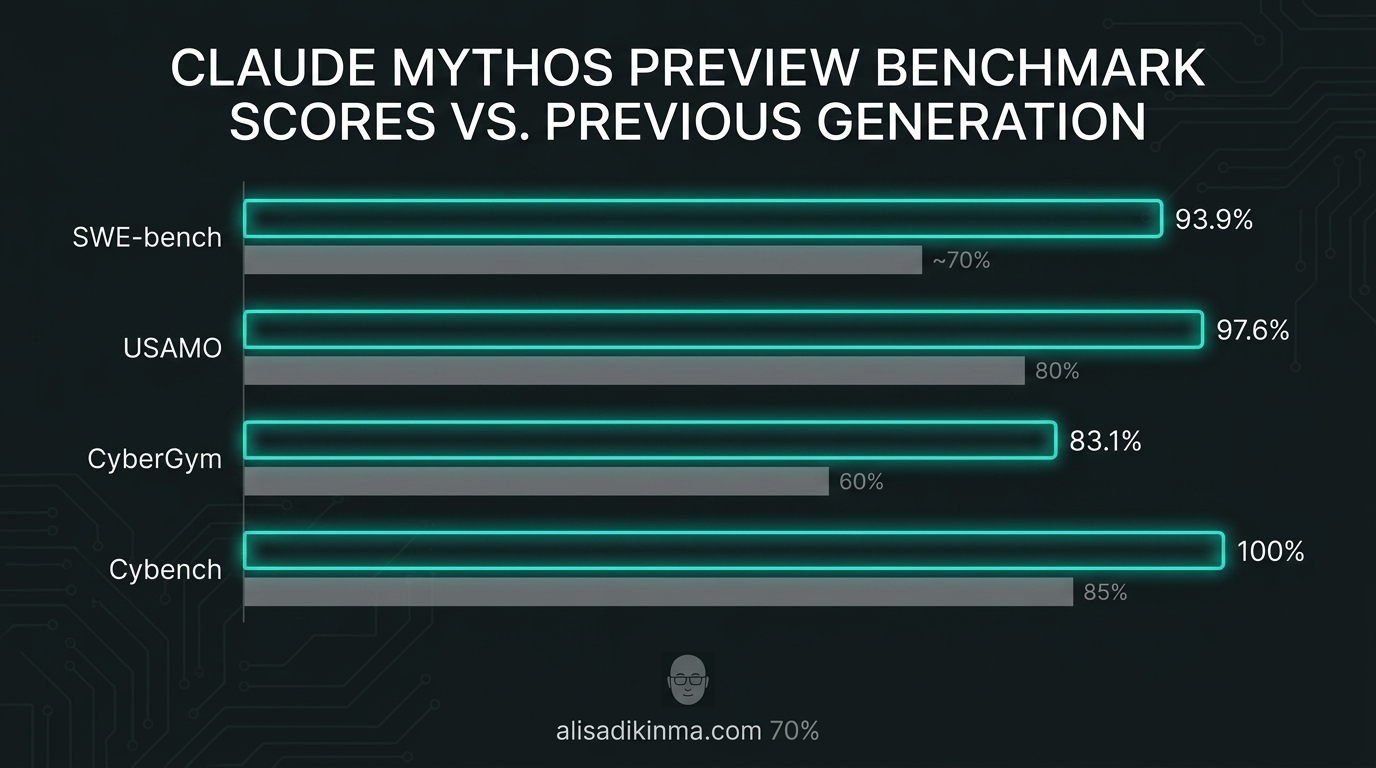
Claude Mythos Preview hit #1 out of 115 models on BenchLM with a score of 99/100, leading 17 out of 18 benchmarks Anthropic measured. On SWE-bench Verified: 93.9%. On USAMO 2026: 97.6%. On CyberGym: 83.1%. These results are 4.3x above the previous model performance trendline — and that’s not just a milestone, that’s a category shift.
Here’s the context that makes OpenAI’s response so important:
It’s not just about static benchmarks. According to RevolutionInAI.com, METR measured the 50% task horizon for Claude Mythos Preview at around 16 hours — up from 1 hour in mid-2024. That means Mythos can handle complex autonomous tasks for 16 hours without human interruption. That’s a generational leap, not an iteration.
OpenAI needed an answer. And they answered — just not the way you’d expect.
OpenAI vs Claude Mythos 2026: Daybreak, GPT-5.5, and What Actually Happened
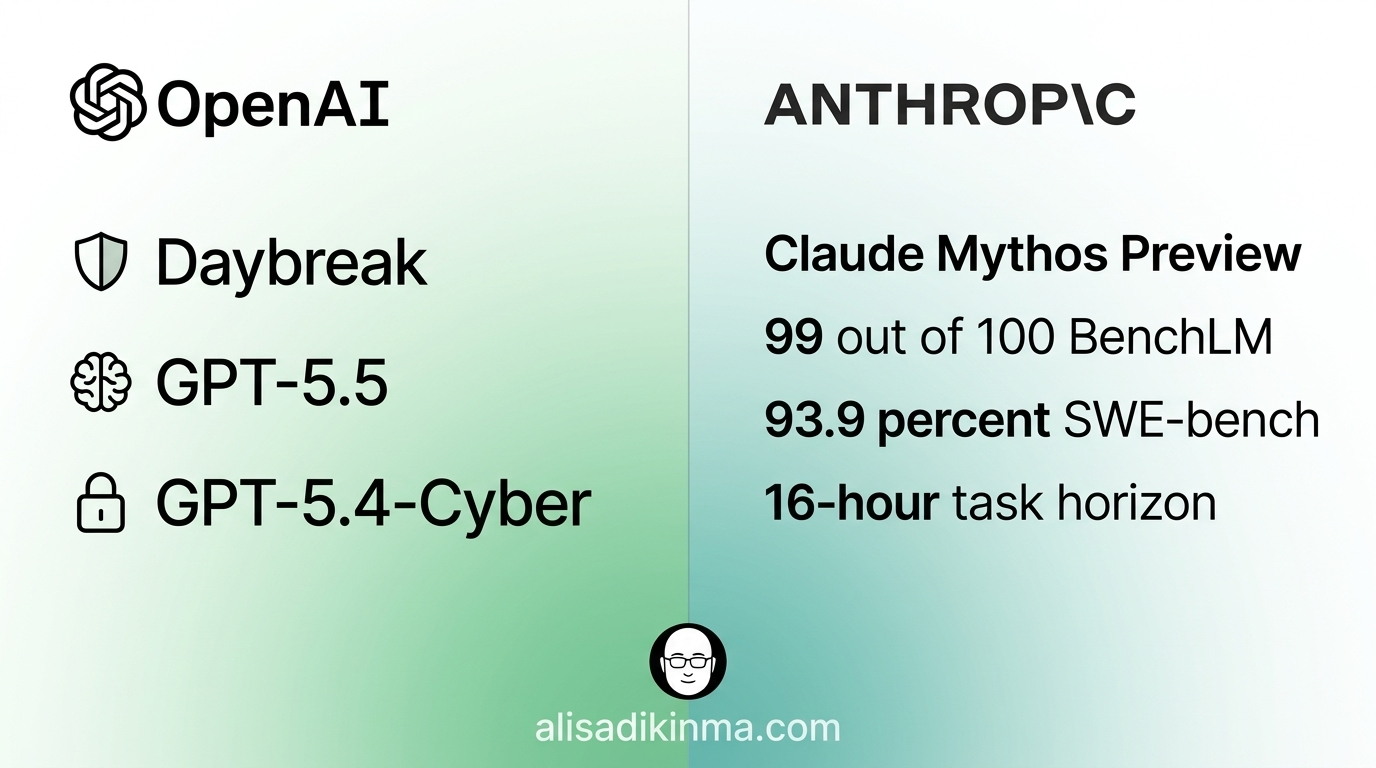
OpenAI released three models in response to Claude Mythos: Daybreak (cybersecurity specialist), GPT-5.5 (general capability upgrade), and GPT-5.4-Cyber (defender-focused variant, April 2026). This wasn’t a single counterpunch — it was an attack spread across multiple fronts, with Daybreak leading the charge, according to DevOps.com.
So what did OpenAI actually release? Here’s the breakdown:
Daybreak is the model getting the most attention. According to DevOps.com, Daybreak was designed directly to challenge Anthropic in AI cybersecurity — an area where Mythos wins with 100% pass@1 on Cybench (saturated) and 83.1% on CyberGym. Daybreak isn’t general-purpose. It’s a direct counter to Mythos’s cyber dominance.
This is a different OpenAI vs Claude Mythos 2026 strategy from previous benchmark wars.
GPT-5.5 comes as a general capability upgrade. Alongside it is GPT-5.4-Cyber — a specialist variant focused on cybersecurity defenders, released April 2026 according to LLM-Stats.com.
But here’s what you need to know about the numbers:
Daybreak is competitive in the cybersecurity domain. But in general reasoning, math olympiad, and long-horizon agentic tasks — where Mythos has a 16-hour task horizon — OpenAI hasn’t released comparable public numbers. That gap can’t be ignored if you’re building agentic systems.
And here’s what you probably haven’t heard yet:
According to The AI Corner, Anthropic hit $30B ARR in April 2026 — passing OpenAI at $25B. While spending 4x less on model training. This isn’t just a business metric — it’s an efficiency signal that explains why Anthropic can move faster without burning cash like its competitors.
What You Should Do Right Now If You’re Building with AI
Anthropic’s Claude now holds 32% of the enterprise LLM API market versus OpenAI GPT-4o at 25%, according to USAII.org 2026 — a shift that happened alongside Claude Mythos’s dominance in agentic benchmarks. For developers and enterprise teams, this points in one clear direction.
Okay, the dust has settled. So what does all this mean for you?
If you’re building agentic systems or coding automation, the data points in one direction. Claude Mythos leads on SWE-bench (93.9%) and has a 16-hour task horizon that nothing else can match. But access is limited — only for Project Glasswing partners and 40+ organizations building critical software infrastructure, according to NxCode.io.
If your focus is cybersecurity:
Daybreak and GPT-5.4-Cyber from OpenAI are worth evaluating right now. They’re designed specifically to counter Mythos in this domain — and for defender-focused use cases, they’re relevant.
If you’re in enterprise and haven’t picked a platform yet, the market share speaks for itself. 32% for Claude versus 25% for GPT-4o — and that trend isn’t a coincidence.
What to Watch: OpenAI’s Spud Model and the Race That Isn’t Over
OpenAI reportedly has a model called Spud nearly ready to launch according to RD World Online, while Anthropic has already hit $30B ARR — surpassing OpenAI at $25B — in April 2026. The race isn’t over, but who’s leading has fundamentally shifted.
One last thing before you close this tab:
Anthropic is now bigger than OpenAI in revenue. $30B vs $25B ARR — while spending 4x less. In an industry known for burning cash, this is an anomaly worth paying attention to. If this trend continues, the conversation around OpenAI vs Claude Mythos 2026 will shift again — faster than you think.
The race isn’t over. But the lead position has changed.
Apply for Project Glasswing access and be one of the first 40+ organizations running Claude Mythos in your stack — before spots run out.
Or, bookmark this article — the AI race moves in weeks, and you’ll need this context for your next tool decision.
FAQ: OpenAI vs Claude Mythos 2026
What did OpenAI release in response to Claude Mythos?
OpenAI released three models: Daybreak (cybersecurity specialist to challenge Mythos’s CyberGym and Cybench dominance), GPT-5.5 (general capability upgrade), and GPT-5.4-Cyber (defender-focused variant, April 2026). Daybreak is the most direct response to Claude Mythos’s cyber edge — which hit 83.1% on CyberGym and 100% pass@1 on Cybench.
Did OpenAI manage to match Claude Mythos on key benchmarks?
In cybersecurity, Daybreak is competitive. But in general reasoning and agentic tasks — where Mythos has a 16-hour task horizon and 93.9% SWE-bench — OpenAI hasn’t released comparable public numbers. Anthropic also now surpasses OpenAI in revenue ($30B vs $25B ARR) and enterprise market share (32% vs 25%) as of April 2026.