Musk Admits in Court: xAI Trained Grok Using OpenAI’s Model
By Ali Sadikin Ma · · Updated
Category: Technology
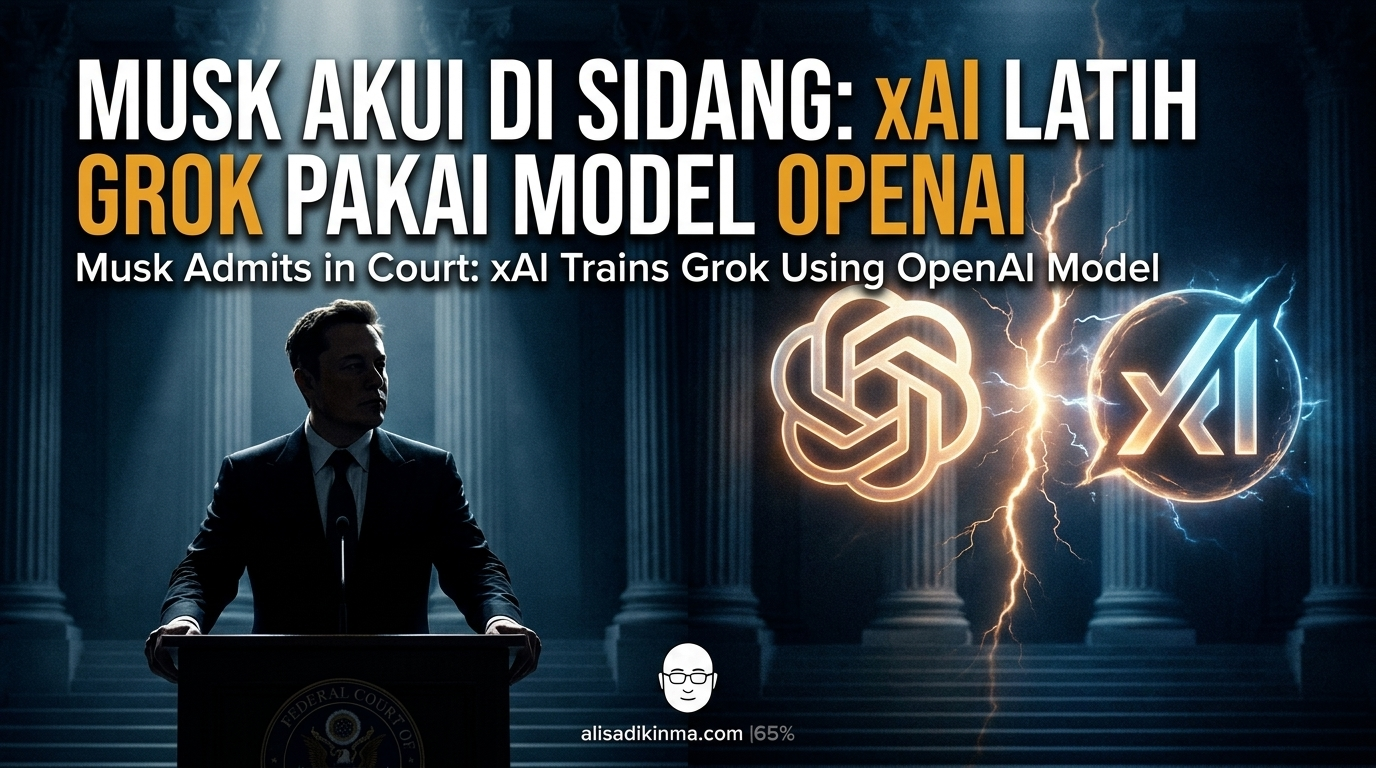
Elon Musk is suing OpenAI. And he just admitted his AI learned from them.
Not a rumor. Not a leak. This was said directly under oath, in California federal court, April 30, 2026.
One word changed everything:
Partly.
Why would one word shake the entire AI industry?
And why is it Musk — OpenAI’s harshest critic — who said it in the courtroom?
The answer touches on something bigger than billionaire drama. It’s about how xAI trained Grok using OpenAI’s model — and what that means for an entire industry racing to build the most advanced AI in the world.
But before we get there, you need to know one thing about Musk that rarely gets talked about.
Why Musk Is Suing a Company He’s Still Apparently Using

Musk founded xAI in 2024 and sued OpenAI in early 2026 — while Grok, his AI chatbot, had already hit 64 million active users per month, up 200% from 35.1 million in mid-2025 according to Business of Apps. Grok now sits third in the US, behind ChatGPT and Google Gemini. But the April 2026 trial revealed something that contradicts Musk’s narrative as OpenAI’s chief critic.
Musk was one of OpenAI’s co-founders in 2015. He left in 2018 — allegedly due to a conflict of interest with Tesla. Since then, he’s become OpenAI’s most vocal critic, accusing them of betraying their original nonprofit mission to build AI “for the benefit of humanity.”
Musk’s 2026 lawsuit targets three things:
First, he’s suing OpenAI for allegedly violating its original nonprofit mission by shifting to a commercial structure. Second, he’s personally suing CEO Sam Altman and co-founder Greg Brockman. Third — and this is the ironic part — he’s doing all of this while leading a company that just admitted to using OpenAI’s output to train its own competing product.
Here’s the irony:
The guy who screamed loudest that “OpenAI is unethical” — might have been using OpenAI’s work to build his own rival all along.
But how? And how did this go unnoticed for so long?
What ‘Partly’ Really Means — and the Evidence xAI Trained Grok Using OpenAI’s Model
In the California trial, a lawyer asked directly: did xAI use distillation techniques on OpenAI’s model to train Grok? Musk answered “Partly” — one word that’s now at the center of one of the biggest AI legal cases of 2026, and one that opens questions about the technical foundation behind Grok’s 200% growth in a single year.
So what is distillation?
Here’s how it works:
You query a large model — say, GPT-4 — through its API. You record a massive volume of outputs: thousands, even millions of responses. Then you use those outputs as training data for your own new model.
The result: your new model learns to “mimic” the response patterns of a model that’s far more expensive and larger — without having to build or own that much compute from scratch.
According to Winston & Strawn’s analysis of the similar DeepSeek case in 2025: distillation allows for cheaper, competitive models without full compute investment. That’s the appeal — and that’s why almost every AI lab, big or small, has an incentive to do it.
The problem:
OpenAI has a clause in their Terms of Service that explicitly prohibits users from using their output to develop competing models. Berkeley Law Network noted this clause as the core of the OpenAI vs. DeepSeek dispute in 2025 — and now, the same clause has resurfaced in the Musk case.
That means xAI isn’t just suspected of playing dirty in the competition. They may also be in breach of a direct contract with OpenAI — an agreement they signed when they first accessed the API.
And this isn’t just about xAI.
The Secret Every AI Player Knows — but Nobody Wants to Talk About
On April 15, 2026, Rep. Bill Huizenga introduced the Deterring American AI Model Theft Act of 2026 — a bill that would sanction anyone using “improper query-and-copy techniques” on American AI models, according to Vision Times. The fact that Congress felt the need to draft a specific law makes one thing clear: distillation has become too widespread to keep ignoring.
DeepSeek from China was accused of doing it to OpenAI’s model. xAI just admitted it. And anyone who’s been around the AI industry long enough knows this isn’t the exception — it’s the norm that nobody acknowledges publicly.
Here’s what this means for you:
4 Real Implications of the xAI Case You Need to Understand Now
1. AI competition isn’t as level as the headlines make it seem
What this means: Every month a new AI model gets claimed as “state of the art” and built from scratch. But many of them — especially the cheaper, faster ones — may not actually be built from scratch.
How it works: Smaller labs query big models through APIs, record the outputs, and use them as training signals. The result looks like innovation. But the foundation is someone else’s hard work — and data — invested first.
Real example: xAI spends around $1 billion per month on infrastructure and training, with plans to expand Colossus toward 2-gigawatt capacity, according to MindStudio and RevolutionInAI. If a lab as big as xAI is using distillation, imagine how dependent smaller labs are.
The result: AI innovation often means “optimizing a foundation someone else built” — with or without permission. And until there’s clear regulation, this will keep happening.
2. OpenAI’s ToS now has real legal consequences
What this means: The anti-distillation clause in OpenAI’s ToS has long been treated as “standard fine print” that’s hard to enforce. The Musk case changes that perception fundamentally.
How it works: If the court rules that xAI violated OpenAI’s ToS, the legal precedent applies to everyone who’s done the same — not just xAI. Every lab that queried OpenAI’s API and used the results as training data now needs to be careful.
What you should do: If you’re building a commercial AI product that uses third-party model APIs, reread their ToS — especially the clauses on competitive use and prohibited training data. Boundaries that were once grey are starting to carry real consequences.
The result: The legal foundation for protecting AI model training data is getting stronger. That’s good for big labs with big investments, but it could make things harder for smaller players who’ve been relying on distillation shortcuts.
3. AI distillation regulation is coming faster than you think
What this means: The Deterring American AI Model Theft Act 2026 is still in the legislative process. But the Musk case has put a “famous face” on a practice that was previously too technical for Congress to discuss.
What to watch: If this bill passes before the xAI case concludes, the judge could factor in the new legislative intent in their ruling. That means the regulation timeline and the legal case timeline are influencing each other — and both are moving faster than usual.
The result: AI labs worldwide — not just in the US — need to start evaluating their training practices now, not after formal regulation kicks in.
4. Grok 5 is being built on a legally contested foundation
What this means: xAI is currently training models at a scale of 1 to 10 trillion parameters simultaneously. Grok 5 is planned in the range of 6 to 10 trillion parameters, according to RevolutionInAI. That’s an extraordinarily ambitious scale.
The big question: How much of Grok’s existing capabilities — and what will exist in Grok 5 — are built on training signals from OpenAI? And if the court orders that data removed, what’s left?
The result: Launching Grok 5 while legal proceedings are unresolved isn’t just a business risk — it could become legal ammunition for competitors and OpenAI’s lawyers alike.
What Changes for Grok, OpenAI, and Everyone Building AI

Remember that one word? “Partly.” It’s now officially on record in US federal court filings — and its impact is moving in three directions at once, reshaping expectations about competition and ownership in the AI industry in 2026.
For xAI and Grok: If the court proves ToS violations or IP theft, xAI could face significant damages — or in an extreme scenario, be ordered to retrain Grok without that data. With $1 billion a month in infrastructure spend, that could dramatically reshape the competitive landscape right when Grok has hit its biggest momentum.
For OpenAI: This is a double-edged sword. Winning in court strengthens their ToS as legal precedent that can be used against anyone. But if distillation is proven effective at building competitive models, OpenAI also has to ask: how exclusive is the value of their training data, really?
For you — anyone who uses AI every day:
Ask yourself: where was the AI you trust every day actually trained on? And if it turns out there are practices being challenged in court, what does that mean for the long-term reliability of that tool?
That’s what the word “partly” opened up for everyone.
Three Things to Watch as This Case Unfolds
This case is far from over. Here are three concrete things to follow, because each could be a different turning point.
Discovery phase in California federal court. The “partly” admission opens the door to a deeper discovery phase — xAI’s internal documents about Grok’s training methodology could be forced into public view. If that happens, this isn’t just a blow for xAI. It could be the first real window into how the world’s top AI models are actually built.
The fate of the Deterring American AI Model Theft Act 2026. Rep. Bill Huizenga introduced this bill in April 2026 to sanction entities using unauthorized query-and-copy techniques. If it passes, this becomes the first precedent that explicitly criminalizes AI distillation. Not just xAI — every lab in the world will need to review their practices.
The launch of Grok 5. With plans for 6 to 10 trillion parameters, Grok 5 is xAI’s biggest bet. If it launches before the case concludes, every performance claim about Grok 5 will immediately be questioned: built from pure innovation, or still sitting on a foundation that’s being debated in court?
The AI industry was never as clean as the press releases made it look. This case is peeling back the layers, one by one.
FAQ: AI Distillation, xAI, and the Musk vs. OpenAI Case
Did xAI break the law by training Grok using OpenAI’s model?
Not proven legally yet. Musk admitted to “partly” using distillation, but the court hasn’t ruled on whether that violates OpenAI’s ToS or intellectual property laws. OpenAI prohibits using their output to train competing models in their ToS. Berkeley Law Network describes this as an issue still actively being debated in US courts in 2026.
What is AI model distillation and why is it controversial?
Distillation is the process of querying a large AI model through its API, recording its outputs, and using those as training data for a new model. According to Winston & Strawn, this allows for cheaper models without full compute investment. The problem: if done without permission, it can potentially violate contracts and intellectual property rights of the source model — exactly the core of the xAI case and the DeepSeek case before it in 2025.
Does this case affect current Grok users?
In the short term, no. Grok keeps running with 64 million active users per month. The extreme scenario — the court ordering OpenAI training data removed and Grok retrained — is still far away and uncertain. But the ruling could shape legal standards for the entire AI industry going forward, so it’s worth watching.
Share this with anyone who still thinks the AI race is clean — they need to read this.
Save this article. The Musk vs. OpenAI case is still evolving — and the next hearing could change everything.