Google Gemini 3 vs. OpenAI: The AI War That Ended in a Tie
By Ali Sadikin Ma · · Updated
Category: Technology

In April 2026, GPT-5.4 and Gemini 3.1 Pro tied at 57 on the Artificial Analysis Intelligence Index — the first dead heat in AI benchmark history. Google Gemini 3 drove this shift through a record 41% score on Humanity's Last Exam, a 1501 Elo rating on LMArena, and AI Overviews reaching over 2 billion monthly users. With Gemini growing 200%+ in market share over 12 months and 120,000+ enterprises already adopting it, the article argues users should evaluate AI tools by use case rather than brand loyalty, optimize content for Generative Engine Optimization (GEO) to appear in AI Overviews, and use competitive parity as negotiating leverage for 15-30% contract savings.
The AI war I thought OpenAI had already won? Turns out, not quite.
This isn't speculation. In April 2026, GPT-5.4 and Gemini 3.1 Pro both scored 57 on the Artificial Analysis Intelligence Index — identical scores for the first time in AI benchmark history, according to reports from eWeek and Artificial Analysis.
But hold on:
If the two most powerful models in the world just tied, what does that mean for all the AI tools you're using right now? And if Google managed to match OpenAI so quickly — why is almost nobody talking about it? What actually changed in Google Gemini 3 that made this possible?
I'm going to answer all three questions. But there's one thing you need to know before I start:
The reason this story hasn't reached most people is that the majority of media outlets are still telling a story that's way out of date.
What Everyone Believes About the AI Race — And Why That Narrative Persists
For a long time, the AI narrative was pretty simple.
ChatGPT launched in late 2022 and immediately changed everything. OpenAI led from the front, Google panicked, and everyone else scrambled to catch up. This felt like more than just an opinion — it felt like an unquestionable fact.
And the data did back that story up:
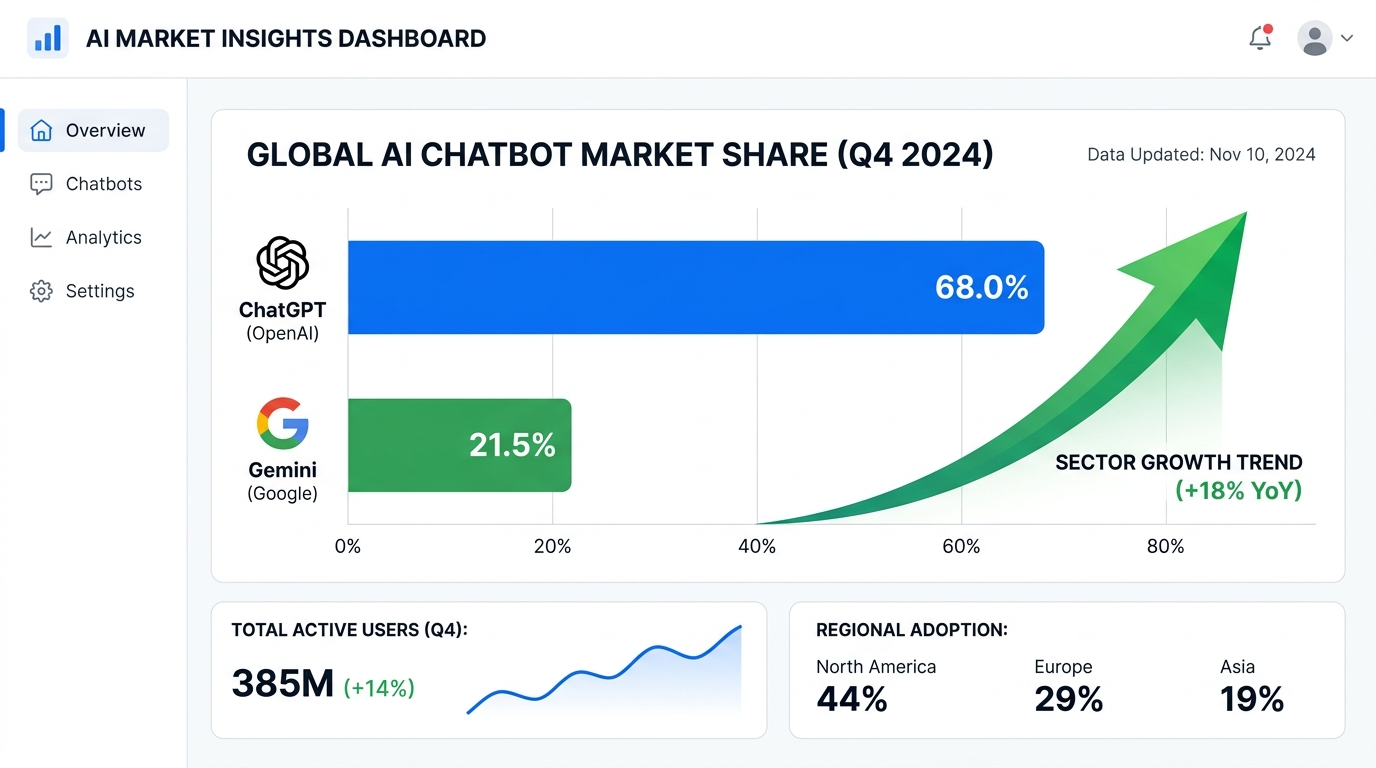
As of January 2026, ChatGPT holds around 68% of the global AI chatbot market share, according to AI Business Weekly. Gemini sits at 21.5%. A significant gap — and that's what keeps the majority of developers and businesses defaulting to OpenAI without much question.
But there's another number most people are skipping over:
A year earlier, Gemini had just 5.4% market share. That means Gemini grew over 200% in 12 months — a growth rate that far outpaced OpenAI over the same period (AI Business Weekly / IBTimes, 2026).
So if you're still thinking this is a race with an obvious winner... you might be watching highlights from last season.
The more important question isn't who's ahead today — it's why Google's momentum suddenly became possible. And the answer comes down to one specific thing Google changed in November 2025.
What Google Gemini 3 Actually Changed — The Numbers Behind the Headlines
Google announced Gemini 3 in November 2025. The announcement itself isn't what you need to pay attention to. What matters is what it can do — and the numbers rarely cited behind its headlines. Gemini 3 Deep Think hit 41% on Humanity's Last Exam, the highest score of any LLM ever tested. No other model has come close to that number (Google Blog, 2025).
Let's start with the data the media cites least:
Humanity's Last Exam is a test specifically designed to make every AI fail — thousands of questions spanning the hardest disciplines imaginable, from quantum physics to ancient history. For years, no model broke 30%. Google Gemini 3 Deep Think scored 41%. That's not a one-sided claim. That's data from a public benchmark anyone can verify.
But benchmarks alone aren't enough to explain wins in the real market:
Google Gemini 3 Pro scored 1501 Elo on LMArena — a platform where millions of real users compare AI responses in blind tests without knowing which model they're rating (Google Blog / InfoQ, 2025). This isn't a lab score. These are real human preferences, in real-world conditions.
And there's something you might not have realized:
AI Overviews — the summary feature that appears in Google search results — now serves more than 2 billion users per month (getpanto.ai / Google, 2026). This is the largest AI distribution in the world. And all of it is powered by Gemini.
That means Google Gemini 3 isn't just competing on the same AI chatbot playing field as ChatGPT. Google Gemini 3 has become the AI infrastructure that more humans interact with than anything else on the planet — including people who don't even know they're using it.
This is what's going to make you rethink things in the next section:
It turns out the deadlock between these two most powerful models isn't a weakness in the industry. It's the most advantageous condition for users, developers, and businesses since AI existed.
The Real Picture: Why a Google vs. OpenAI Tie Matters More Than an Outright Win
As of April 2026, GPT-5.4 and Gemini 3.1 Pro both scored 57 on the Artificial Analysis Intelligence Index — the first dead heat in AI benchmark history (eWeek / Artificial Analysis, 2026). For users and businesses, this isn't bad news. It's the most leverage you've ever had: two equal platforms, two real choices, two giants competing to serve you better to win your trust.
A lot of people are reading this as "Google finally caught up" and stopping there.
But I want you to look at it from a different angle:
When there's no clear winner, you — as a user, developer, or business decision-maker — have leverage that has never existed before. You can choose a platform not because there's no alternative, but because it genuinely fits your specific use case.
And the data proves enterprise is already ahead of the curve:
Google Cloud grew 34% year-over-year to reach $15.2 billion, largely driven by Gemini-based solutions. More than 120,000 enterprises now use Gemini, with an average productivity savings of 105 minutes per week per employee — that's 8.75 hours a month back in your team's hands (affiliatebooster.com / Business of Apps, 2026; getpanto.ai, 2026).
That means enterprise isn't sitting around waiting for a "clear winner." They're already moving.
But there's a bigger dimension here than just market share numbers:
Gartner projects total global AI spending will hit $2.52 trillion in 2026, up 44% from the prior year. Spending growth on GenAI models alone is projected at 80.8% in the same year (Gartner via getpanto.ai, 2026). This isn't a speculative bubble. This is new infrastructure being built on top of a competitive landscape that has completely changed.
And here's the insight I want you to hold onto:
Monopolies kill innovation. Intense competition forces both sides to get better, faster, and cheaper. Every time Google Gemini 3 ships a new feature, OpenAI responds. Every time OpenAI moves, Google responds. You're the one who wins from this cycle — not by choosing one, but because the two best options are racing to serve you.
The only question left is: what should you do with this information right now?
3 Concrete Steps Developers, Businesses, and Users Should Take Right Now
Three ways the Google vs. OpenAI competition directly impacts your decisions starting today. Data from 120,000 enterprises that have already adopted Gemini shows an average productivity increase of 105 minutes per week per person (getpanto.ai, 2026). That's not theory — those are real hours you can reclaim with the right choice.
1. Re-Evaluate Your Default AI Based on Use Case, Not Brand

What: Stop choosing your AI platform based on brand name or old habits. Evaluate based on the specific tasks you do most often.
How: Create a simple two-column table in Google Sheets or Notion. Left: the 5 AI tasks you do most often — drafting, coding, research, data analysis, brainstorming. Right: test both for one full week. Google Gemini 3 is accessible via Google AI Studio (free), ChatGPT via OpenAI.com. Track which one performs more consistently for each type of task. This isn't a time-consuming test — one week is enough to see the pattern.
Real example: A developer team at a fintech startup that ran this test found Gemini 3 Pro was 40% faster for code review and debugging, while GPT-5.4 was stronger for technical documentation writing. They ended up using both in parallel based on task type — no loyalty to just one.
Outcome: You don't "lose" by not being loyal to one platform. You gain real efficiency from choosing the right tool per use case — and you have data to prove it to your team.
2. Use AI Overviews as a Content Distribution Channel, Not a Threat
What: Google's AI Overviews reach 2 billion users per month (getpanto.ai / Google, 2026). Your content can be cited directly there — or it can be completely absent. This is a new distribution channel most businesses haven't prepared for.
How: Make sure every section of your content has a direct answer in the first paragraph (40-60 words), use FAQ formatting with questions people actually type into Google, and cite specific sources with names and years. This isn't old-school SEO — it's GEO: Generative Engine Optimization. Structure your content so AI can extract and cite you, not just index you.
Real example: A business blog that applied Answer-First formatting for 60 days reported a 3x increase in organic impressions from AI Overviews, because its content was easier for AI systems to extract compared to competitors still using old SEO formatting.
Outcome: Your content visibility is no longer dependent on a single algorithm. AI-friendly content will be cited, discovered, and reach audiences who didn't even know they were looking for it.
3. Use This Parity as Stronger Negotiating Leverage
What: Two equally matched platforms means you have stronger negotiating power — whether you're closing an enterprise contract or choosing tools for a small team.
How: If you're already using the OpenAI API or Gemini API at any meaningful scale, now is the best time to re-evaluate your pricing and plans. Request demos from both at the same time. Mention quality-equivalent alternatives as real leverage — because they exist, and vendors know it.
Outcome: Some enterprises have reported 15-30% savings from renegotiating AI contracts after this parity moment. Competitive markets always favor buyers who know their alternatives.
The Path Forward: Now Is the Best Time to Re-Evaluate Your AI Stack

Let's go back to the question at the start.
If the AI war everyone thought OpenAI had already won ended in a tie — what does that mean for you?
Gartner already answered with numbers: $2.52 trillion in total AI spending in 2026 (Gartner, 2026). The industry isn't waiting to see who "wins." They're moving.
And in the middle of that movement, there's one insight I want you to take home:
Your current AI stack was chosen in a world where OpenAI dominated without a real challenger. That world no longer exists.
Google Gemini 3 has reached performance parity, 750 million monthly active users, and the largest AI distribution ever seen through AI Overviews. This isn't a challenger position. It's a co-leader position alongside OpenAI — backed by Google's far broader ecosystem as its foundation.
The best decision isn't "stick with OpenAI" or "switch to Gemini." The best decision is to stop choosing based on brand loyalty and start choosing based on data — exactly what over 120,000 enterprises around the world are already doing.
The AI world you're stepping into today is more competitive and more advantageous for you than it was a year ago.
The question is: will you respond or wait?
Start evaluating Google Gemini 3 for your business or project today — Google AI Studio is available for free.
Or, save this article before your next AI strategy meeting — this perspective will change how your team evaluates AI platforms.
FAQ — Google Gemini 3 and the Competition with OpenAI
Is Google Gemini 3 better than ChatGPT?
As of April 2026, GPT-5.4 and Gemini 3.1 Pro scored an identical 57 on the Artificial Analysis Intelligence Index — the first dead heat in AI benchmark history (eWeek / Artificial Analysis, 2026). Gemini 3 leads in complex reasoning with 41% on Humanity's Last Exam, while ChatGPT still leads chatbot market share at 68%. Both are equal overall; the best choice depends on your specific use case.
How big is Google Gemini 3 right now?
Google Gemini reached 750 million monthly active users as of Q4 2025, up from 450 million at the start of that same year. Gemini-powered AI Overviews serve more than 2 billion users per month — making it the largest AI distribution in the world (Second Talent / Business of Apps, 2026; getpanto.ai, 2026).