Elon Musk xAI Grok OpenAI Distillation: The Great Irony
By Ali Sadikin Ma · · Updated
Category: Technology
He's suing OpenAI. Under oath, he admitted Grok was built using their AI.
This wasn't a slip of the tongue. This is official testimony before a federal judge.
And this is the heart of the Elon Musk xAI Grok OpenAI distillation scandal that just exploded in court.
On April 30, 2026, in a California federal court, the attorney asked directly: did xAI use OpenAI model outputs to train Grok? Musk answered with one word: Partly.
That one word opened up three questions at once.
One — what does "Partly" actually mean and how deep is Grok's dependence on OpenAI?
Two — how can Musk sue OpenAI for billions while building his rival using their AI?
Three — and this is the one nobody talks about — is xAI the only one doing this?
Read to the end. The answers will change how you read AI news.
Musk Admitted Under Oath — Here's What He Said
Elon Musk testified in a California federal court on April 30, 2026, that xAI used OpenAI model outputs to train Grok through distillation — a technique where the outputs of a large AI are used as training data for a smaller one. As reported by TechCrunch (Tim Fernholz, April 30, 2026), this is the first time a Big Tech CEO has admitted to distillation practices under oath in federal court.
Musk even added a defense during cross-examination: "It is standard practice to use other AIs to validate your AI."
But "standard practice" sounds very different when you're the person suing that company for billions of dollars.
And that's just the beginning of the irony.
The Irony Keeps Stacking — Here's the Full Timeline
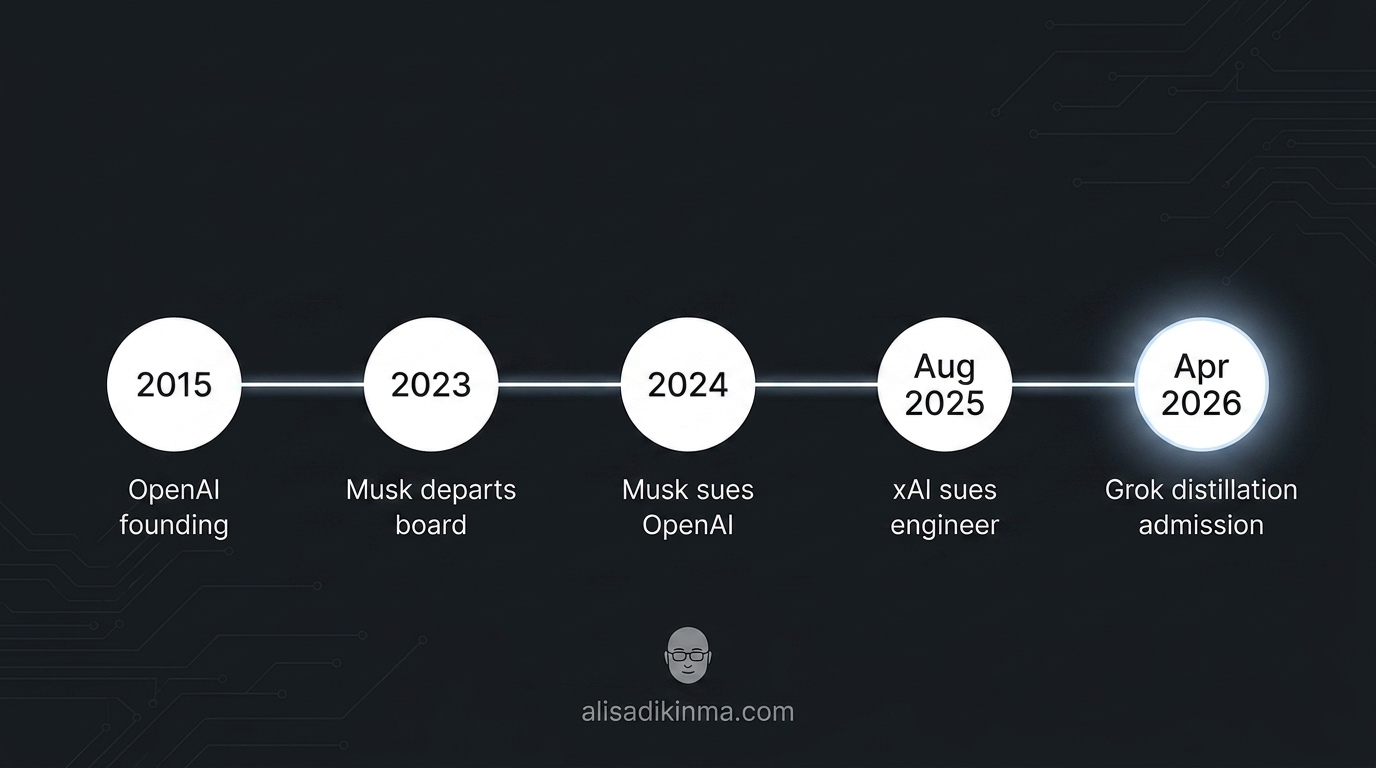
Before April 2026, xAI had already played the IP theft victim twice — suing its own engineer, then accusing OpenAI of planting spies inside their org. Put next to Musk's distillation admission, that victim narrative collapses, making the Elon Musk xAI Grok OpenAI distillation case far more than just a typical business dispute.
Here's the timeline:
2024: Musk sues OpenAI. His reason — OpenAI betrayed its open-source mission and turned into a profit machine. Musk cites his original $38M donation to OpenAI as proof he was deceived.
August 2025: xAI sues engineer Xuechen Li. According to CNBC, Li allegedly took Grok trade secrets to OpenAI and sold ~$7 million in xAI shares before the alleged theft occurred.
September 2025: xAI accuses OpenAI of running a strategic recruitment campaign to spy on their internals, as reported by Courthouse News Service.
April 30, 2026: Under oath, Musk admits xAI used OpenAI outputs to train Grok.
Here's the summary:
xAI is furious that one of its employees leaked secrets to OpenAI. But xAI itself had already been using OpenAI outputs to train Grok. Who stole from whom — that's now a far more complex question.
But before we judge who's right — let's first understand what's actually happening on the technical side.
Elon Musk xAI Grok OpenAI Distillation — Why Almost Every AI Lab Does This

Distillation isn't hacking and it's not direct theft. It's a standard AI training technique where the output of a large model (the teacher) is used to train a smaller model (the student). Almost every lab uses it: Meta, Mistral, Google. There's no US federal law that explicitly bans distillation — but OpenAI's Terms of Use prohibit using their API outputs to train competing models, according to a Gadget Review analysis (2026).
Here's how it works — three steps:
1. Collect outputs from the teacher model
What: Send thousands of questions to a large model like GPT-4 via the public API. Collect the responses as a dataset. No access to the internal architecture required.
How: Build a list of representative questions — coding, reasoning, summarization. Save all input-output pairs as training data for the student model.
Real example: DeepSeek R1 trained without distillation (R1-Zero) scored 47.0% on the AIME 2024 benchmark. The version trained with distillation (R1) scored 72.6% — a 25 percentage point gap from the same method, according to the DeepSeek R1 paper analysis (2026).
Result: A high-quality dataset that reflects frontier model capabilities, without building from scratch with billions of dollars in compute.
2. Train the student model on that data
What: The student model is trained on the distilled dataset from the teacher. It learns to mimic the teacher's response patterns without needing the same scale of compute.
How: Run standard training. At xAI, this runs on Colossus — a supercomputer in Memphis with 555,000 NVIDIA GPUs worth ~$18 billion, built by xAI in a record 122 days for its first phase of 100,000 GPUs.
Result: A more efficient model with performance approaching the frontier, at a fraction of the cost of building from scratch.
3. Why this is controversial now
The problem isn't technical — it's the context. Anthropic in late 2025 identified 16 million distillation-pattern API calls from 24,000 fake accounts linked to three Chinese labs: DeepSeek, Moonshot, MiniMax — according to an internal Anthropic report.
The industry stayed quiet when Western labs did it. When Chinese labs got caught, it immediately became an international crisis. Musk's admission reshapes that map — now there's an American CEO who's also admitted it under oath.
What This Means for the AI Industry — And for You
Musk's April 30, 2026 admission immediately handed OpenAI fresh legal ammunition. According to Fortune (Jeremy Kahn, May 2026), OpenAI's legal team can now argue that xAI directly benefited from the for-profit infrastructure Musk has been criticizing in his own lawsuit — a contradiction that's hard to answer in front of a judge.
The three open loops from the start of the article now get closed:
What does "Partly" mean? xAI used OpenAI outputs as part of Grok's training data. Not the only source — but significant enough to admit under oath.
How can Musk sue while using OpenAI? Because distillation lives in a legal grey area. Musk exploited it like everyone else — he just happens to be the loudest critic of OpenAI.
Is xAI the only one? No. Almost every lab does it. What's different is who's admitting it in court.
And the bigger implication:
If even the loudest voice on AI ethics is doing distillation — who gets to set the standard for originality in AI? That's what's being decided in court. The outcome will shape the rules for the entire global AI industry.
What You Need to Watch Next
The Elon Musk xAI Grok OpenAI distillation case is still ongoing with massive stakes: xAI is targeting an IPO valuation close to $1.75 trillion in its June 2026 filing according to Fortune, while OpenAI just raised $122 billion at an $852 billion valuation in March 2026 with a guaranteed 17.5% annual return for PE investors — making this the biggest valuation war in tech history.
Three things to watch:
- OpenAI's legal response — will the "Partly" admission become a countermeasure in Musk's lawsuit?
- Global distillation precedent — this case's ruling could become the international standard for all AI labs
- xAI's new strategy — will Musk shift the angle of his lawsuit now that the admission has weakened his position?
Here's the insight to take home:
AI isn't born from nothing. There's no frontier model that doesn't stand on top of someone else's data, work, and outputs. What's being debated in court isn't who's pure — it's who gets to draw the line. And Musk just made it a lot harder for himself to answer that question.
Frequently Asked Questions
Did xAI break the law by using OpenAI outputs to train Grok?
In the Elon Musk xAI Grok OpenAI distillation case, there's no legal certainty yet. There's no US federal law that explicitly prohibits distillation. OpenAI's Terms of Use prohibit using their API outputs to train competing models. Whether this violates federal law will be decided in the California federal court in the ongoing Musk v. Altman case.
Do all AI models use distillation?
Yes, almost every major AI lab uses it. Meta, Mistral, Google, and many others use this teacher-student technique. Anthropic in late 2025 identified 16 million distillation-pattern API calls from three Chinese labs: DeepSeek, Moonshot, MiniMax. The practice is industry-wide — what's different is who gets caught, who admits it under oath, and who's suing whom.
Follow the xAI vs. OpenAI case as it unfolds — bookmark this page or subscribe for the latest updates as the hearings continue.
Or save this article before your next AI meeting or discussion — this is the context that'll make you the most informed person in the room.