DeepClaude: How to Run Claude Code with DeepSeek, 17x Cheaper
By Ali Sadikin Ma · · Updated
Category: Technology
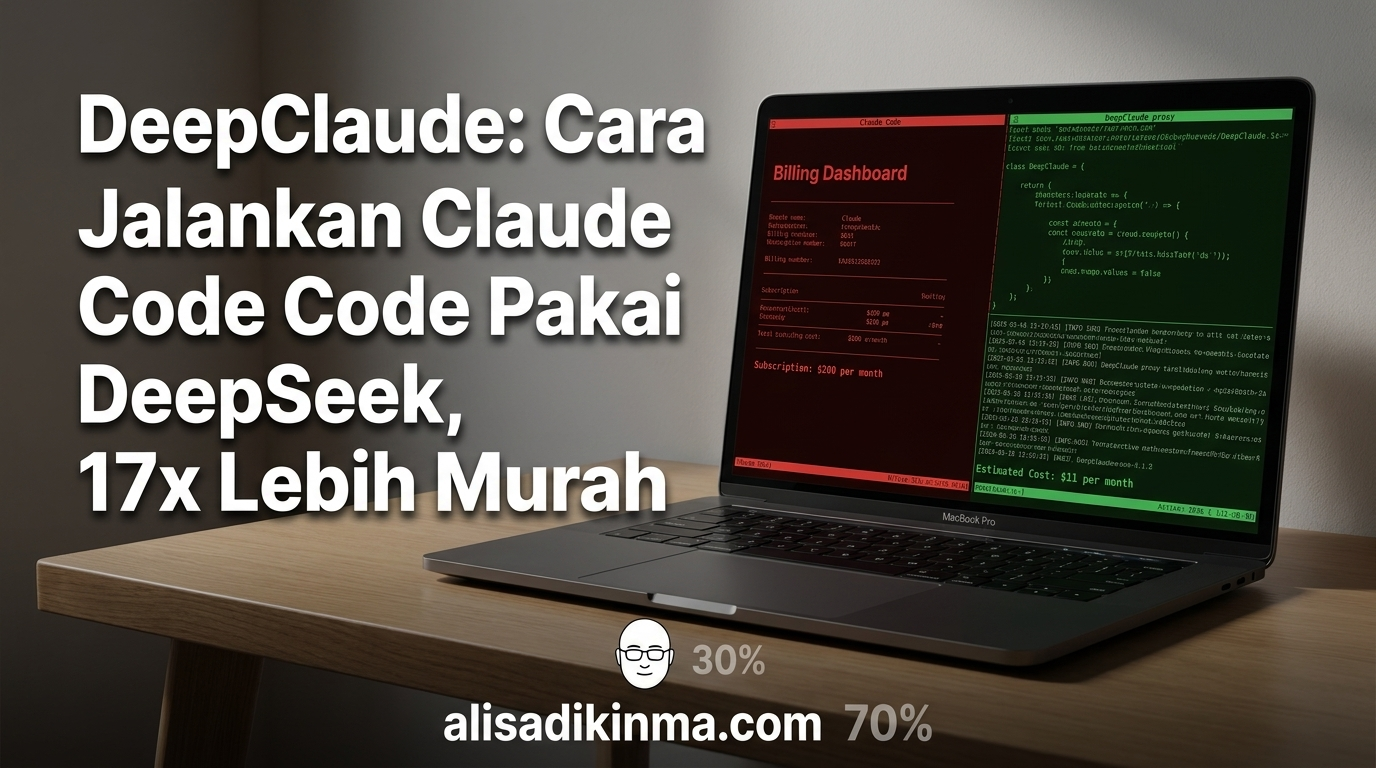
Claude Code bills you $200 a month. DeepClaude doesn't.
That's not a typo. And it's not a marketing gimmick from some random project.
There's a developer who already proved it firsthand — their annual Claude Code bill dropped from $1,200 to $60. Not through a discount, not a free trial. But through one open-source script that changes how Claude Code connects to its AI backend, without changing a single thing about the interface you already know.
But before you open your terminal:
Is this setup legal — or are you messing with the Terms of Service?
Is DeepSeek V4 Pro good enough for serious coding work, or will you regret it mid-project?
And if there's a major trade-off that's not immediately obvious — what is it?
All three of those questions get answered here. But first, you need to see why $200 a month isn't just a number — it's a problem that's quietly killing AI adoption among the developers who need it most.
Why $200/Month Is Quietly Killing AI Adoption Among Developers
Claude Code Max 20x is priced at $200 a month — or $2,400 a year — based on official Anthropic data confirmed by Finout in 2026. For professional developers at large companies with clear tool budgets, that number might make sense. But for solo developers, freelancers, and students paying out of pocket, $2,400 a year for a single AI tool is hard to justify when another model that's 17x cheaper is starting to show similar performance.
Here are the numbers that'll frustrate you:
Claude Code Pro: $20/month — the limits make intensive work feel constrained.
Claude Code Max 5x: $100/month.
Claude Code Max 20x: $200/month, or $2,400 a year for a single tool.
On the other side:
Claude Sonnet is priced at $15 per million output tokens (LLM API Pricing 2026, TLDL). DeepSeek V4 Pro via OpenRouter? $0.87 per million output tokens. That's a 17.2x difference — and you've been paying the higher rate because Claude Code can only connect to the Anthropic backend by default.
Here's the real problem:
It's not that Claude Code is expensive in absolute terms. It's that you had no other choice — until now. You were locked into one provider, one price, no alternatives. That alternative just showed up.
What Is DeepClaude? The Wrapper That Changes How It Works
DeepClaude is an open-source proxy layer that redirects the Claude Code CLI to alternative AI models — in this case DeepSeek V4 Pro via OpenRouter. The project appeared a few weeks after Anthropic accidentally leaked the Claude Code source code to npm on March 31, 2026 — 512,000 lines of TypeScript that the global developer community immediately dissected, according to Decrypt's report. A developer named aattaran built DeepClaude from those findings, and the repo racked up nearly 1,000 GitHub stars in a very short time.
This isn't a jailbreak. It's not a Claude fork. It's not a cheat code to access Anthropic models without paying.
Here's how it works:
You still use the same Claude Code CLI. Same shortcuts. Same commands. But DeepClaude sits as middleware between Claude Code and the Anthropic API — intercepting every request, redirecting it to DeepSeek V4 Pro via OpenRouter, then returning the result back to Claude Code. From Claude Code CLI's perspective, everything runs normally. The only difference is who's actually handling your request — and how much you're paying for it.
But the biggest question from earlier still hasn't been answered:
If DeepSeek V4 Pro is 17x cheaper, is the coding quality worth it? Or is this a "you get what you pay for" situation?
I'll answer that in the performance section. But setup first — because you need to know what you're installing before deciding whether it's worth trying.
How to Set Up DeepClaude in 30 Minutes (Step-by-Step)
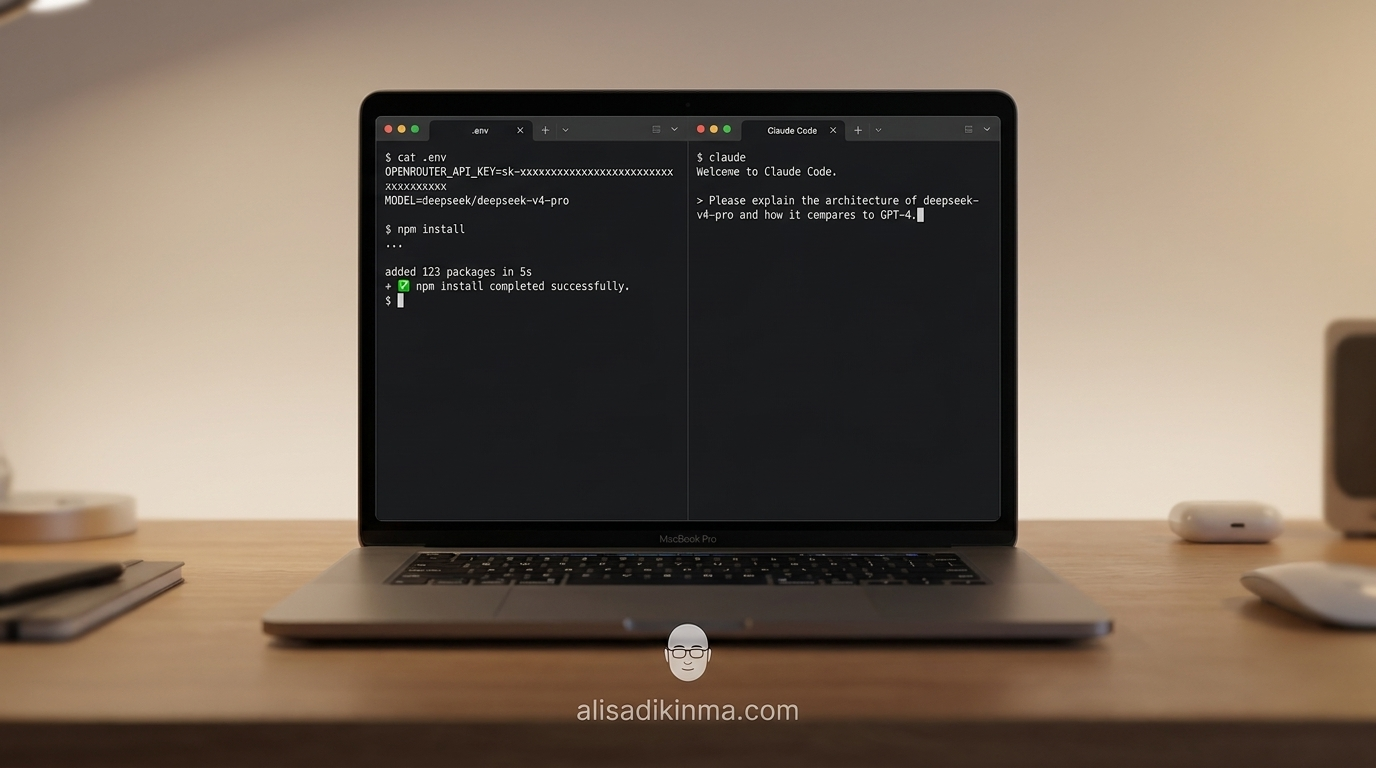
DeepClaude can be set up by anyone who's familiar with a terminal and basic Node.js. No DevOps skills needed, no advanced knowledge of API routing or proxy configuration. From zero to Claude Code running on DeepSeek, realistic time estimate: 20–30 minutes including time to read the docs.
Step 1: Create an OpenRouter Account and Generate an API Key
What you're doing: Head to openrouter.ai, sign up for a free account, and create a new API key in the dashboard.
How to do it: After registering and logging into OpenRouter, go to the "Keys" menu in the left sidebar. Click "Create Key", give it an easy-to-identify name — like "deepclaude-main" — then click Create. Copy the key that appears on screen immediately. Important: this key is only shown once. If you close the page before copying it, you'll need to generate a new one from scratch. Save it in a password manager or somewhere secure.
Why OpenRouter? OpenRouter offers DeepSeek V4 Pro at a promotional rate of $0.435 per million input tokens and $0.87 per million output tokens — prices valid until May 31, 2026, after which rates double according to Decrypt and Pulse24 AI in 2026. This is the best window to set up DeepClaude at the lowest possible cost. You can add credit via credit card or PayPal, and a minimum $5 deposit is enough for several weeks of normal use.
What you get: An active API key and available credit. Get this ready before moving on — you'll need this key in Step 3.
Step 2: Clone the DeepClaude Repo and Install Dependencies
What you're doing: Pull the DeepClaude source code from GitHub to your local machine and install all its Node.js dependencies.
How to do it: Open your terminal, navigate to your development folder, and run these three commands in order:
git clone https://github.com/aattaran/deepclaude.git
cd deepclaude
npm install
The npm install process usually finishes in 30–60 seconds depending on your internet speed. If it completes without red errors, you're 40% of the way there. Yellow warnings? Normal — ignore them.
Real example: Developer John Rodrigues, who documented the entire process on his Substack in 2026, finished the clone and install steps in under 10 minutes on his MacBook M2. After fully switching to DeepClaude, his annual Claude Code bill dropped from $1,200 to $60 — a 95% saving with no meaningful change to his daily workflow.
What you get: A deepclaude folder with all dependencies installed and ready to configure.
Step 3: Configure Environment Variables
What you're doing: Create a .env file in the deepclaude root folder and fill it with your OpenRouter API key and the model configuration you want.
How to do it: Inside the deepclaude folder, create a new file named .env — note the dot at the start of the filename, it's a hidden file on Unix/Mac. Fill the file with the following lines:
OPENROUTER_API_KEY=sk-or-xxxxxxxxxxxxx
MODEL=deepseek/deepseek-v4-pro
PORT=3000
Replace sk-or-xxxxxxxxxxxxx with the OpenRouter API key you created in Step 1. The model ID deepseek/deepseek-v4-pro is the official model name on OpenRouter — make sure it's exactly like this, including lowercase letters and the forward slash, not an abbreviation or any other name.
The most common pitfall: Don't add spaces around the equals sign (=). The wrong format (OPENROUTER_API_KEY = sk-or-xxx) will make the server unable to read your key — without an informative error message, the server just silently fails to authenticate with OpenRouter and all requests will time out.
What you get: Full configuration saved. One more step before DeepClaude goes live.
Step 4: Start the Proxy and Redirect Claude Code
What you're doing: Start the DeepClaude server, then override the Claude Code endpoint so all its requests go through the local proxy you just set up.
How to do it: Open two terminal windows at the same time — one for the proxy, one for Claude Code.
In the first terminal, start the proxy server:
node server.jsThe server will run at http://localhost:3000. You'll see log output confirming the server is active. Keep this terminal open as long as you want to use DeepClaude — closing it stops the proxy and Claude Code will fall back to Anthropic (or error out if ANTHROPIC_BASE_URL is still set).
In the second terminal, set the environment variable and launch Claude Code:
export ANTHROPIC_BASE_URL=http://localhost:3000
claude
Claude Code will open exactly like normal. Identical interface. But now, all requests are routed to DeepSeek V4 Pro via OpenRouter — not Anthropic — and you only pay for the tokens you actually use.
How to verify it worked: Type a simple command in Claude Code, like "explain what this function does" on a code file. If you get a coherent, relevant response, your setup worked. You can also check the proxy terminal to see incoming request logs in real-time.
What you get: Claude Code running fully on the DeepSeek V4 Pro backend. Anthropic bill: zero. OpenRouter bill: pay-as-you-go for the tokens you consume.
Performance Check: Is DeepSeek V4 Pro on Claude's Level for Coding?
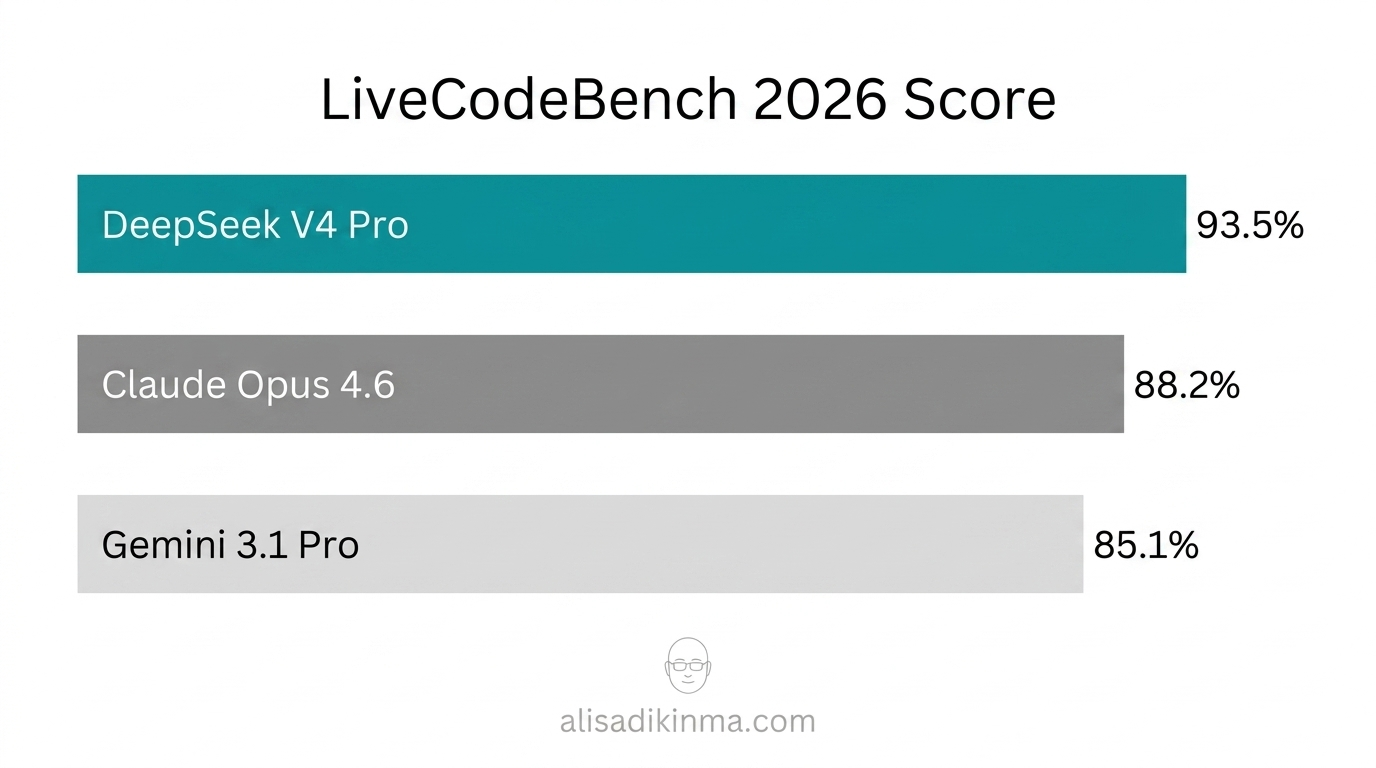
DeepSeek V4 Pro scored 93.5% on LiveCodeBench in 2026, beating Gemini 3.1 Pro and Claude Opus 4.6 on competitive coding benchmarks — Decrypt's report confirms these numbers. That means this 17x cheaper model isn't just an "okay alternative" — by official benchmarks, it actually outperforms Claude Opus 4.6, which is usually the standard developers compare against. But there's another side to consider before going all-in.
Here's the honest answer:
DeepSeek V4 Pro has real limitations. It can't process image input — if your workflow involves analyzing screenshots, architecture diagrams, or visual mockups regularly, that's a deal-breaker worth taking seriously. It doesn't support parallel tool calls — tasks that need simultaneous execution run one by one and feel slower. No MCP server integration. And for very complex, multi-step reasoning tasks, some developers report performance below Claude Sonnet.
But here's the big picture:
If you mostly write code, debug, refactor, and explore codebases without needing image input — DeepSeek V4 Pro can handle almost all of that. With benchmark scores that beat Claude Opus 4.6 in competitive programming, you're not actually downgrading. You're swapping premium branding for equal or better performance on specific coding tasks — at 17x lower cost.
Real Math: What Are You Actually Paying Per Month?
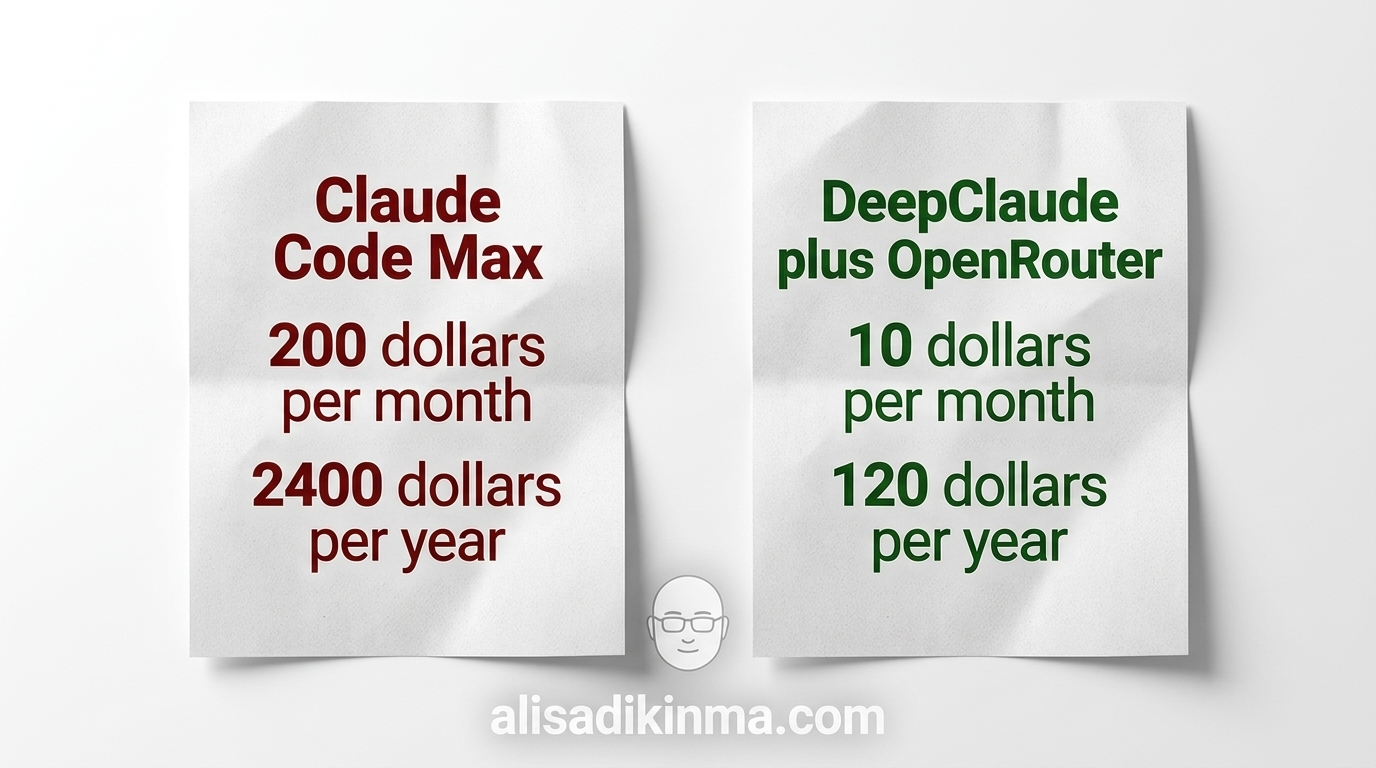
Claude Code Max 20x is priced at $200/month or $2,400/year — official Anthropic data confirmed by Finout in 2026. DeepClaude with DeepSeek V4 Pro via OpenRouter brings that down to around $8–12/month for heavy use, or under $5/month for moderate use. One developer on Substack already proved the real numbers: from $1,200/year down to $60, a 95% saving (John Rodrigues, Substack, 2026).
Let's run the numbers:
Claude Code Max 20x: $200/month = $2,400/year
DeepClaude + DeepSeek V4 Pro (heavy use): ~$10/month = ~$120/year
DeepClaude + DeepSeek V4 Pro (moderate use): <$5/month = <$60/year
One thing you need to note right now:
The OpenRouter promotional price — $0.87 per million output tokens — is valid until May 31, 2026. After that, rates double. Even after that increase, it's still 8–9x cheaper than Claude Sonnet. But the best window to get the lowest rates is before the end of May 2026 — and the setup only takes 30 minutes.
Who Should Use DeepClaude (and Who Shouldn't)
DeepClaude isn't a universal solution. But for developers who've been holding their breath every time the monthly bill comes in, this is worth taking seriously.
DeepClaude is right for you if:
- You're a solo developer, freelancer, or student paying for Claude Code out of pocket
- Your workflow is mostly coding, debugging, and refactoring without needing image input
- You don't rely on parallel tool calls or MCP server integrations in your daily setup
- You want full control over your AI spending — paying only for the tokens you actually use
DeepClaude isn't right for you if:
- You regularly analyze screenshots, diagrams, or images as part of your coding workflow
- Your setup needs parallel tool calls or active MCP server integrations
- You work on an enterprise team with strict compliance requirements and audit trails
- Very complex, multi-step hard reasoning tasks are the core of your daily work
These limitations are real and there's no point hiding them. But for developers who fit the first criteria — this could be the best financial decision you make this year for your development setup.
FAQ: Common Questions About DeepClaude
Is DeepClaude legal? Does it violate Anthropic's Terms of Service?
DeepClaude doesn't illegally access Anthropic's systems. It's a local proxy that uses the Claude Code CLI — Anthropic's official open-source tool — while redirecting requests to a different model provider. You're not violating Anthropic's ToS as long as you don't misuse the Claude Code license or claim DeepSeek output as Claude output. Still recommended to read the latest ToS before deploying to production environments, since policies can change at any time.
What happens after May 31, 2026 when OpenRouter's promotional pricing ends?
DeepSeek V4 Pro rates on OpenRouter double after May 31, 2026 — output tokens go from $0.87 to around $1.74 per million, based on confirmation from Decrypt and Pulse24 AI. Even at those new prices, it's still around 8–9x cheaper than Claude Sonnet. The savings remain very significant — just not as big as during the promotional period before end of May.
Can you switch back to Claude for heavy reasoning tasks?
Yes, anytime, and as easily as deleting one variable. DeepClaude is a proxy — not a permanent replacement for your setup. Just unset the ANTHROPIC_BASE_URL variable and Claude Code immediately goes back to the Anthropic API like normal. A lot of developers use a hybrid setup: DeepClaude for high-volume daily coding grind, Claude Sonnet for critical reasoning tasks that need maximum accuracy.
Closing: Your Next Bill Could Look Very Different
You started reading this because there's a $200 number that makes you uncomfortable every month.
Now you know there's another way. And there's one thing that's more surprising than I expected when I first researched this:
The model that beats Claude Opus 4.6 on competitive coding benchmarks in 2026 is also the one that's 17x cheaper. You've been paying a premium for the brand — not for the best performance on the coding tasks you actually do every day.
The question now: your Claude Code bill next month — how much of it is actually worth it?
Star the DeepClaude repo on GitHub and create an OpenRouter account now — the $0.87/M output token promotional price ends May 31, 2026.
Or, save this article and open it again before your Claude Code renewal — once you run the numbers again, the decision might be a lot easier than you think.