Boss Obsessed with ChatGPT? 5 Smart Ways to Handle It
By Ali Sadikin Ma · · Updated
Category: Technology
The Question Nobody Wants to Ask
Your boss got replaced by ChatGPT. Now they expect you to do the same.
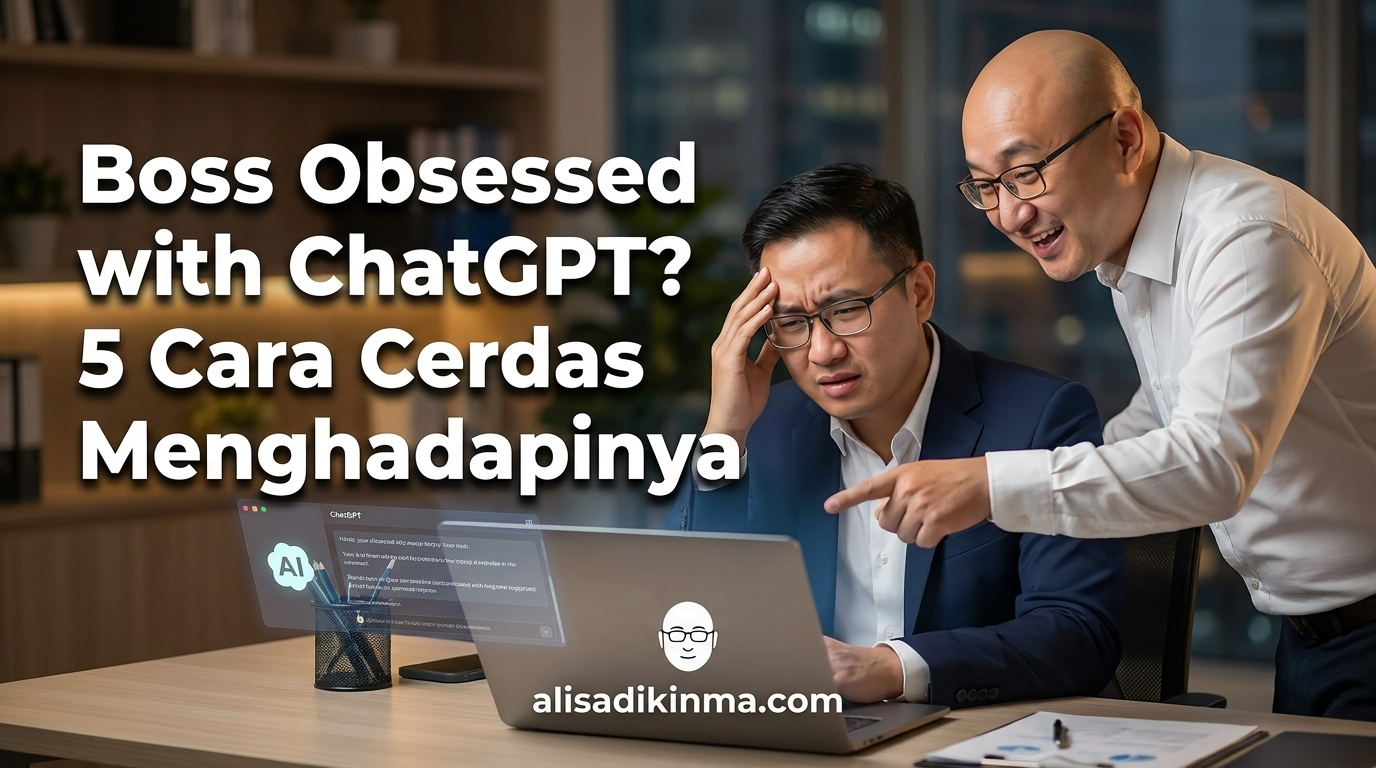
Two months ago, you could knock on your boss's door and ask for their take on a tricky client. Now? They forward a ChatGPT link and say, "Try asking here first." You're not the only one with a boss obsessed with ChatGPT at work.
Data from HR Dive shows ChatGPT usage in the workplace more than doubled in a year. And here's the surprising part: 97% of employees have gone to ChatGPT for advice instead of asking their boss directly — and 63% do it regularly. That means you and your boss are both asking the same machine.
But here's what you might not realize:
The boss obsessed with ChatGPT at your office isn't your enemy. But how you respond to this situation can make or break your career.
There's a hidden cost to just going along with it that nobody ever talks about openly.
And there's a line — if crossed — that's no longer about work style, but about your rights as an employee.
This guide gives you 5 concrete ways to navigate this situation. But before we get there, you need to see just how big the cost is that you've been absorbing without realizing it.
The Hidden Cost Nobody Talks About
Here's what's missing from the AI hype at work:
AI doesn't reduce your workload. It's actually the opposite.
Harvard Business Review found that AI actually increases employee workload, not reduces it. Workdays get longer. Not because the tools are bad — but because someone still has to check, edit, and verify the output so it doesn't embarrass the company.
And that "someone" is you.
That's the real cost that gets ignored when dealing with a boss obsessed with ChatGPT at work.
MIT Media Lab analyzed hundreds of companies running AI pilot programs. The result: 95% of those programs failed to produce measurable cost savings. The 5% that succeeded? They were led by managers who genuinely understood what employees needed — not just ones who were excited about the new tech.
Here's the frustrating part:
Your boss is excited about AI because they feel more productive. But that productivity is on their end. You're the one who has to clean up the output, rewrite the tone, and make sure the results don't make the company look amateur in front of clients.
In a moment, you'll see why this isn't just about extra work — it's about who takes the risk when everything goes wrong.
Why Your Boss Acts Like This (And Why It's Not Entirely Their Fault)
Before you get more annoyed at your boss, there's one thing you need to understand first:
They're scared too.
Pew Research Center shows 75% of employees worry AI will make some jobs obsolete — and 65% are anxious AI will replace their own job. But that worry isn't just at the bottom level. Managers and executives feel the exact same pressure: if they don't look "AI-first," their own bosses will see them as outdated.
So they act. Without a clear strategy.
BambooHR found that 44% of organizations that have started integrating AI into their workflows don't have a clear strategy for doing it. They follow the trend, hoping everything sorts itself out.
Your boss obsessed with ChatGPT isn't your enemy.
They're someone who's also figuring this out — while pretending they already know the answer. Understanding this gives you an edge they don't have: you can be strategic, not just reactive.
The question is: what strategy actually works?
5 Ways to Navigate a Boss Obsessed with ChatGPT Without Losing Your Mind (or Your Job)
Data from the Resume-Now AI Boss Effect Report 2025 shows 72% of employees want to improve their AI skills — but only 32% have received formal training from their company. That means anyone with a boss obsessed with ChatGPT needs to build their own strategy. Here's how.
1. Be the Translator, Not Just a User
What you should do:
Don't just use ChatGPT because your boss told you to. Understand its limits — and be the person on the team who can explain why a certain output needs editing, and which ones don't.
How to do it:
Every time you use AI for a task, note three things: (a) what AI got right, (b) what you had to fix, (c) how long the fix took. Within two weeks, you've got real data on where AI adds value and where it actually creates new problems.
Real example:
A marketing team at a fintech startup found ChatGPT could draft email campaigns in 2 minutes — but 100% needed editing because the tone was wrong for their audience. They stopped using AI for direct copywriting and started using it only for topic research. Result: production time dropped 40%, quality improved consistently.

Outcome:
You become the person who can say "this works for X, but not for Y" with data in hand. And that's what makes you irreplaceable when your boss obsessed with ChatGPT keeps pushing AI adoption.
2. Propose Standards, Not Pushback
What you should do:
Instead of rejecting AI use, bring structure to your boss obsessed with ChatGPT. This is way more powerful than just resisting.
How to do it:
Create one simple document: "AI Usage Guide for the Team." Include: when it's okay to use, when manual review is required, and who's responsible for verifying output before it goes out. Bring it to the weekly meeting and ask for feedback from the whole team.
Real example:
A legal team at a consulting firm built an internal AI policy after a manager accidentally sent an AI-generated contract draft without review. Result: they now have a clear SOP, the boss is happy because the team looks "AI-forward," and employees have protection if something goes wrong.
Outcome:
You come across as a problem-solver, not a resistor. Your boss gets what they want — AI adoption — and you get what you need: an accountability framework that protects everyone.
3. Separate What Can Be Delegated to AI From What Can't
What you should do:
Not every task is right for AI. Knowing the difference is the rarest skill right now — and the hardest to replicate.
How to do it:
Create two columns in Notion or Google Sheets: "AI-Ready Tasks" and "Human-Only Tasks." Human-Only criteria: anything involving personal client relationships, ethical decisions, or sensitive information that isn't public yet.
Check this number:
68% of employees don't disclose their ChatGPT usage at work, according to HR Dive. Most use AI on an ad-hoc basis without a clear system — then act surprised when the results aren't consistent over time.
Real example:
A PR agency decided that press release drafts could use AI, but all direct communication with journalists still had to be written by humans. Within six months, they had a faster process without losing credibility with media.
Outcome:
You know exactly when AI helps and when it causes problems — a critical skill when your boss obsessed with ChatGPT demands more AI adoption.
4. Document the Contributions AI Can't Replace
What you should do:
If everyone's using AI because of a boss obsessed with ChatGPT, what sets you apart is the things AI can't do — and you need written proof of that.
How to do it:
Every week, write down three things you decided or did that required human judgment — empathy, contextual intuition, or interpersonal relationships you've built over years. Keep it in a personal document. This becomes your portfolio for the annual review.
Real example:
An account manager in Jakarta started documenting the moments where their intuition and personal client relationships successfully prevented churn. At the annual review, they had 47 concrete examples. Their colleagues could only show AI outputs that were identical to everyone else's on the team.

Outcome:
When the company evaluates who's "worth more than AI," you have real proof — not just a claim.
5. Build Your Own AI Skills — In the Area You Choose
This fifth strategy is the one most people skip. And it's the one that changes the dynamic the most.
What you should do:
Don't wait for company training. Build your own AI expertise — but in the specific context of your work. Not becoming a generalist AI user, but an AI-specialist in the domain you already own.
How to do it:
Pick one AI tool that's relevant to your day-to-day work. Study it 30 minutes a day for two weeks. Build one real project using it and present the results to your team — with before and after data.
Real example:
A data analyst at an e-commerce company learned how to use Claude to automate monthly reports that used to take hours. Within three weeks, they presented an automated dashboard that saved six hours of work per week — and immediately became the go-to person for AI questions across the entire team.
Outcome:
You're no longer just following the AI trend because your boss obsessed with ChatGPT said so. You become the person who knows how to use AI for the right purpose, at the right moment. That's a huge difference.
When "Going Along With It" Has Gone Too Far
This is where the line shifts — from work style preference to self-protection.
Some uses of AI in the workplace have already entered legal territory. NYC Local Law 144 requires bias audits for automated employment decision tools. California SB 7 — known as the No Robo Bosses Act — explicitly limits AI use in decisions related to promotions and layoffs. By 2025, more than 25 US states have introduced similar legislation to regulate AI in the workplace.
Here's what that means:
If your boss obsessed with ChatGPT is using AI to evaluate performance, decide raises, or determine who gets laid off — that's no longer just a tech trend. That could be a serious legal issue.
You have the right to know if automated tools are being used in decisions that affect your career. In some jurisdictions, you even have the right to request an audit of those systems.
One thing to keep in mind:
Going along with it is valid as long as the boundaries are clear. But if you're being asked to hand over important decisions to AI without human oversight — that's when you need to speak up, not stay quiet.
What You're Actually Protecting
Remember the question from the start — who's actually in charge when everyone's asking ChatGPT?

Here's the answer:
You.
97% of employees have gone to ChatGPT for advice instead of their boss. That means you and your boss are both turning to the same tools — but with different fears. Your boss is afraid of looking behind the times. You're afraid of losing relevance.
But your relevance isn't about how fluent you are with AI.
It's about judgment. Decisions that need context, relationships, and intuition that can't be prompted. The moments where you know a ChatGPT email sounds wrong for a specific client — and you know exactly why.
Think about this now:
The last decision you made that required genuine human judgment — could ChatGPT have done it the same way?
If not, that's what you need to protect.
Not your position. Not your title. But your ability to think in ways AI hasn't figured out yet — and that holds regardless of the situation, even when your boss obsessed with ChatGPT keeps pushing for faster adoption.
FAQ: AI-Obsessed Boss — The Most Common Questions
Am I required to use ChatGPT if my boss asks me to?
There's no legal obligation to use specific tools unless it's written into your employment contract. Outright refusal can be seen as resistance to change. The best strategy: use it with clear boundaries, propose a written guide for the team, and document results consistently so there's clear accountability.
What if I get blamed for wrong AI output?
This is a real risk you need to anticipate from the start. Always document that an output was AI-assisted and went through manual review before being sent. Make sure there's a clear paper trail about who approved the final output — that's your protection if something goes wrong later.
Are AI skills required to stay relevant in 2026?
According to the Resume-Now AI Boss Effect Report 2025, 72% of employees want to improve their AI skills, but only 32% have received formal training from their company. Dealing with a boss obsessed with ChatGPT while building the right skills is the most advantageous combination. Focus on building both, not choosing one over the other.
Save this guide for the next time your boss forwards an AI-generated memo and expects you to reply with a chatbot too.
Not sure where to start? Read our guide on how to build your own AI strategy before your company builds one for you.