AI Is Designing OpenAI's Next Model — And It's Not Hype
By Ali Sadikin Ma · · Updated
Category: Technology
OpenAI's next model isn't being built by engineers. AI is doing it.
This isn't some claim from a tech blogger or anonymous account. This is what Masayoshi Son — CEO of SoftBank, OpenAI's biggest investor with $41 billion already in — told CNBC directly on June 5, 2026.
Son confirmed it: an AI model is actively designing OpenAI's next model. For a lot of people, this is the first real sign that OpenAI superintelligence 2026 isn't just a paper claim anymore — it's already moving.
Two questions are definitely coming up right now:
First — what does "AI designing AI" actually mean technically? Literal or just a marketing metaphor?
Second — is this just more hype, or something genuinely different from every AI claim before it?
We'll answer both. But there's one piece of context you need to get first — without it, the scale of Son's statement won't make sense.
AI Building Itself — What Masayoshi Son Told CNBC, June 5, 2026
On June 5, 2026, Masayoshi Son sat in front of a CNBC camera and said something you rarely hear from an investor at his level: a technical confirmation, not just a big vision. Engineers at OpenAI told him directly — an AI model is actively designing the model that will replace it.
SoftBank plans a total $65 billion investment in OpenAI for a 13% stake, with $41 billion already in as of end of 2025, according to CNBC. Not a bet from someone who talks carelessly.
Son has talked about AI at a big scale before. But this time it's different: he's speaking with technical precision, citing direct confirmation from the OpenAI team.
And that's what opens one loop in your head right now:
If this is true, how far along is the process?
Why This OpenAI Superintelligence 2026 Claim Is Different from Everything Before It
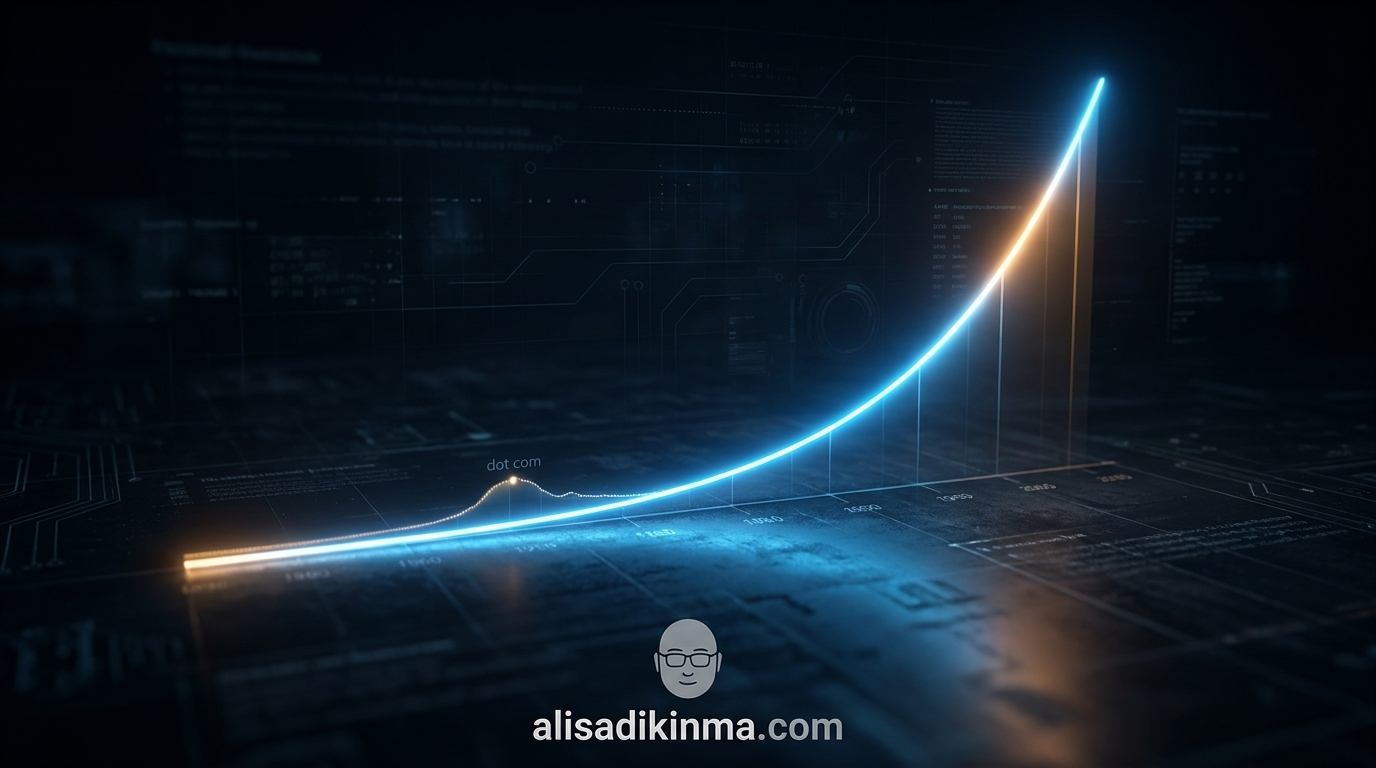
Masayoshi Son called the AI revolution something 50 times bigger than the dot-com revolution of the 2000s, based on his direct statement to CNBC. That number is wild. But that's not what makes this statement different from previous AI claims.
Here's the important part:
Son isn't talking about AI that helps humans work faster. He's talking about AI that builds its own replacement — a recursive loop where each model generation trains the next one, with no human intervention in between.
Not a new concept, but the first time there's been an inside confirmation. Anthropic formally defines it as recursive self-improvement — the condition when AI "becomes fully and autonomously capable of designing and developing its own successor" — and warned that this moment "could arrive faster than most institutions are prepared for."
This isn't a warning from a sci-fi novel. It's from the world's biggest AI lab.
But claims and reality are two different things. There's one question that actually hasn't been answered yet:
Is this recursive loop actually running — or is it still in the experimental stage?
The Technical Reality Behind the Claim — What GPT-5.3-Codex Has Already Done
OpenAI announced GPT-5.3-Codex in February 2026 and called it "the first model to play an instrumental role in creating itself." Not a metaphor. This model was used to debug the next model's training, manage deployment, and diagnose test results — three functions usually handled by a human engineering team. Plus: GPT-5.2 Pro already crossed the 90% threshold on ARC-AGI-1, a fluid reasoning benchmark that's hard to fake, according to Mainland Moment. The recursive loop isn't theory — it's running.
There are three specific documented things that GPT-5.3-Codex did:
1. Debugging its own training process
GPT-5.3-Codex read the training logs of the model that will replace it, diagnosed anomalies, and proposed fixes. This isn't running a script already written by engineers — it's reasoning about a system the model had never seen before.
Picture an employee writing a complete guide for their replacement before leaving the office, based on a deep understanding of the entire job. The difference: GPT-5.3-Codex does this at the model architecture level. A debugging process that normally takes an engineering team days gets done in a single inference session.
That means the time between one model generation and the next could be far shorter than anything we've seen before.
2. Managing infrastructure deployment
The model makes decisions in the deployment process — infrastructure configuration, cross-version consistency checks, test result validation before the system goes to production. Not as a helper tool, but as a decision-maker in the pipeline.
In a business context: this is equivalent to a technical manager authorizing production rollouts without needing human review at every step. Fewer human bottlenecks, faster development cycles for the next OpenAI superintelligence model.
And it's this cycle speed that makes the recursive loop dangerous — not in a destructive sense, but in the sense that it's hard to predict from the outside.
3. Diagnosing and suggesting architecture changes
When there's a gap between expected and actual performance, GPT-5.3-Codex diagnoses the cause and suggests modifications to the architecture or training dataset. Not pattern matching — this is causal reasoning about a system that's building its own replacement.
That's what Son means by "AI designing AI." Not writing code. Not running tests. But making architectural decisions that shape the capabilities of the next AI generation.
The recursive loop has started. The question now: what does this mean for you, concretely?
What This Means for You — Timeline, Work, and the 2-Year Window
OpenAI plans to deploy an intern-level AI research agent in September 2026 and a fully autonomous AI agent by 2028, based on reports from Times of AI and o-mega.ai. Son revised his forecast from 10 years to "less than two years" for superintelligence — and called his previous estimate too conservative. This window is real, and there are three implications that directly affect your work.
1. September 2026 is the date you need to mark
When OpenAI releases an intern-level agent for research, junior-level workloads in research, analysis, and coding are going to change shape. Whoever learns fastest how to work alongside these agents — not avoid them — will be in a much stronger position.
The concrete step right now: identify one repeating task in your work that could be delegated to AI. Start experimenting with tools available today, before September 2026 arrives and everyone else is already 6 months ahead of you.
Don't wait for it to be available — practicing how to use it starts now.
2. Your value is in decisions AI can't make yet
Son asked himself: how many decisions can AI make better than humans? The more useful question for you: which decisions in your work still require social context, negotiation, or empathy that AI can't do yet?
That's your value for the next two years. Not speed, not volume — but the kind of judgment that still needs a human behind it.
3. Position yourself as a bridge, not a competitor
The most impacted won't be people whose jobs can be automated — it'll be people who refuse to learn how to integrate AI into their workflow. The bridge between AI agent capabilities and human organizational needs is the safest and rarest position in the next two years.
How many of your daily decisions could AI already help you make better, if you were willing to learn how to use it?
What You Need to Watch — Signals That'll Prove Whether Son Is Right
SoftBank has already put in $41 billion of the planned $65 billion in OpenAI for a 13% stake, according to CNBC — the single largest investment by one investor into one AI company in history. OpenAI targets a fully autonomous AI agent by 2028. But big money and big targets aren't proof that Son is right. The real signal you need to watch is this one simple question.
Will the AI-designed AI model outperform the model that designed it?
That's the only indicator that matters. Not OpenAI's next announcement, not SoftBank's valuation, not Masayoshi Son's claims at a conference.
If the recursive loop produces measurable improvement from generation to generation — faster than a human engineering team could achieve — Son is right, and OpenAI superintelligence 2026 is the beginning of something much bigger.
If the plateau comes faster than expected, we're still in early experimentation.
Remember the claim at the start of this article: OpenAI's next model isn't being built by engineers.
The question now isn't whether superintelligence is coming. It's whether you'll recognize it when it arrives.
What would you do differently this week if you genuinely believed ASI was 24 months away?
FAQ: OpenAI Superintelligence 2026
What is OpenAI superintelligence 2026?
Superintelligence in this context refers to AI that can design and improve itself without human guidance. Masayoshi Son's statement to CNBC in June 2026 confirmed this has already started — GPT-5.3-Codex has already debugged and managed the training process of the model replacing it. OpenAI targets a fully autonomous AI agent by 2028.
What specifically did GPT-5.3-Codex do in building OpenAI's next model?
GPT-5.3-Codex did three specific things: debugged the training process of its successor model, managed infrastructure deployment configuration, and diagnosed performance gaps to suggest architecture changes. OpenAI called it "the first model to play an instrumental role in creating itself" at the February 2026 announcement.
Follow the latest AI developments — save this article and check back when OpenAI releases their next model.
Not ready to decide anything yet? Read this article first and share it with coworkers who need to know — this isn't regular hype.