xAI OpenAI Acquisitions Strategy: What Neither Has Bought Yet
By Ali Sadikin Ma · · Updated
Category: Technology
Analysis of the xAI and OpenAI acquisition strategies as of April 2026, covering what each company has bought, the strategic layers both have left uncovered, and the specific acquisitions that would most dramatically shift the enterprise AI landscape. xAI has focused on consumer distribution and physical infrastructure (X Corp, SpaceX), while OpenAI has pursued product capabilities and vertical expansion (Statsig, Torch Health). Both companies share critical gaps in enterprise trust infrastructure and developer daily workflow. Three strategic acquisition targets are identified for each: xAI should target Anysphere/Cursor, Harvey AI/Ironclad, and CrowdStrike/Darktrace; OpenAI should target Scale AI, Cloudflare, and Palantir. Includes a 3-point framework for analyzing future AI acquisitions: identify which layer is filled, who loses leverage, and whether the deal closes a gap or merely adds size.
Everyone's tracking the xAI OpenAI acquisitions strategy — which deals closed, what's already been bought. Nobody's asking what they still need.
That's where things get interesting.
In February 2026, SpaceX acquired xAI in an all-stock deal valued at $1.25 trillion — the largest merger in human history, according to CNBC. Before that, in March 2025, xAI had already swallowed X Corp at a combined valuation of $113 billion (CoinGeek, 2025). OpenAI isn't far behind: 14 total acquisitions as of April 2026, with 6 deals closed in 2025 alone — the most aggressive year in the company's history (Tracxn, 2026).
The numbers are insane. But numbers aren't strategy.
There are three questions nobody has seriously answered:
Who's actually winning strategically — not just financially?
Does spending more automatically mean smarter?
And most importantly: what specific acquisitions would actually reshape the AI landscape — that neither of them has made yet?
Let's answer all three.
xAI OpenAI Acquisitions Strategy Scorecard: What Have They Bought So Far?
Both xAI and OpenAI are in full acquisition mode. xAI picked up X Corp for $113 billion in 2025, Hotshot for AI video, then merged with SpaceX at $1.25 trillion (2026). OpenAI has closed 14 total acquisitions as of April 2026 — including Statsig ($1.1 billion, September 2025) and Torch Health ($60 million, January 2026) — backed by a $110 billion fundraise at an $840 billion post-money valuation (PipelineRoad, 2026).
But here's what most M&A analyses miss:
These two companies are buying at completely different layers. And that makes direct comparisons misleading.
xAI is playing at the distribution and data layer. X Corp gives them access to hundreds of millions of active users plus a real-time data firehose that can't be bought any other way. Hotshot adds generative AI video capability. The SpaceX merger gives them orbital infrastructure — Starlink satellites, edge computing, global connectivity that no competitor has at that scale.
OpenAI is moving in a different direction. Statsig is a product experimentation platform — meaning they bought the ability to optimize their own products faster. Torch Health opens the door to the healthcare vertical. The six 2025 acquisitions mostly targeted product capabilities and vertical expansion, not distribution or physical infrastructure.
Now Musk, through SpaceX — which has been xAI's parent company since February 2026 — has the option to acquire Anysphere, the maker of Cursor, for $60 billion, or pay $10 billion for a collaboration deal short of a full acquisition (TechCrunch, April 2026).
This isn't coincidence. It's a pattern.
And the pattern reveals a major strategic gap that neither has filled — which we'll dig into next.
What Those Trillions Haven't Covered: The Gaps Both Companies Share
Behind the big numbers, xAI and OpenAI share the same strategic gap: neither has the layer that connects their core AI to real enterprise adoption. xAI is strong on consumer distribution and physical infrastructure, but weak on enterprise middleware and trust layer. OpenAI is starting to expand into healthcare and SaaS, but doesn't yet have independent data infrastructure or global-scale distribution channels.
Consider this:
In February 2025, Musk and xAI made a hostile bid of $97.4 billion to acquire OpenAI. OpenAI called it a "sham bid designed to disrupt their business operations" (TechCrunch, 2025). Musk tried to buy his biggest competitor. OpenAI pushed back hard and refocused on product expansion.
Then OpenAI bought... Torch Health. A $60 million healthcare startup.
And xAI bought Hotshot — a still-small AI video startup.
Neither move is wrong. But neither is a move to win the next-level strategic battle.
Why?
Two big holes that neither has filled:
Gap one: Enterprise trust layer. Neither xAI nor OpenAI has acquired a company that can give them the compliance credibility, audit trails, and governance that large enterprises need — Fortune 500s, government agencies, tier-1 healthcare. Torch Health is a small step in the right direction. But it's far from a solution.
Gap two: Cybersecurity and AI safety infrastructure. As AI models get more powerful, the threat surface gets wider. Neither company has acquired a leading cybersecurity firm to protect their enterprise-scale deployments. And that's the primary reason so many enterprise CTOs are still hesitant to go all-in.
The next section answers the real question: which specific acquisitions close these gaps — and why neither has made them yet?
The Real Picture: What xAI and OpenAI Should Buy Next
xAI needs acquisitions in the developer tooling and enterprise security layer to close the gap in a strategy that's been laser-focused on consumer distribution. OpenAI needs to shore up data infrastructure and global distribution channels they don't yet have. Three strong targets per company could fundamentally redraw the enterprise AI map — and SpaceX has already opened the door with the $60 billion Cursor option (TechCrunch, 2026).
This isn't guesswork. It's gap-based analysis.
For xAI: 3 Most Strategic Targets
1. Anysphere (Cursor) — Developer Tooling Layer
What it is: An AI-native IDE that's become the go-to choice for millions of developers worldwide. SpaceX already has the option to acquire it for $60 billion or pay $10 billion for a collaboration deal (TechCrunch, 2026).
Why it closes the gap: xAI has Grok, a powerful language model. But they don't have a surface where developers actually work every day. Cursor is that surface. This acquisition gives xAI direct access to millions of active developers — not as social media users like X Corp, but as daily power users of AI coding tools who can't just switch tools on a whim.
How it works concretely: Grok gets integrated directly into Cursor as the default AI engine. Developers already using Cursor are automatically exposed to Grok every day — not by choice, but because that's the tool. This is captive distribution you can't buy with ads.
Strategic outcome: xAI becomes the default AI layer inside global developer workflows. Grok is already the brain. Cursor is the hands. It's a combination neither OpenAI nor Google has right now — and one acquisition could close that gap permanently.
2. Harvey AI or Ironclad — Legal AI Layer
What it is: Two of the leading legal AI startups serving major law firms and Fortune 500 enterprise legal departments.
Why it closes the gap: xAI needs a door into enterprise trust environments. Legal AI is the vertical with the highest compliance requirements, but also the highest willingness-to-pay per seat. Winning here gives xAI legitimacy that can't be bought with branding or ads — because tier-1 law firms don't use tools they don't fully trust.
How it works concretely: Start with contract review and due diligence automation. Firms that adopt AI for legal work typically extend adoption to other departments within 12 months. xAI enters as a legal AI vendor, then grows into a broader enterprise AI partner.
Strategic outcome: xAI becomes a trusted C-suite vendor, not just "Musk's tools." Legal AI is the gateway to enterprise decision-makers that have so far been out of reach for a brand that feels too Musk-centric.
3. CrowdStrike or Darktrace — Cybersecurity Layer
What it is: Two global enterprise cybersecurity leaders — CrowdStrike in endpoint protection, Darktrace in AI-driven threat detection.
Why it closes the gap: Enterprise-scale AI deployment without a strong security layer is the single biggest argument CTO skeptics keep making. This closes the one objection that keeps coming up in enterprise boardrooms.
How it works concretely: xAI bundles AI inference + cybersecurity into a single enterprise contract. This isn't just an added feature — it's a new market position: "AI that's secure by default." OpenAI doesn't have this. Microsoft has part of it, but not the strongest version.
Strategic outcome: xAI enters enterprise RFPs it's been losing due to security concerns — and wins because now it has an answer competitors don't.
For OpenAI: 3 Most Strategic Targets
1. Scale AI — Data Infrastructure Layer
What it is: A data labeling and AI infrastructure company used by nearly every big tech player — including OpenAI's competitors — to train their models.
Why it closes the gap: OpenAI has the strongest models. But they depend on a data pipeline that competitors could restrict or take over at any time. Scale AI gives them full control over the most fundamental layer.
How it works concretely: OpenAI stops paying external data vendors and takes control of its own quality pipeline. Beyond that — they can sell data labeling services to other competitors, turning a cost center into a new revenue stream.
Strategic outcome: OpenAI builds a much deeper moat at the training data layer, while opening up new revenue from competitors who have no choice but to keep using Scale AI.
2. Cloudflare — Global Distribution Layer
What it is: Global CDN and edge computing infrastructure serving most of the internet — with a presence in 300+ cities across 100+ countries.
Why it closes the gap: OpenAI needs the ability to deploy AI inference at the edge — close to the user, not just from US data centers. This is their biggest distribution gap compared to xAI, which already has Starlink as global infrastructure. High latency kills AI user experience, especially in Asia and emerging markets.
How it works concretely: AI inference runs on the nearest Cloudflare node, not routing to US servers. Response times drop dramatically for users outside the US. OpenAI suddenly becomes competitive in markets it's been losing to local players because of lower latency.
Strategic outcome: OpenAI can offer low-latency AI inference globally — including Southeast Asia, Africa, and Latin America markets that have so far been out of reach competitively.
3. Palantir — Enterprise Data + Government Layer
What it is: An enterprise data analytics platform with existing contracts with the US government, NATO, and hundreds of Fortune 500 companies — with a trust track record built over 20 years.
Why it closes the gap: OpenAI has started entering healthcare with Torch Health. But Torch Health is a small startup. Palantir isn't just technology — it's existing trust relationships with the hardest-to-reach decision-makers: governments and regulated industries.
How it works concretely: OpenAI doesn't need to build trust from scratch in the government sector — Palantir already has that. It's just a matter of layering AI capabilities on top of existing contracts and relationships whose value can't be measured in ordinary terms.
Strategic outcome: OpenAI instantly gains a distribution channel into the most valuable enterprise segments that have so far been impenetrable — government, defense, and highly regulated industries — with legitimacy that's already proven.
What This All Means for the Rest of the AI Market
The xAI and OpenAI acquisition wave is sending a clear signal to the market: AI is shifting from the model competition phase to the layer ownership phase. AI companies still standing independently in the developer tools, data infrastructure, enterprise security, and global distribution layers are now potential acquisition targets — or they'll get squeezed out of the main fight.
Remember the first question we opened with?
Who's actually winning strategically?
Here's the answer:
Not whoever spends the most. But whoever chooses most precisely which layers they own.
xAI leads at the consumer distribution and physical infrastructure layer — Starlink, SpaceX, and X Corp give them a combination nobody else has. OpenAI leads at the model quality layer and early enterprise expansion — the $840 billion fundraise gives them the runway to move fast.
But neither has won at the two most decisive layers: genuine enterprise trust and developer daily workflow.
Now think about your own industry:
Which AI verticals in your space are still standing on their own — not yet acquired by anyone?
That could be the next acquisition target. Or if you're fast and you're in that space — it's your chance to position yourself before one of these two giants makes a move.
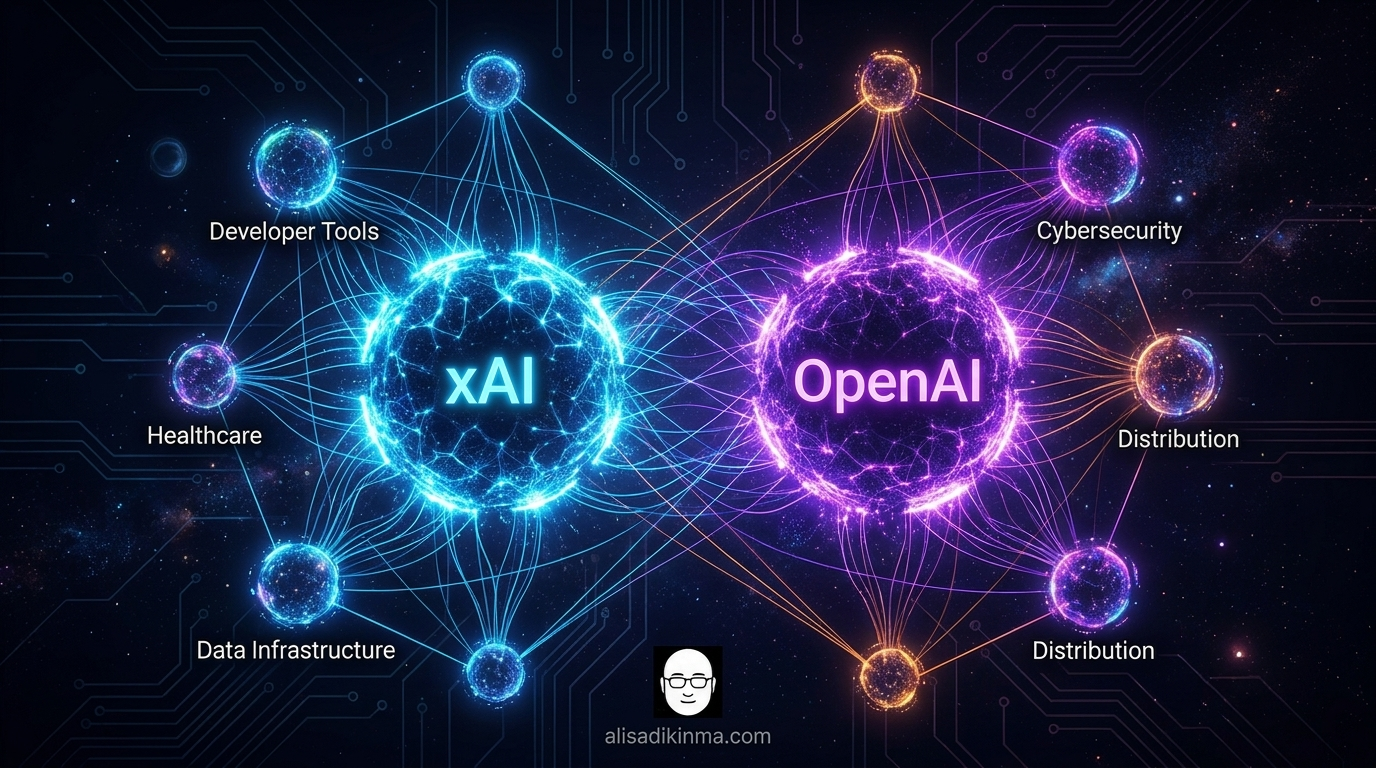
This isn't about who builds the best AI anymore. It's about who controls the on-ramp.
A 3-Point Framework for Reading the Next xAI OpenAI Acquisitions Move
Every time a major AI acquisition headline drops, most people focus on the price. That's the wrong question.
Three questions you should be asking instead:
1. Which layer does this acquisition fill?
There are three layers always in play: distribution (who reaches users), data (who owns the model's fuel), and trust (who enterprise and government actually trust). If an acquisition doesn't clearly fill one of these three — it's a defensive move, not a strategic one. A big price tag doesn't automatically mean strategic.
2. Who loses leverage if this deal closes?
Acquisitions aren't just about the buyer. Every deal locks another player out of access to the same layer. When xAI acquires Cursor, who loses? Google and Anthropic lose the biggest access point to developer daily workflow. The question "who loses" is often more informative than "who wins."
3. Does this close a gap — or just add size?
The biggest mergers aren't always the most strategic. SpaceX-xAI is the strongest infrastructure combination ever assembled. But does it close xAI's enterprise trust gap? Not necessarily. Size isn't strategy. Gap-filling is strategy.
The next AI acquisition that truly matters will fall into one of these three categories. Now you have the framework to read it — before the mainstream headlines catch up.
FAQ: xAI, OpenAI, and the AI Acquisition Race
Will xAI Acquire Cursor (Anysphere)?
SpaceX — which has been xAI's parent company since February 2026 — has the option to acquire Anysphere, the maker of Cursor, for $60 billion, or pay $10 billion for a collaboration deal short of a full acquisition (TechCrunch, April 2026). The option is already in their hands. The only question is when and at what number the deal gets officially locked in.
How Many Companies Has OpenAI Acquired?
As of April 2026, OpenAI has completed 14 total acquisitions — with 6 of those closing in 2025 alone, making 2025 the most aggressive year in the company's history (Tracxn, 2026). The $110 billion fundraise in late February 2026, which brought their valuation to $840 billion, gives them the capital to keep moving in 2026 (PipelineRoad, 2026).
What Is xAI's Acquisition Strategy in 2026?
xAI is moving on three layers simultaneously: consumer distribution (X Corp, hundreds of millions of users), AI content capability (Hotshot for generative video), and physical infrastructure (the $1.25 trillion SpaceX merger). The pattern is clear: own the data pipeline, own the distribution channel, then own the physical layer that competitors can't replicate. This isn't just an AI race — it's a layer-by-layer monopoly build (CNBC, 2026; CoinGeek, 2025).
What's Your Next Move?
The next AI acquisition analysis is already in motion before the headline drops.
Subscribe for weekly AI acquisition analysis — before it goes mainstream.
Or: Bookmark this article now. The next big deal from xAI or OpenAI will prove — or disprove — what's laid out above. And you'll want to have read this before everyone else starts talking about it.