Vibe Coding: How Schools Save $200K Without Any Developers
By Ali Sadikin Ma · · Updated
Category: AI Vibe Coding
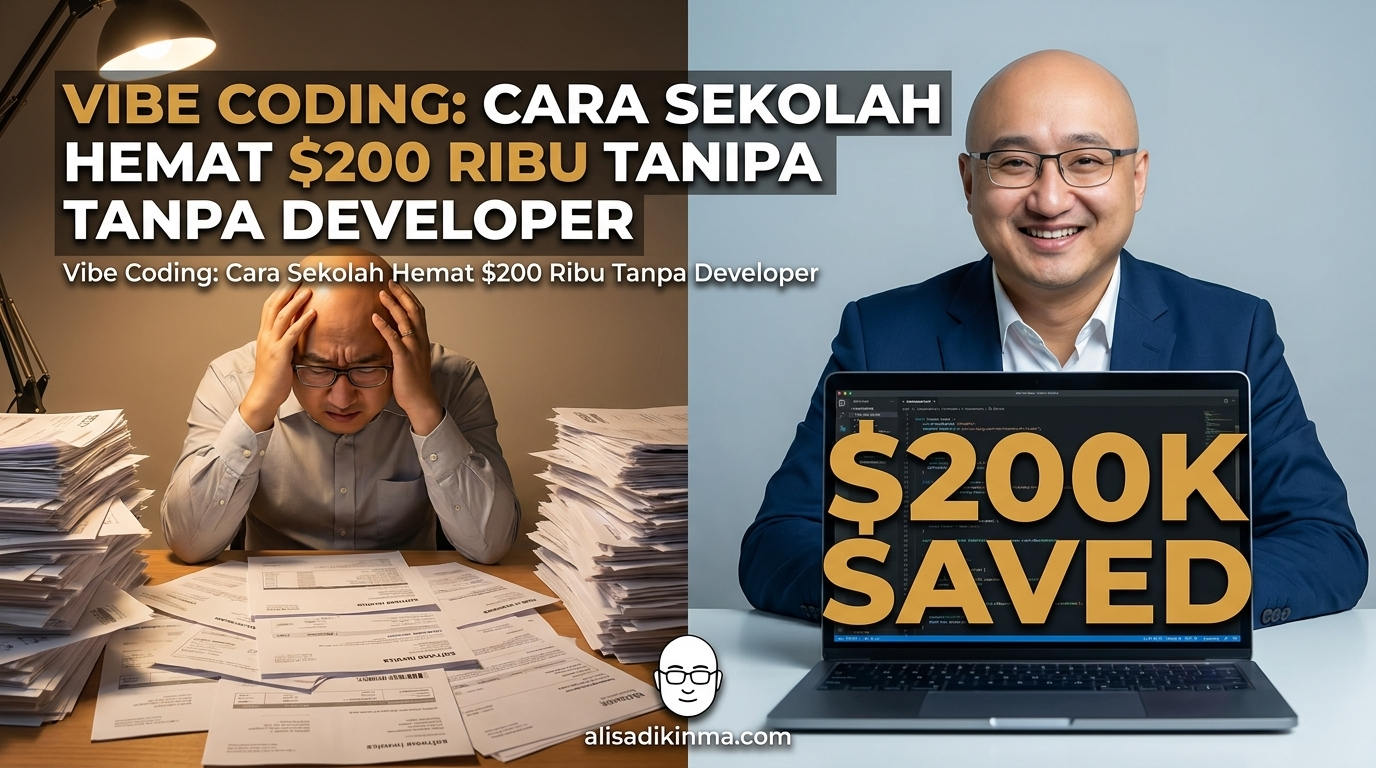
This district saved $200K — without firing a single IT staff member.
No magic tricks. No miracles.
What they did is something that two years ago would've been impossible for school administrators without a tech background: building their own software.
And the key is the cost-saving vibe coding for schools approach — a new way of working that helped Peninsula School District in Gig Harbor, Washington slash tech spending by $200K to $250K per year, according to an EdWeek report from May 2026.
Three questions probably just popped into your head:
- What is vibe coding, and why are we only hearing about it now?
- How can administrators with zero coding skills build working software?
- Can my school or district do the same thing?
All the answers are below — but before we get there, there's one long-standing problem we need to acknowledge first.
Why Schools Keep Getting Trapped in Expensive Software Subscriptions
Non-technical user adoption of vibe coding jumped 520% year-over-year in 2026 according to Hostinger — a strong signal that more and more non-technical organizations just can't deal with software that doesn't fit their needs. And schools are among the hardest hit.
Picture this:
One teacher data management platform. One learning evaluation app. One attendance monitoring system. Each with its own annual subscription, each with features that 80% of the time never get touched — but you still have to pay for them every year.
And when a specific need comes up — like a tool to analyze recorded teaching videos and give automated feedback — there's no product that fits. Asking a vendor to add the feature? Too expensive. Building from scratch? You've got no dev team.
This isn't just one district complaining. It's a structural trap that drains school tech budgets every year on products that were never really designed for their specific needs.
But something changed in 2025:
AI changed who can build software.
What Is Vibe Coding? It's Not Regular Coding
Vibe coding doesn't mean you need to learn Python or JavaScript. The term was coined by Andrej Karpathy — a leading AI researcher and former AI director at Tesla — in February 2025. The concept is simple: you describe what you want to build in everyday language, and AI writes the code.
Imagine typing into Claude Code: "I need an app that can analyze recorded teaching videos and give automated feedback based on a specific rubric." Within minutes, AI generates working code — without you having to understand a single line of it.
IBM reported up to 60% reduction in development time for internal enterprise apps using AI-assisted coding, according to Braiviq 2026. And the fastest-growing segment isn't professional developers — it's non-technical users, with 520% YoY growth.
Now here's the question:
How exactly did Peninsula District implement this, and what are the real costs involved?
Cost-Saving Vibe Coding for Schools: 4 Steps Peninsula District Actually Used
This isn't theory. This is the methodology used by real school administrators — most with zero CS background — to build software that saves hundreds of thousands of dollars a year.
Step 1: Audit all your active software contracts
What they did: Peninsula District started not by building software, but by questioning what they were already paying for. One simple question became the starting point: "Do we actually need this, or can we build it ourselves?"
How to do it: Build a three-column spreadsheet — software name, annual cost, and actual usage frequency. Every row showing high cost and low frequency goes on the "replacement candidates" list. Google Sheets is enough — no special tools or expensive consultants needed.
Real example: Peninsula identified Informed K12 — a school contract management platform — as the first candidate. After building an internal solution through vibe coding, that contract was cancelled entirely, according to EdWeek 2026.
Result: One cancelled contract means immediate savings going straight into the district's budget. Multiply that by 3–4 active contracts, and you're getting close to $200K a year.
Step 2: Set up private AI infrastructure before you start building
What they did: Before building a single app, Peninsula set up AI Studio — an internal private AI system running on their own servers, not on a third-party public cloud.

How to do it: AI Studio runs at around $600 per month ($7,200 per year). It becomes the central "kitchen" where all vibe-coded apps are run and tested — way cheaper than a single average enterprise software subscription.
Real example: With AI Studio as the foundation, all processed student data stays within the district's internal environment. This meets the strict FERPA (Family Educational Rights and Privacy Act) regulations for educational institutions in the US, according to EdWeek 2026.
Result: A secure, centralized foundation — and the first governance layer that prevents uncontrolled ad-hoc app building by anyone.
After this step, what happened next surprised even their own internal team.
Step 3: Build your first app with Claude Code
What they did: District administrators — without a CS degree — used Claude Code ($200 per month per user) to build LessonLens, their first instructional coaching app.
How to do it: Pure vibe coding approach: describe the need in natural language, Claude Code generates working code, then the result gets tested immediately by teachers and administrators in the field. No external vendors, no consultants, no months-long RFP process.
Real example: LessonLens analyzes uploaded teaching recording videos and provides automated feedback based on evaluation rubrics. According to EdWeek 2026, a product like this would be unaffordable if bought from an outside vendor — custom development costs can reach hundreds of thousands of dollars for a single app.
Result: One custom app that's 100% aligned with the district's needs, built for $200 per month. No unused features, no compromises on the team's specific requirements.
Step 4: Replicate the methodology for the next contract
What they did: After LessonLens proved successful, Peninsula used the same methodology to systematically identify and replace more inefficient subscriptions.
How to do it: Go back to the Step 1 audit spreadsheet. Every software on the "candidates" list gets analyzed: what's its core function? Can that need be described in natural language to Claude Code? If yes, build it. If not — because of complexity or specific regulations — keep the contract and move on to the next item.
Real example: Peninsula is targeting 3–4 ed tech contracts to cancel throughout 2026, according to K-12 Dive 2026. Each "audit → build → cancel" cycle adds savings toward the projected $200K–$250K total, while continuously building the team's internal capabilities.
Result: Dependency on external vendors shrinks gradually, internal capabilities grow, and every saving is directly documented for reporting to the school board.
The Numbers Behind the $200K Savings: The Breakdown Nobody Talks About

According to Peninsula School District projections reported by EdWeek and K-12 Dive (May 2026), total savings are projected at $200K–$250K per year from cancelling 3–4 ed tech contracts. The breakdown: third-party platform subscriptions can reach tens of thousands of dollars per contract per year — while Peninsula's entire vibe coding infrastructure (AI Studio + Claude Code) runs under $20,000 per year.
This isn't an isolated phenomenon. The vibe coding market hit $4.7 billion in 2025 and is projected to grow to $12.3 billion by 2027 — a 38–42% CAGR, according to Second Talent 2026. That means: more organizations will follow Peninsula's lead in the next two years.
And on the adoption side:
92% of US developers now use AI coding tools daily, while 41% of all code produced globally is already generated by AI, according to Hostinger 2026. This isn't a trend that's still rising — it's already the new standard for the software industry.
Risks You Can't Ignore (and How Peninsula Handled Them)
But there's something they almost missed.
Vibe coding isn't without risk. And if you skip this section, that $200K savings could turn into a problem that's way more expensive to fix.
Risk 1 — Code security vulnerabilities: Research cited by Hostinger (2026) found that 45% of AI-generated code contains security vulnerabilities, including command injection and hardcoded secrets. For schools managing personal data of minor students, this isn't a risk you can compromise on.
How Peninsula handled it: AI Studio runs on the district's internal servers — not a public cloud. All student data stays in a controlled environment, and every piece of code gets reviewed before deployment to production.
Risk 2 — Governance without structure: Gartner warned that app building by citizen developers will increase software defects by 2,500% by 2028 without proper governance, according to GovTech 2026.
How Peninsula handled it: By setting up AI Studio as centralized infrastructure from day one — instead of letting every administrator build and deploy ad-hoc — Peninsula had a built-in governance layer from the start.
The question isn't whether vibe coding is safe or not. The question is whether your organization has the systems to make sure it stays safe.
Can Your District or Organization Do the Same?
Remember those three questions at the start of this article?
We've answered the first two. Now the third one — and this is the most important one for you.

The answer doesn't depend on your budget, your IT team size, or your district's scale.
What matters is one thing: is there someone in your organization willing to sit down, define the problem clearly, and experiment with AI as a build partner?
Peninsula isn't a tech-giant district. They're a school in Gig Harbor, Washington. Most of their administrators don't have a CS degree. What they had was the willingness to define their own problems — and the belief that AI could help them build a solution.
Gartner projects that by 2028, 40% of new enterprise production software will be created through vibe coding methods, according to Second Talent 2026. This isn't a direction that's up for debate anymore.
Think of one tool in your district or organization that's the most inefficient and most expensive — the one whose features have never been 100% aligned with your needs.
That's your starting point.
What Peninsula experienced isn't just about saving $200K. It's about something bigger: taking back control over tools that are supposed to serve their needs — not the other way around.
FAQ: Common Questions About Vibe Coding in Schools
Is vibe coding safe for student data?
Safety depends on implementation, not method. Peninsula District runs AI Studio on their own internal servers — not a public cloud — so student data never leaves the district's environment. With the right governance, vibe coding can be safer than uncontrolled third-party SaaS subscriptions. The main key: private infrastructure from the start, not after problems show up.
What's the minimum cost to start vibe coding at a school?
Minimum cost is around $200 per month for one Claude Code license — the main tool Peninsula used. Add the AI Studio infrastructure (~$600 per month), and the total initial investment is around $800–$1,000 per month. Replace one average ed tech contract, and ROI is immediately positive in the first month without waiting for the end of the fiscal year.
Start auditing your district's software contracts this week — identify the three most expensive and least-used tools. Those are your first candidates to replace with a vibe coding solution.
Save this article before your next technology budget meeting — it'll change how you think about ed-tech investment and what you can actually build yourself.