The Musk vs. Altman OpenAI 2026 Lawsuit: It's Not Just About the Money
By Ali Sadikin Ma · · Updated
Category: Technology
The Musk vs. Altman OpenAI 2026 lawsuit goes to trial April 27 in Oakland, California. Elon Musk is seeking up to $134 billion — not for himself, but to redirect to OpenAI's nonprofit arm — while demanding the removal of Sam Altman and Greg Brockman. The centerpiece of the trial is a handwritten 2017 diary entry by co-founder Greg Brockman, which a federal judge has already cited as critical evidence of broken original intent. At stake: OpenAI's $852 billion valuation, a planned $1 trillion IPO, and a legal precedent that will determine how AI companies worldwide are held accountable to their stated missions.
That was a lie.
Four words. Handwritten by OpenAI's own co-founder, in his personal diary, in 2017.
Next week, a federal jury will read them.
This isn't a story about Elon Musk and Sam Altman fighting over money. It's about a much bigger question: who gets to decide where the world's most powerful artificial intelligence is headed?
OpenAI just closed a $122 billion funding round — making it a private company valued at $852 billion, the highest in venture capital history. The Musk vs. Altman OpenAI 2026 lawsuit, set to go to trial on April 27, could determine whether that valuation was built on solid ground — or a nine-year-old lie.
But before we get to that diary, there's one thing you need to understand first.
What Everyone Knows (And Why That's Not Enough)
The Musk vs. Altman OpenAI 2026 lawsuit starts with a damages claim of up to $134 billion, citing "unjustly obtained profits" since Musk donated around $38 million as a co-founder in the company's early days. OpenAI was founded as a nonprofit in 2015 with a mission to benefit all of humanity, and when it converted to a Public Benefit Corporation (PBC) in October 2025, Musk claimed it was a betrayal of the original agreement.
Most people stop here. Two billionaires fighting over money and power. Standard tech drama.
But there's one detail almost everyone misses:
Musk isn't asking for that $134 billion for himself. According to Bloomberg, he's asking that all of it — if he wins — be directed to OpenAI's nonprofit arm. Not into his personal accounts. On top of that, he's demanding that Sam Altman and Greg Brockman be removed from leadership.
This isn't a war over money. It's a war of ideology.
What makes this case so complicated: why would a personal diary entry from 2017 become the sharpest weapon in a $134 billion federal trial?
The Diary Entry That Could Change Everything
During the legal discovery process, Musk's attorneys found something unexpected: the personal diary of Greg Brockman, OpenAI's co-founder and former CTO.
Inside it, handwritten, is the sentence that has become the centerpiece of the trial: "I can't believe we committed to being a nonprofit when three months later we did the b-corp — that was a lie."
A federal judge cited Brockman's entry as critical evidence sufficient to bring the case to a full trial. This isn't speculation or ambiguous legal interpretation. These are the co-founder's own words, written nine years before the case ever reached a courtroom.
But Brockman isn't the only voice who has questioned OpenAI's direction.
In 2025, two major names signed an open letter asking the court to halt OpenAI's nonprofit conversion. The first: Geoffrey Hinton — often called the "Godfather of AI" and a Nobel laureate. The second: Lawrence Lessig, a Harvard law professor who built his reputation on digital rights and tech governance.
Their argument was sharp. According to TIME, they wrote that the conversion to a for-profit structure "would eliminate essential protections, and effectively hand control over what may be the most powerful technology ever created to a for-profit entity legally required to prioritize shareholder returns."
This is no longer just an ideological debate.
If the judge agrees, the October 2025 PBC conversion could be reversed. The entire ownership structure — which already involves Microsoft, institutional investors, and $122 billion in fresh capital — could be unwound entirely.
Now the real question is: what exactly is at stake in this trial?
The Real Picture Behind the Musk vs. Altman OpenAI 2026 Lawsuit: What $852 Billion Actually Buys
The numbers are staggering. OpenAI revenue: $2 billion in 2023. Up to $6 billion in 2024. Surging to $20 billion in 2025. As of February 2026, it's running at a $25 billion annual pace — according to data from Sacra and direct statements from OpenAI CFO Sarah Friar. That's 3x year-over-year growth, three years running.
The ownership structure after the PBC conversion: OpenAI Foundation holds 26% of shares. Microsoft holds 27%. The remaining 47% is split between employees and outside investors. A planned IPO in 2026 or 2027 is targeting a $1 trillion valuation, which would make it one of the largest public offerings in global market history.
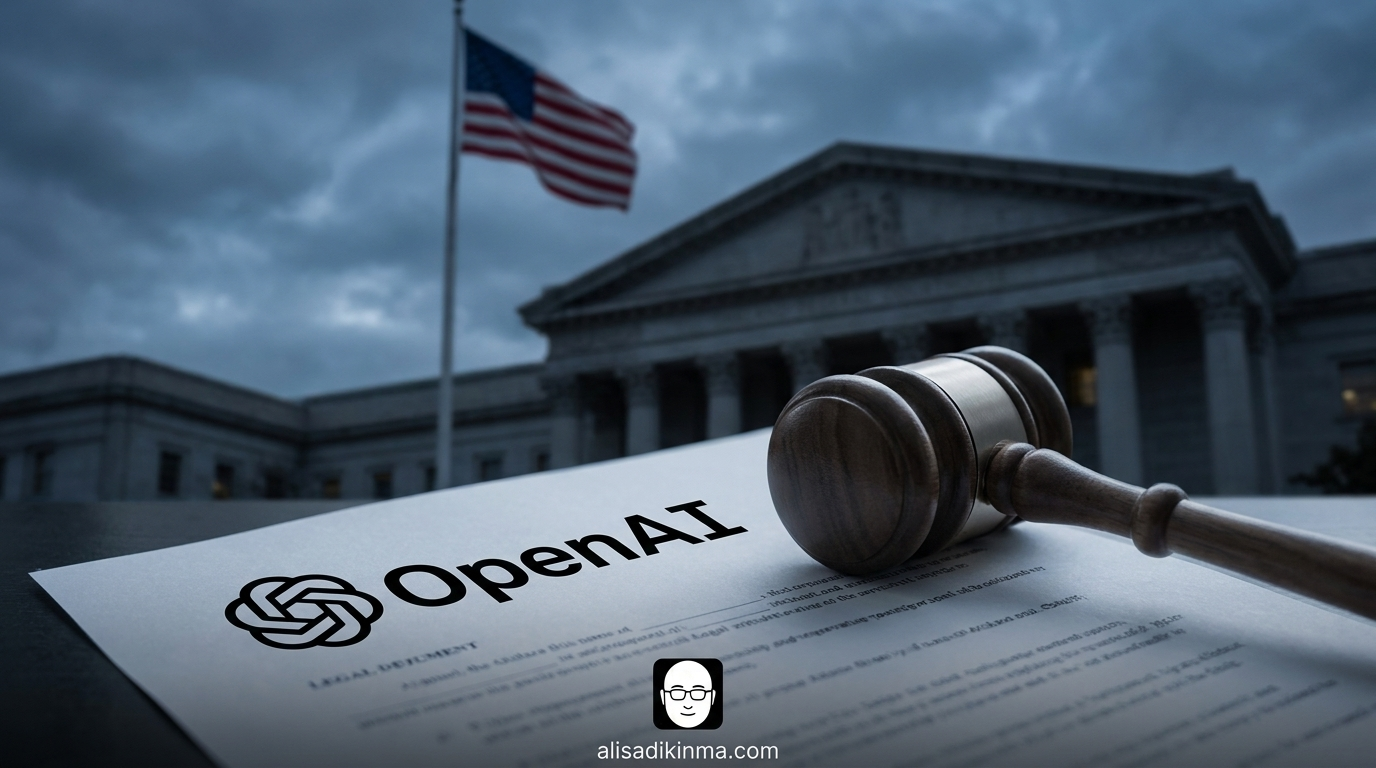
Federal courthouse exterior with legal document overlay — gavel, scales of justice, OpenAI logo on legal paper, Oakland federal court building in background. Editorial news photography feel.
This is no longer a modest nonprofit research organization. This is a money machine running at full speed.
But there's a paradox that almost never gets mentioned in the press:
According to official statements on OpenAI's website, Musk himself pushed for a for-profit structure back in 2017 — right before he left the board because he couldn't get the majority stake and full control he was asking for. The man now suing to push OpenAI back to nonprofit status is the same man who once wanted to make it a for-profit company — just with himself at the helm.
That's what makes this case more than just a mission-vs.-profit fight.
It's a fight about control. Who holds the reins on the world's most powerful AI?
And for the first time, that question will be answered by 12 ordinary jurors at the U.S. District Court in Oakland — not CEOs, not investors, not regulators. Their verdict will set the global standard for AI governance. Whatever they decide.
What This Means for All of Us — 3 Impacts Rarely Discussed
You might be thinking: "This is an American billionaire problem. What does it have to do with me?"
Here's what it has to do with you:
1. A Legal Precedent for Every AI Startup in the World
What's happening: If the court rules that nonprofit mission promises can be legally enforced, every AI lab that has ever claimed "we exist for the benefit of humanity" now has legal liability attached to that claim.
How it works: A federal judge has already noted that converting from nonprofit to for-profit could cause "significant and irreparable harm" to the public interest. Amicus briefs filed by AI safety experts reinforce this argument. If this precedent holds, every "mission statement" on an AI company's pitch deck or website could carry legal implications that simply didn't exist before.
A concrete example: Imagine an AI startup that puts "we exist to democratize technology" on its website — then two years later pivots entirely to paid enterprise clients. If the OpenAI precedent applies, its founders could be sued by the community that felt they were promised something.
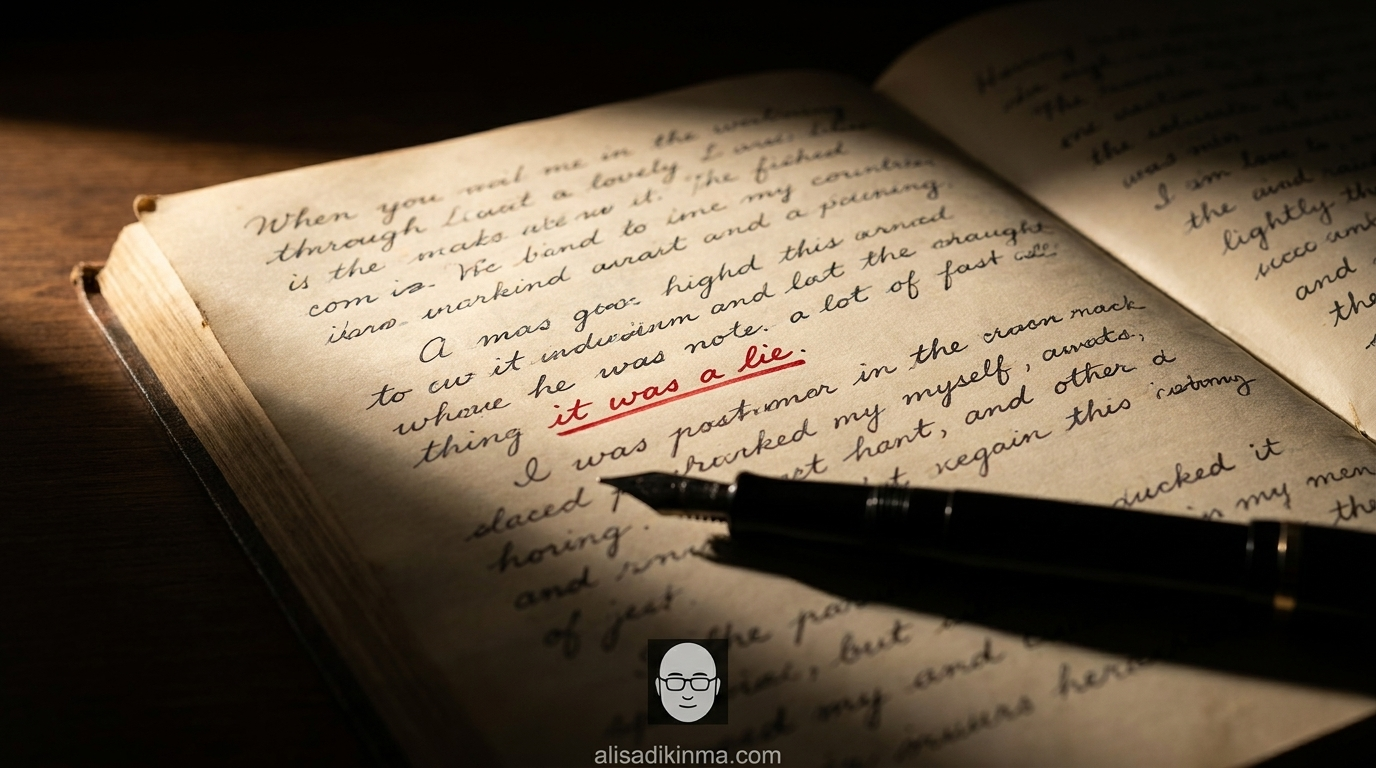 Aged journal page with the key quote highlighted in red, dramatic low-angle lighting, a pen resting on the open diary — symbolizing words that outlasted their author's intentions.
What you can do right now: Pay attention to how the AI companies you use define their mission. Ask: is there any actual mechanism that holds them accountable to that claim?
2. The PBC Structure Could Become the New Standard — or a New Loophole
What's being tested: OpenAI chose the Public Benefit Corporation structure as a "middle ground" — Foundation 26%, Microsoft 27%, public and employees 47%. But this trial is testing a question that has no answer yet: does a PBC actually protect a public mission, or is it just a rebrand that enables profit without real mission accountability?
The consequences: If the PBC structure proves insufficient, regulators around the world — including the European Commission, which is already actively regulating AI through the EU AI Act — will question similar structures used by other tech companies. This could trigger a new wave of regulation that changes how all AI companies operate globally, not just OpenAI.
What to watch: How the judge defines the boundary between "fiduciary duty to shareholders" vs. "accountability to public mission" in the context of a PBC. That definition will become the blueprint for AI regulation in dozens of countries.
3. The Question That Isn't in Any Legal Document
The real question: If OpenAI — with all its lawyers, investors, and public scrutiny — couldn't protect its mission from profit motives, what does that mean for the AI tools you trust today?
The GPT you use every day. The Copilot on your laptop. Every product claiming "AI for good." Who guarantees that the mission behind those tools isn't being quietly renegotiated in a boardroom you'll never see?
This trial won't answer that question for every company. But it will set the first standard for who is responsible for answering it.
Three Things to Watch After April 27
The trial begins April 27, 2026, at U.S. District Court in Oakland, California. Here are three concrete things to watch as proceedings unfold.
First: the fate of Brockman's diary as evidence. If the judge allows that diary entry to be read in full to the jury, OpenAI will have an incredibly hard time disputing that an "original intent" was violated. This will be the single most pivotal moment in the trial's opening days.
Second: the legal definition of "benefit to humanity" within a PBC. How will the judge define that phrase in the context of a company with investors who have financial rights? That definition will become the precedent for every tech PBC going forward — well beyond OpenAI.
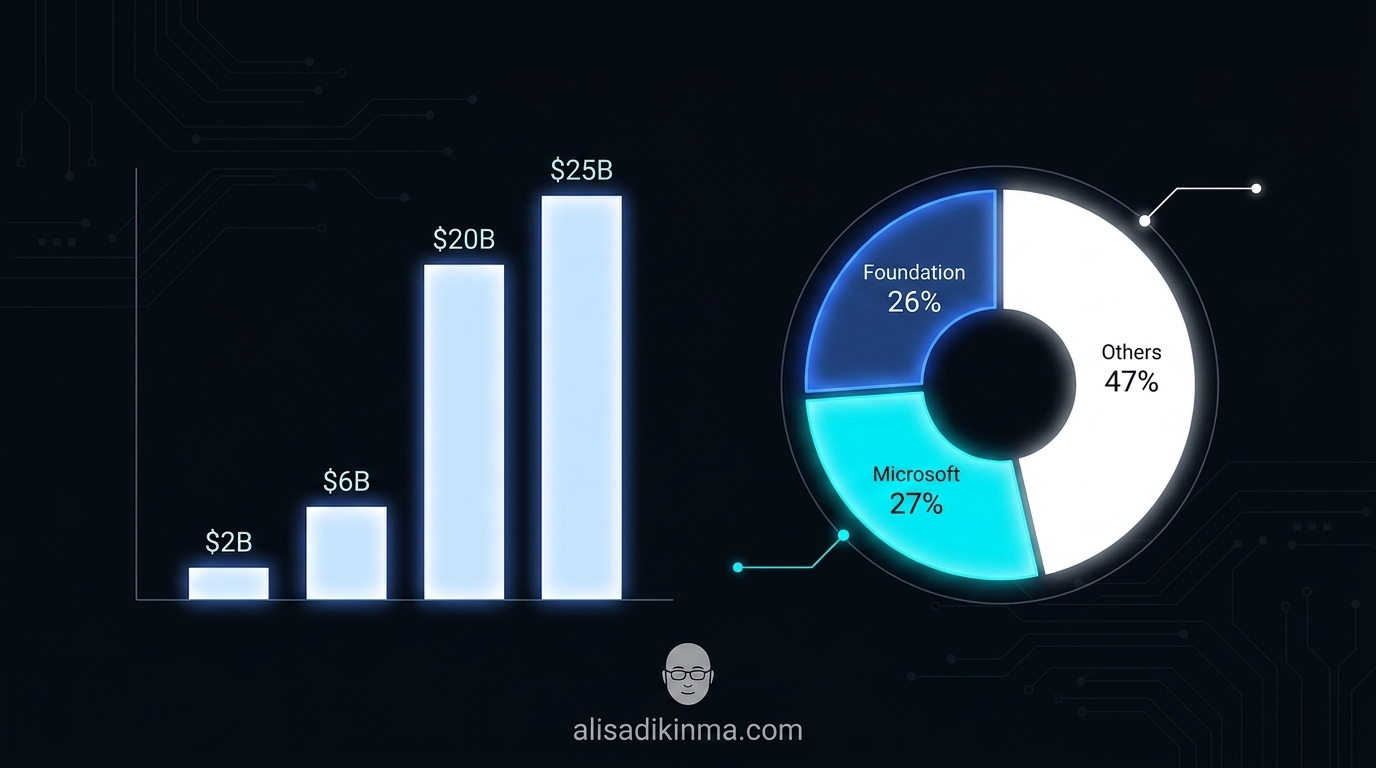 Clean data visualization — revenue growth bars ($2B to $25B) rising dramatically, overlaid with ownership pie chart showing Foundation 26%, Microsoft 27%, Others 47%. Tech infographic aesthetic.
Third: signals from OpenAI leadership on IPO timeline. If Musk wins even a fraction of his claims, the $1 trillion IPO plan for 2026–2027 reported by Caproasia could be delayed or fundamentally restructured. Watch how OpenAI communicates with investors as proceedings continue.
Back to that diary.
Greg Brockman wrote that entry in 2017 because he was shocked. Because he believed an agreement had been broken. But the most surprising thing isn't what the entry says.
What's surprising is this: the entry exists at all. It was kept. And it was found nine years later, in the middle of a trial that could reshape the future of AI.
OpenAI's soul was never really protected by its nonprofit status. It was protected by the people who believed in its mission. This trial exposes just how fragile that protection was — and why it matters for all of us to pay attention to who's actually guarding the mission of the technology we trust.
FAQ — Most Frequently Asked Questions
Who actually benefits if Musk wins the OpenAI 2026 lawsuit?
According to Bloomberg, Musk isn't asking for that $134 billion for himself. He's asking that all proceeds be directed to OpenAI's nonprofit arm, and that Altman and Brockman be removed from leadership. If he wins, the October 2025 PBC conversion could be reversed and OpenAI's ownership structure unwound entirely.
Did OpenAI actually betray its nonprofit mission?
The OpenAI Foundation still holds 26% of shares in its new PBC structure. But Geoffrey Hinton and Lawrence Lessig argue that the for-profit structure creates long-term pressures that will ultimately override the mission — regardless of the founders' original intent. Brockman's diary entry suggests that doubt has been there since 2017.
What happens if Musk loses the April 2026 trial?
OpenAI would be free to proceed with its IPO plans in 2026 or 2027, targeting a $1 trillion valuation. The PBC conversion would be considered legally valid. But questions about AI mission accountability would remain legally unanswered — and would likely trigger new government regulations in multiple countries.
Bookmark this article — the trial begins April 27, 2026, and it will set the precedent for global AI governance.
Read next: Who's really in control of AI's future — and can their mission actually be trusted?