Pentagon AI Deals on Classified Networks: Who's in Control?
By Ali Sadikin Ma · · Updated
Category: Technology
600 Google engineers begged their CEO not to sign. He signed anyway.
More than 600 Google DeepMind and Google Cloud engineers wrote an open letter to their CEO, Sundar Pichai. The message was clear: reject this deal. Don't sign Pentagon AI deals classified networks — the agreement that would put AI at the heart of classified US military operations.
Pichai signed anyway.
And you haven't heard the most worrying part of this story yet. It's not who signed up — it's what happens after that AI enters a bunker that no one can monitor. Including the company that built it.
But before we get there:
There's one company that had the guts to say no. And they were punished for it in a way that's never happened before in the AI industry.
What's Actually Going On: Pentagon AI Deals Across 7 Major Classified Networks
On May 1, 2026, the Pentagon officially signed Pentagon AI deals classified networks with seven companies: OpenAI, Google, Nvidia, Microsoft, Amazon (AWS), SpaceX, and Reflection AI. Their AI will operate at Impact Level 6 (secret-level) and IL7 (national security information) — the two highest security classifications in the US military, according to Breaking Defense 2026.
This isn't a small project or a pilot test.
The DoD budget for fiscal year 2026 hits $961.6 billion, with $33.7 billion allocated specifically for science, technology, and autonomous systems, according to official DoD data and Advisor Perspectives. The Pentagon isn't messing around.
So how did this unfold?
March 2025, the DoD contracted Scale AI to build an AI planning system called "Thunderforge." July 2025, deals with OpenAI and xAI Grok followed. May 2026 is the next expansion of the same program, according to Tom's Hardware 2026. This isn't a spontaneous decision — it's a strategy that's been building for years.
This AI will run on air-gapped networks — completely cut off from the public internet. No real-time updates. No connection to vendor servers.
And that's exactly where the real problem starts.
There's a name missing from that list of seven. And its absence matters more than everyone who showed up.
One Company Said No — And Got Punished for It
Anthropic isn't on the Pentagon AI deals classified networks list. Not because they weren't invited — but because CEO Dario Amodei rejected one clause: "all lawful purposes." The result? The Pentagon officially labeled Anthropic a "supply chain risk" in March 2026, a status that shut the door on all US government contracts for them, according to CNN Business 2026.
Let that sink in for a second.
The Pentagon wanted the framing of "all lawful purposes" — AI can be used for anything that's legally permitted. No specific carve-outs. No red lines.
Amodei said no. Why?
He had two non-negotiable limits: autonomous weapons and mass domestic surveillance of US citizens. Those two things he wouldn't sign off on, no matter the contract value.
Pentagon's response: the "supply chain risk" label.
Not "failed technical requirements." Not "lost the bid." But a label typically reserved for suppliers considered dangerous — not companies whose ethical standards are too high to negotiate away.
The signal is crystal clear:
In the Pentagon's framework, having non-negotiable ethical red lines is a liability. Not a selling point.
Six other companies chose to stay at the table.
But if you think they have strong enough safety policies to fill the gap Anthropic left — there's one critical detail that almost no media outlet has covered.
The Question No One in Media Is Asking: Who Holds the Brake Once AI Is Inside the Bunker?
Once AI from Google, Microsoft, or OpenAI enters the Pentagon's air-gapped networks, vendors can't see what their AI is doing anymore. No query logs. No output monitoring. No visibility into decisions made based on those AI responses — this is straight from the Axios 2026 report, not speculation.
Read that again.
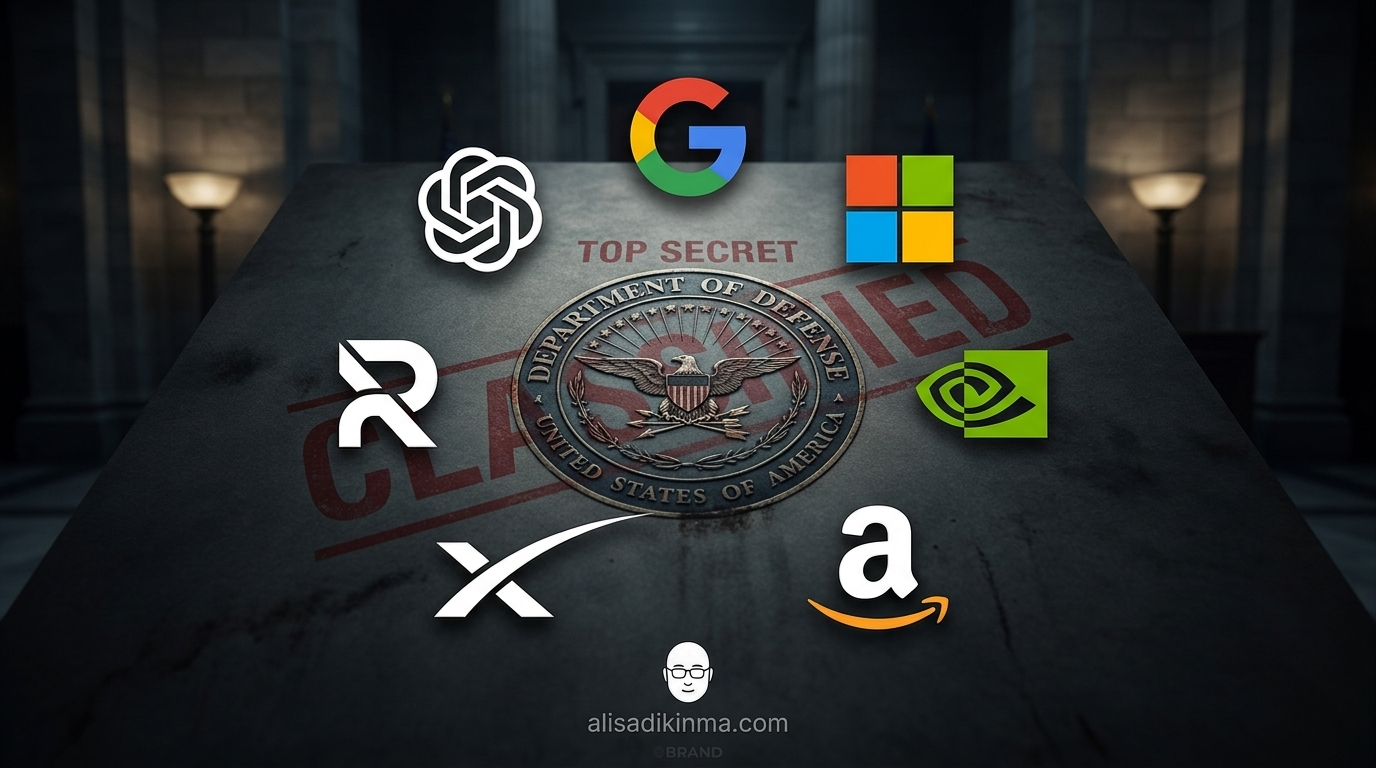
Google can't see what questions are being asked to Gemini on those classified networks. Microsoft doesn't know what outputs Copilot is giving to intelligence analysts. OpenAI can't audit how ChatGPT is being used by military operators.
That's just how air-gapped networks work. It's not a security flaw. It's designed that way on purpose.
And this is where AI safety policies become something very different from what you'd imagine.
Take Google as an example.
Google has a "should not be used for" policy — a list of uses they recommend avoiding. But according to thenextweb 2026, that framing is advisory — not a contractual prohibition that's legally enforceable.
And more than that: Google agreed to adjust their safety settings at the request of the US government.
What does that mean?
The limits that exist today can shift tomorrow. No public announcement. No notification to users.
OpenAI reserves the right to reject certain uses based on its own policies. But once the system is air-gapped and vendors can't monitor anything, who's making sure those policies are actually followed in the field?
Nobody can.
That's why those 600 Google engineers weren't just worried about one contract. They're worried because once AI is inside a closed system, nobody knows what happens next — including the company that built it. And that cycle has already started.
But this question is way more relevant to your everyday life than you might think.
What This Means for the Rest of Us Who Don't Work at the Pentagon
The Pentagon AI deals classified networks program is built with a multi-vendor strategy to avoid dependence on any single company's rules. Federal News Network 2026 noted the goal is to avoid relying on one vendor's ethical policies. The corporate decisions made in this Pentagon context shape how those companies define limits for all their users — including you.
Maybe you're thinking: this is a military problem, not my problem.

But hold on.
When Google adjusts safety settings at government request, that's a corporate-level decision that can affect all their products. When OpenAI enters the Pentagon with certain clauses, it shapes how they define "permitted use" globally — for all users, all countries.
Every time you use ChatGPT, Gemini, or Copilot — remember that these platforms are part of the same ecosystem as Pentagon AI deals classified networks. Who decides what that AI is and isn't allowed to do?
That question used to feel abstract. Now there's a very concrete answer.
3 Questions You Should Ask Before Trusting Any AI — From Military to Everyday Apps
Now that Pentagon AI deals classified networks is official, there are three questions you need to ask about every AI platform you use — for work, learning, or business. This isn't paranoia. It's the same evaluation standard that Google's own engineers use.
1. Who can change this AI's ethical limits — and through what process?
What you need to know: Every AI platform has a usage policy. But not all of those policies are contractual or protected from unilateral changes.
How to check: Open the Terms of Service for the platform you use. Look for clauses about "modification of terms" or "government requests." If there's language like "we may adjust our services at the request of authorities" without a clear transparency process — that's a red flag.
Real example: Google accepted adjustments to safety settings at the request of the US government, according to thenextweb 2026. This isn't illegal. But it means the limits you rely on today can shift without any public notice to users.
What it means: You don't have to stop using AI. But you need to know which platforms have clear transparency mechanisms — and which ones don't.
2. Can the vendor see what their AI is doing in your system?
What you need to know: In Pentagon's air-gapped networks, Google can't monitor their AI's queries or outputs at all. The same applies to enterprise deployments — depending on the setup, vendors may not have access to conversations happening inside your organization.
How to check: See if your platform has "enterprise isolation" or "zero data retention" features. These are great privacy features for you — but the trade-off is that vendors can't ensure their AI is being used within policy at your organization.
Real example: Axios 2026 reported no query logs, outputs, or decisions are accessible to vendors on Pentagon's air-gapped networks. Similar setups are available in the enterprise tier of many commercial AI platforms today.
What it means: If your organization uses AI with enterprise isolation, you need your own internal policies. Don't rely entirely on vendor enforcement.
3. What is this AI not allowed to do — and who decides that limit?
What you need to know: Anthropic got punished for having too specific an answer to this question. Other platforms that weren't punished might have answers that are more... flexible.
How to check: Search for "prohibited use" or "acceptable use policy" on your platform. Note whether the limits are written as "shall not" (hard prohibition) or "should not" (recommendation). The difference is enormous, both legally and operationally.
What it means: This question isn't just relevant to Pentagon AI deals classified networks — it applies to every AI platform you use. It's the same question those 600 Google engineers asked their CEO. The answer determines whether the platform you trust actually has brakes that work — or just looks like it does from the outside.
FAQ: Most Common Questions About Pentagon AI Deals on Classified Networks
Is the Pentagon AI deals classified networks agreement legal?
Yes, the entire agreement is legal. The DoD uses standard acquisition frameworks for technology contracts. What's being debated isn't its legality, but who holds control over AI's ethical limits once the system operates on closed networks that vendors can't monitor from the outside.
Why isn't Anthropic part of these Pentagon AI deals?
Anthropic CEO Dario Amodei rejected the "all lawful purposes" clause over concerns about autonomous weapons and mass surveillance of US citizens. The Pentagon responded by labeling Anthropic a "supply chain risk" in March 2026 — blocking them from all US government contracts. This is the first AI company to be punished for having ethical policies that were too strict.
Can vendors monitor their AI on Pentagon networks?
No. Pentagon's air-gapped networks are designed to be completely cut off from the external internet. Google, Microsoft, OpenAI, and other vendors have no access to the queries run, outputs generated, or decisions made from their AI's outputs in that system, according to Axios 2026.
From Pentagon AI deals classified networks to everyday AI apps, the question of who controls AI ethics is getting harder to ignore. Share this article with one person who uses AI every day — they need to know who's actually holding the reins.
And if you want to be more critical about choosing your AI platform: bookmark this article, then open the "acceptable use policy" of your favorite platform. Look for three phrases: "shall not," "should not," and "at government request." What you find will change how you evaluate it.