OpenAI IPO: 3 Facts Altman Doesn't Want You to Know
By Ali Sadikin Ma · · Updated
Category: Technology
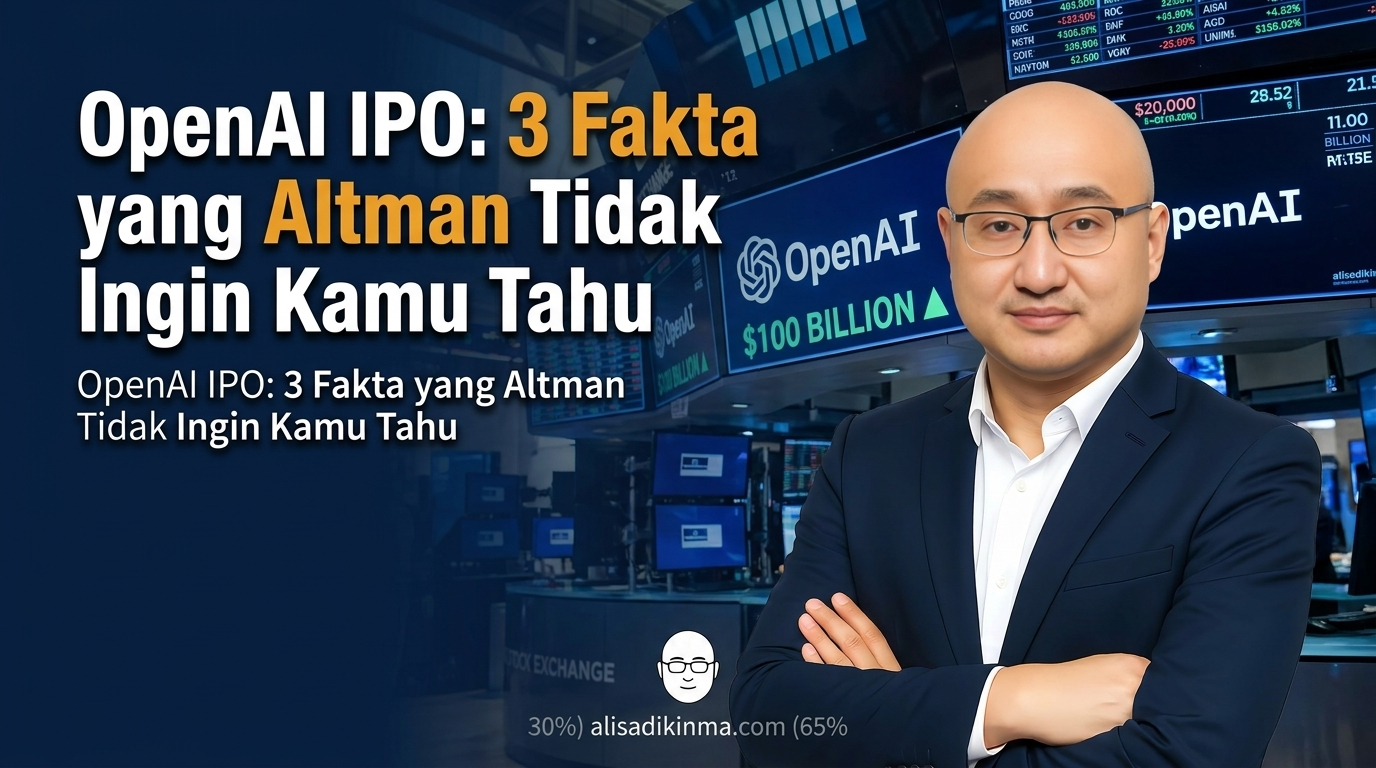
OpenAI wants to “benefit humanity.”
Its IPO tells a different story.
But before you write this off as just another financial news cycle, there are three facts you need to know — and they’re all buried in data that hasn’t made it into many headlines.
OpenAI Wants AI for Everyone — But the IPO Says Otherwise
On May 22, 2026, OpenAI filed a confidential S-1 with the SEC. On June 8, 2026, they announced it publicly. The target: a valuation between $852 billion and $1 trillion, with Goldman Sachs and Morgan Stanley as lead underwriters. If it pulls it off, the OpenAI IPO will be the largest in history — twice the record set by Saudi Aramco’s 2019 IPO at $25.6 billion.
Sam Altman called it a generational shift. “Every few generations, a new technology changes everything. This is happening again with AI,” he wrote in an official statement, quoted by SQ Magazine, June 2026.
But there are three questions that haven’t been answered.
What does “AI for everyone” mean when the company building it is chasing a valuation equal to the GDP of a developed nation?
Why is a company that loses $1.22 for every dollar it makes considered worth $1 trillion?
And should you — as a retail investor, developer, or ChatGPT user — be excited or worried?
Those three questions deserve honest answers. The answers are in data that most headlines aren’t writing about.
The ‘AI Democratization’ Narrative Behind a $1 Trillion Filing
The OpenAI IPO is more than just a standard stock listing. This is the biggest public bet in tech history — and the “AI for everyone” mission is at the center of it. Pew Research Center found that 34% of US adults were already using ChatGPT as of early 2025, including 58% of people under 30 (survey conducted February–March 2025, n=5,123).
CFO Sarah Friar was explicit about this on CNBC, April 2026: “AI needs to garner trust in everything that we do. It has to be that everyone partakes, that it isn’t just that a very small group, and everyone else gets left behind.”
But hold on:
In February 2026, Sam Altman stood on stage at the AI Impact Summit 2026 in New Delhi and said it directly: “Centralization of AI in one company or country could lead to ruin.”
His own company is now filing a $1 trillion OpenAI IPO.
This isn’t just rhetorical irony. It’s a question that needs answering before you decide anything about this IPO.
And before we get into what you should actually do — there are three facts you need to understand first. But before that, let’s look at the financials that rarely make the headlines.
A Company Losing $1.22 Per Dollar Is Asking for a $1 Trillion Valuation
OpenAI reported a negative operating margin of -122% in Q1 2026. For every dollar coming in, the company spends $1.22. The operating loss for that quarter alone reached approximately $6.95 billion, according to The Statesman 2026. This isn’t a one-off anomaly — it’s a trend that’s projected to continue.
Projections from Deutsche Bank and The Information put OpenAI’s total cumulative non-GAAP losses through 2029 at $44 billion. Meanwhile, GAAP figures that the media rarely covers are much larger: $25–26 billion per year, roughly 80% higher than the $14 billion figure that usually gets cited in headlines — per FutureSearch analysis quoted by Indmoney.com.

And there’s more:
HSBC estimates OpenAI will need more than $207 billion in additional capital through 2030 just to stay on its current trajectory, according to CMC Markets 2026.
And while those numbers keep swelling, OpenAI’s own market position is eroding. ChatGPT’s traffic market share dropped from 86.7% to 64.5% in the 12 months through May 2026. Meanwhile, Google Gemini grew from 5.7% to 21.5% in the same period, according to traffic data quoted by ChatForest.
So a reasonable question follows:
If the numbers are this bad, why are big investors like Amazon ($50 billion), SoftBank ($30 billion), and Nvidia ($30 billion) still willing to come in during the March 2026 funding round — recorded as the largest private capital raise in history at $122 billion?
Even so, investor interest in the OpenAI IPO hasn’t faded. The answer lies in three facts that haven’t gotten much public attention.
3 Hidden Facts Inside OpenAI’s S-1
OpenAI’s S-1 hasn’t been fully released to the public yet. But from the data that’s already leaked into various analyst reports, there are three things you need to understand before talking about this OpenAI IPO. Each fact ties directly to how large the risk actually is — and who gets hit the hardest.
Fact 1: OpenAI’s Enterprise Dominance Isn’t What It Used to Be
In 2023, OpenAI owned 50% of all enterprise LLM API spend. As of December 2025, that number had dropped to 27%, according to SQ Magazine 2026 data. Meanwhile, Anthropic climbed from 12% to 40%. Google went from 7% to 21% in the same period.
In the AI coding segment, it’s even more extreme. OpenAI holds just 21% market share. Anthropic controls 54% — driven by rapid enterprise adoption of Claude Code.
What does that mean for you?
This $1 trillion valuation is based on the assumption of continued dominance. But the data from the past two years tells the opposite story: competitors are catching up fast, and in critical segments they’ve already pulled ahead. The question for prospective investors: what’s a fair price for a company that’s been consistently losing its enterprise position?
Fact 2: OpenAI’s Business Model Is Shifting to Ads
OpenAI launched its advertising business on May 5, 2026. Within six weeks, annualized revenue from ads had crossed $100 million. Internal projections put the target at $2.5 billion in 2026, $11 billion in 2027, and $100 billion in 2030 — according to ChatForest OpenAI IPO Guide, May 2026.
That $100 billion ads target for 2030 is not a small number. It’s significantly larger than the projected subscription revenue.
Here’s the question:
If the primary monetization model shifts to ads, then ChatGPT user data and developer API data become the main commercial asset. A public company under pressure to hit quarterly earnings doesn’t have many reasons to hold back from optimizing that asset.
OpenAI’s inference cost is itself projected to rise 68% to $14.1 billion in 2026 from $8.4 billion in 2025, per Sacra data quoted by Indmoney.com. Gross margins are stuck around 33%. Ads are one way out of this margin squeeze — but with significant consequences for developers and users.
Fact 3: A Governance Risk With No Precedent in US Markets
OpenAI isn’t your typical tech company. Its structure is unique: the OpenAI Foundation nonprofit still holds roughly 26% of shares in the public benefit corporation that’s going public. Microsoft holds approximately 27% plus a 20% revenue share that stays in place. Nothing like this structure has existed in US public markets before.
And there’s another layer of risk:
Elon Musk sued OpenAI seeking $134 billion in damages over its nonprofit-to-for-profit conversion. The US House Oversight Committee is investigating Sam Altman’s conflicts of interest — specifically undisclosed personal investments in Helion Energy and Stoke Space, two companies OpenAI had considered investing in. Total legal exposure is estimated between $500 million and $5 billion, per CryptoBriefing May 2026.
For institutional investors, this is a massive wildcard. For global regulators — including those in Indonesia — it’s a reason to pay close attention to who ultimately holds control over AI infrastructure used by hundreds of millions of people.
Should You Join the OpenAI IPO? Here’s How to Think About It
Polymarket gives 77% odds that the OpenAI IPO closes before December 31, 2026, but only 30% odds before September 30, 2026. Trading volume on these predictions reached $1.9 million as of June 10, 2026. Translation: the IPO is likely happening this year, but no one knows exactly when.
And public interest is very real. In the March 2026 private round, individual investors put in more than $3 billion — three times the $1 billion OpenAI itself had expected, according to Bloomberg quoted by Let’s Data Science.
The right way to think about this depends on where you stand.
If you’re a retail investor looking to buy: the main question isn’t “will OpenAI survive?” It probably will. The question is whether the IPO price already reflects all the risks above. Greg Jensen of Bridgewater Associates called it already “priced for a monopoly outcome that does not yet exist” — per Financial Times, April 2026.
If you’re a developer relying on the OpenAI API: the shift to an ad-based business model is a signal you should be watching right now. Diversifying API access to Anthropic or Google AI Studio is a sensible move to start today, before quarterly earnings pressure changes the platform’s priorities.
If you’re just a ChatGPT user: there’s no direct path to join the OpenAI IPO right now. Secondary markets like EquityZen or Forge are available for pre-IPO investing, but with high minimum investments and far greater liquidity risk than regular stocks.
The Real Question Behind ‘Open AI Access’
The global AI market was valued at $390.9 billion in 2025 and is projected to reach $3.5 trillion by 2033 — 8.9x growth in eight years, per Paper Trading Journal IPO Statistics 2026. Amid that kind of growth, OpenAI is betting everything.

OpenAI’s valuation has grown roughly 85,000% from around $1 billion in 2019 to $852 billion in 2026. This OpenAI IPO isn’t just a financial event.
It’s the first test of a much bigger question:
Can a public market be forced to serve a mission — or will public markets ultimately force that mission to serve quarterly earnings?
Altman himself said in New Delhi, February 2026: “by the end of 2028 more of the world’s intellectual capacity could reside inside data centers than outside.” If that happens, who controls those data centers becomes a far bigger question than stock price movements.
The OpenAI IPO isn’t about whether Altman’s mission is genuine. That’s the wrong question.
The right question: will the incentive structure of public markets let that mission survive when shareholders are demanding profit at every quarterly meeting? That answer doesn’t exist yet — and that alone is the strongest reason to follow this very closely.
FAQ: OpenAI IPO — The Most Common Questions
When Will the OpenAI IPO Happen?
OpenAI hasn’t announced an official IPO date. Polymarket gives 77% odds that the OpenAI IPO closes before December 31, 2026, but only 30% odds before September 2026. OpenAI itself has stated it “hasn’t decided on timing” because some things are easier to resolve as a private company first, per Motley Fool June 2026.
Can Indonesian Retail Investors Participate in the OpenAI IPO?
No direct investment path has been announced. Current options are pre-IPO secondary markets like EquityZen or Forge, with high minimum investments and greater liquidity risk. Once the official IPO happens, OpenAI shares could be purchased through brokers that provide access to the US stock market, such as Interactive Brokers or Webull.
Will OpenAI Reach Profitability After the IPO?
Not anytime soon. According to projections from Deutsche Bank and The Information, OpenAI isn’t expected to reach profitability until around 2030. Total cumulative non-GAAP losses are projected to reach $44 billion between 2026–2029, with inference costs alone rising 68% to $14.1 billion in 2026.
Want OpenAI IPO analysis and the latest AI developments delivered straight to your inbox? Subscribe to our newsletter now.
Or bookmark this article first — this perspective will be far more relevant once the OpenAI IPO date is officially announced and the opening price is set.