OpenAI GPT-Realtime-2: Voice AI That Can Finally Think
By Ali Sadikin Ma · · Updated
Category: Technology
Voice AI has always been great at talking. Never great at thinking.
That's not a criticism. It's a technical reality the whole industry has accepted for years. You can build a voice AI that sounds exactly like a real human — perfect intonation, natural conversation rhythm, responses in milliseconds. But ask it to follow multi-step instructions? Handle unexpected exceptions? Make decisions mid-conversation when things get complex?
It'll fail.
Not because the voice isn't good. But because its reasoning is on par with a kindergartener.
GPT-Realtime-2 just changed that. And the changes OpenAI shipped in May 2026 are bigger than most developers realize.
But before we get into it: what exactly changed? How significant is the improvement — real change or just marketing? And is this relevant to the voice product you're building?
Why Voice AI Has Always Thought Like a Toddler
The problem isn't in the audio. It's in the architecture.
Previous-generation voice models — including GPT-Realtime-1.5 — were designed around one primary priority: low latency. The model had to respond in hundreds of milliseconds to keep conversations feeling natural. The trade-off? A very limited reasoning budget.
Picture this:
GPT-4 can write complex legal briefs. Can write code, debug problems, analyze multi-page contracts. But the voice version — which was supposed to be "GPT-4 that can talk" — can't follow five-step instructions without getting lost at step three.
That's not hyperbole. It's documented technical limitation that's been a real barrier in production for a long time.
Any developer who's built a voice agent knows this scenario: you deploy, the user starts talking, and suddenly the agent "forgets" instructions from two turns ago. Or worse — calls the wrong tool because it can't track context across a long conversation.
You're not the problem. The architecture is. And the root of that architectural problem is actually simple — which is exactly what OpenAI just fixed.
Before we get there, you need to see just how big the leap actually is.
The Numbers That Prove Something Really Changed in OpenAI GPT-Realtime-2
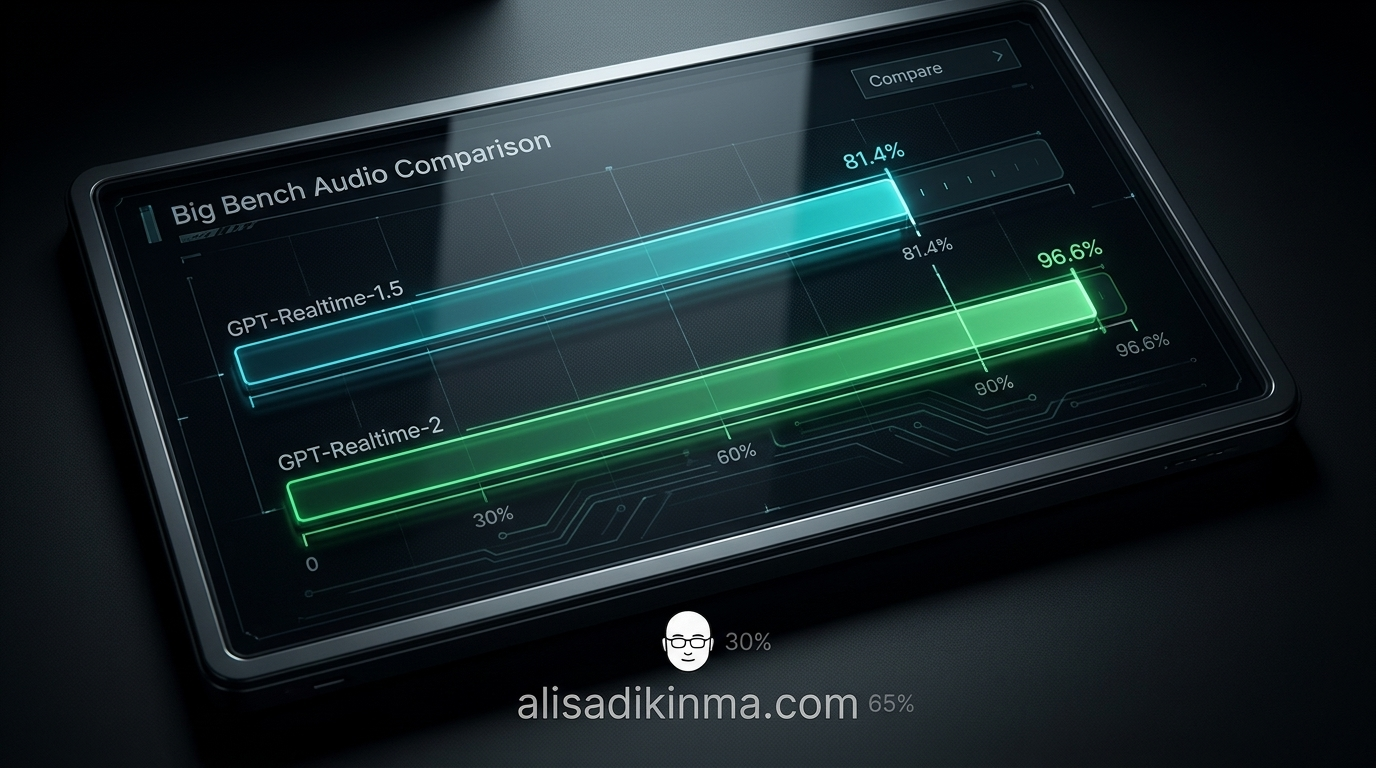
GPT-Realtime-2 launched in May 2026, and its benchmarks show changes that can't be ignored. On Big Bench Audio — one of the toughest benchmarks for audio reasoning — the model scored 96.6% accuracy on 'high' reasoning settings. Its predecessor, GPT-Realtime-1.5, only got 81.4%. That's a 15.2 percentage point jump, according to The Decoder. Not statistical noise.
But the more relevant benchmark for developers is Audio MultiChallenge — the closest thing to real-world production conditions, with layered instruction-following. GPT-Realtime-2 on 'xhigh' settings hits a 48.5% pass rate, up from 34.7% on the previous model — a 13.8 percentage point improvement.
And these two numbers are what you'll feel most directly in production:
18.6 percentage point improvement in instruction-following accuracy. 12.9 percentage point improvement in tool-calling accuracy. These are from OpenAI's internal evaluations — meaning on the two most critical tasks for production voice agents, this model is substantively more reliable than its predecessor.
There are five reasoning levels you can tune per-request — and the choice you make here can reshape your entire product architecture. We'll cover that in the next section, plus one pricing number that might surprise you.
5 Concrete Things That Are Different Now
1. Reasoning is tunable per-request
GPT-Realtime-2 is the first voice model to expose tunable reasoning depth at inference time. There are 5 levels: minimal, low, medium, high, xhigh. The default is 'low' — optimized for low latency, according to The Decoder.
How to use it: set the reasoning level parameter in your API call based on the request type. Want ultra-fast responses for simple FAQs? Use 'low'. Want the model to handle complex multi-step orchestration? Bump it up to 'high' or 'xhigh'.
Real example: a call center using GPT-Realtime-2 can set 'low' for initial greetings and identity verification (sub-500ms response), then auto-switch to 'high' when the customer moves into a complex dispute topic that needs reasoning across policy and account history.
The result: you don't have to choose between "fast but dumb" or "smart but slow" anymore. You pick both — per-request. This is the first time any voice platform has offered this control at inference time.
2. Four times more memory
The context window jumped from 32,000 to 128,000 tokens — four times the previous generation, based on OpenAI data via The Decoder and VentureBeat (May 2026).
How to use it: long conversations can now be held in a single session without context loss. A customer service voice agent can remember the full support ticket history, user preferences, and conversation details across one long call.
Real example: a medical intake voice agent that needs to track 20+ symptom details, medical history, and allergies in one conversation — everything now fits in the new context window. Before, this required complicated external memory workarounds.
The result: conversations that felt choppy and mid-session "amnesia"? That's an old-generation problem.
3. 70+ languages, real-time, one pipeline
GPT-Realtime-Translate can handle speech translation from 70+ input languages to 13 output languages in real-time, according to TechCrunch (May 7, 2026).
How to use it: it integrates directly with the Realtime API — no separate translation pipeline needed. One API call, one model, multilingual end-to-end.
Real example: a global customer support platform that previously needed 3 separate models (STT → translate → TTS) can now handle Indonesian to Mandarin within a single latency budget — with full reasoning context throughout the conversation.
The result: infrastructure costs drop, latency decreases, and translation quality improves because the model has reasoning context to handle idioms and conversational nuances accurately.
4. Instruction-following you can finally trust
18.6 percentage point improvement in instruction-following accuracy — from OpenAI's internal evaluations. This is the metric you'll feel most directly in day-to-day production.
How to use it: the model can now track complex branching instructions without getting lost. It can follow long system prompts consistently, even after a conversation runs dozens of turns deep.
Real example: a sales voice agent that has to follow a strict compliance script — but also needs to adapt naturally to varied customer responses — used to be a source of bugs that ate up days of developer time. Now the behavior is far more predictable and testable.
The result: enough confidence to ship a voice agent to production without workarounds or manual oversight that drains your team's resources.
5. The price went down, not up
GPT-Realtime-2 is priced at $32 per million audio input tokens and $64 per million audio output tokens — about 20% cheaper than the previous Realtime API, according to The Decoder.
How to use it: you upgrade to a significantly smarter model and pay less. This almost never happens in the AI industry — usually capability goes up, and prices follow.
Real example: a startup that previously had to limit voice features to the most basic scenarios because of cost concerns now has headroom to scale into more complex use cases without worrying about a billing shock at the end of the month.
The result: the budget that used to be your excuse to push voice features down the roadmap? That's no longer a valid blocker for getting started.
What Does This Mean If You're Building a Voice Product?
So what does all this mean for people actively building voice products?
Think about the last conversation flow in your product that failed — not because of latency, not because of accent, not because of audio quality — but because of reasoning. The model didn't understand complex instructions. Got lost mid-way through a multi-step flow. Called the wrong tool because it couldn't track context across a long conversation.
That's not a problem you can solve with fine-tuning or longer prompt engineering. That's an architectural limitation of the previous model.
GPT-Realtime-2 directly addresses that.
The most concrete proof: Zillow. They're already using GPT-Realtime-2 for complex voice interactions, and they've reported significant improvements in call success rates and compliance robustness — the two metrics that are hardest to achieve in voice AI production, according to the OpenAI Realtime API Production Guide 2026 by forasoft.com.
Compliance robustness is an important metric. It means the model can consistently follow regulatory scripts without hallucinating or skipping steps. In regulated industries — fintech, healthcare, real estate — that's not a nice-to-have. It's a prerequisite for shipping to production.
Voice AI developers have always had to make a painful compromise between speed and reasoning quality. At least one of those major compromises doesn't need to be made anymore.
How to Start Using GPT-Realtime-2 Today

GPT-Realtime-2 is live on the OpenAI API. Access it via the same Realtime API endpoint — just update the model parameter to gpt-realtime-2. No waiting list, no special beta access.
Start with reasoning level 'low'. Measure latency for your specific use case first. If response quality isn't cutting it for the task at hand — bump up to 'medium', measure again. Iterate from there until you find the sweet spot between latency and reasoning quality.
Don't just set everything to 'xhigh' right away. That level is for heavy reasoning scenarios: complex multi-step orchestration, compliance-critical conversations, situations where the model needs to track many instructions at once. For FAQs and simple queries, 'low' is more than enough and way faster.
Remember this:
What OpenAI just gave voice AI that GPT-4 never had — it's live, it's in the API, and it costs less than the previous version.
The question isn't whether you should upgrade. The question is: which conversation flow in your product is losing the most because of reasoning failure? That's where you start.
Try GPT-Realtime-2 now via the OpenAI API — start with reasoning level 'low' and measure the latency in your own product.
Or save this article before your next sprint planning session — it'll change how you prioritize voice features on your roadmap.
FAQ — Most Common Questions
Is GPT-Realtime-2 available to all developers?
Yes. GPT-Realtime-2 is live on the OpenAI API as of May 2026. You can access it via the same Realtime API endpoint by updating the model parameter. It's priced at $32 per million audio input tokens and $64 per million audio output tokens — about 20% cheaper than the previous version, according to The Decoder.
Will a higher reasoning level make responses slower?
There is a latency trade-off. The 'low' default is optimized for fast responses. The higher the reasoning level, the longer the response time. But that's exactly what makes the flexibility unique — you can pick the right reasoning level per request type, not one size for every use case at once.
What use cases are the best fit for GPT-Realtime-2?
The use cases that benefit most are the ones that previously failed because of reasoning, not audio quality: complex customer service, compliance-critical conversations, multi-step voice agent orchestration, and multilingual real-time support. Zillow has already proven this for real estate voice interactions in 2026, with significant improvements in call success rates and compliance robustness.