OpenAI Codex vs Claude Code: These Numbers Change Everything
By Ali Sadikin Ma · · Updated
Category: Technology
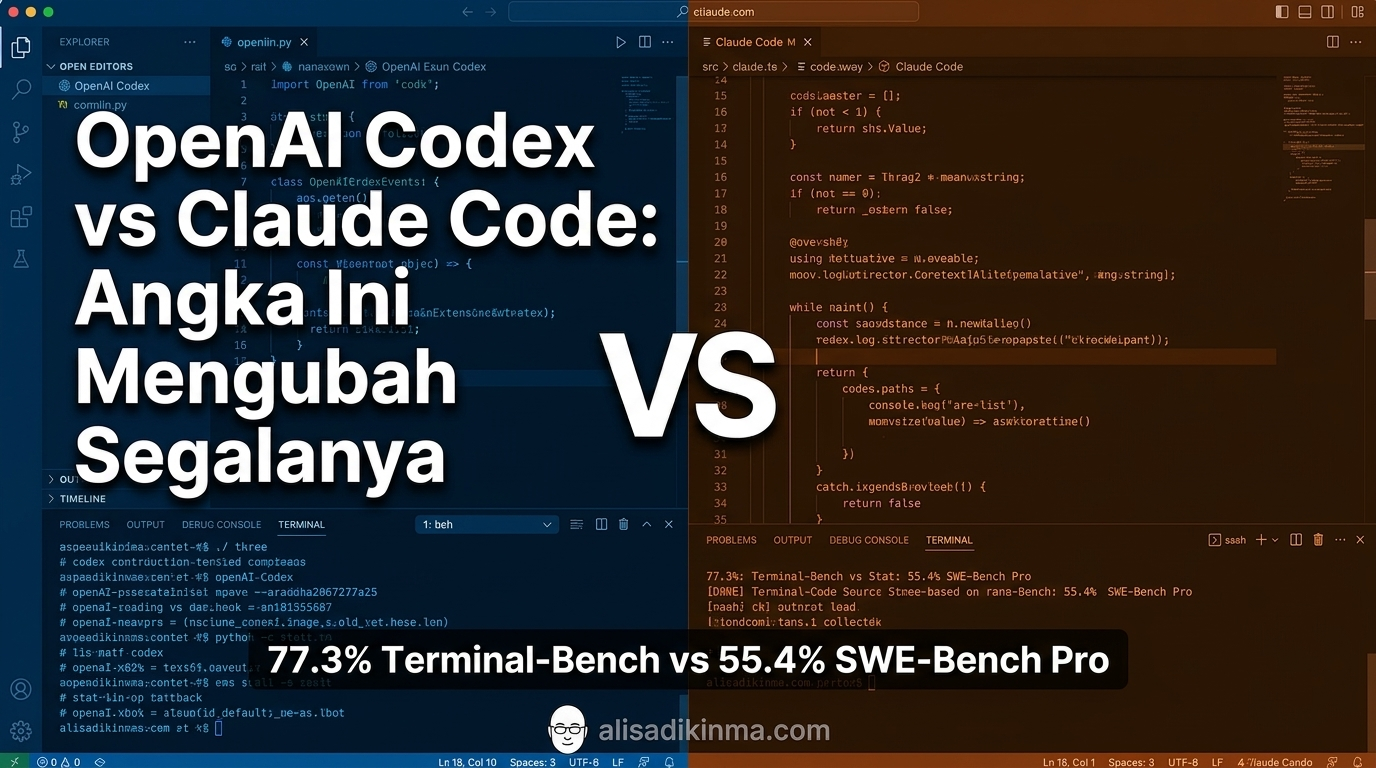
GPT-5.3-Codex has surpassed Claude for the first time on key benchmarks — Terminal-Bench (77.3%) and SWE-Bench Pro (56.8% vs Claude Opus 4.6's 55.4%) — while Codex grew from 5% to 40% of Claude Code's user base in four months. Neither 'Claude Code is finished' nor 'nothing to worry about' is the right read. The article argues the most productive developers in 2026 use both tools strategically: Codex for speed-critical tasks and parallel agents, Claude Code for deep reasoning and complex debugging.
Codex grew from 5% to 40% of Claude Code's user base in just four months.
OpenAI is no longer playing catch-up. They're already out front.
For developers who've gone all-in on Claude Code, that number should be unsettling. For those just starting to pick an AI coding tool, it makes the choice even more confusing. And for anyone who's heard the OpenAI Codex vs Claude Code debate but doesn't know who to trust — this article answers with data, not hype.
But before we get there, there's a question that matters a lot more than just who's winning today.
Almost everyone is betting on the wrong story. There are two camps that are both wrong about what's actually happening. And if you follow either one, you'll pick the wrong tool at the most critical moment for your career and productivity.
First, let's look at the numbers that should change how you see this competition.
The Numbers That Should Change Your Decision
Between September 2025 and January 2026, Codex climbed from roughly 5% to about 40% of Claude Code's user base, according to Reuters as cited by The New Stack. At the same time, Codex npm downloads exploded 177x in a year — from 82,000 in April 2025 to 14.53 million in March 2026, according to gradually.ai.
Sam Altman confirmed it himself on April 8, 2026: Codex already has 3 million weekly users. That's not a normal number for any developer tool.
For context: a tool reaching millions of active developers in under a year almost never happens in the developer tools world. Codex did it with a growth rate faster than nearly any tool before it.
That's not noise. It's the first signal of a much bigger shift.
But there are two wrong ways most people interpret this signal — and both are dangerous.
Two Wrong Narratives That Keep Circulating
Two narratives dominate the discussion around this battle — and both miss the mark. Camp one says Claude Code is done. Camp two says Codex is just catching up and there's nothing to worry about yet. The data doesn't support either.
Here are the facts:
Claude Code still has 112,297 GitHub stars. Codex CLI sits at 74,468. That gap isn't small. On top of that, Claude Code is generating a $2.5 billion annualized run rate with 135,000 GitHub commits flowing through its platform every day, according to WaveSpeedAI 2026.
Those aren't metrics from a dying product. Not even close.
But if you think those numbers mean Claude Code is sitting comfortably with no serious threat? Think again.
Both camps are missing a far more important story. And that story is in the latest benchmarks OpenAI just released — benchmarks that, for the first time, put Codex ahead of Claude.
Why This Isn't the Final Blow
Claude Code leads in one metric that's hard to buy: developer engagement. A survey of 500+ developers in early 2026 showed Claude Code generating 4x more discussion than Codex CLI — even though 65% of respondents listed Codex as their raw preference, according to buildfastwithai.com.
What does that mean?
Developers using Claude Code are more engaged. They're not just dabbling — they're investing more time, discussion, and trust. In the developer community, that depth of engagement is a lot harder to displace than a preference survey.
On GitHub, Claude Code has 112,297 stars vs Codex CLI at 74,468 vs Gemini CLI at 100,857, according to NxCode. Star counts are a lagging indicator — but a gap this size doesn't disappear overnight, even with Codex's aggressive growth rate.
But something changed with GPT-5.3-Codex that makes all of that defense more fragile than it used to be.
For the first time, Codex has benchmark numbers that beat Claude. And those numbers are real.
What Actually Changed with GPT-5.3-Codex
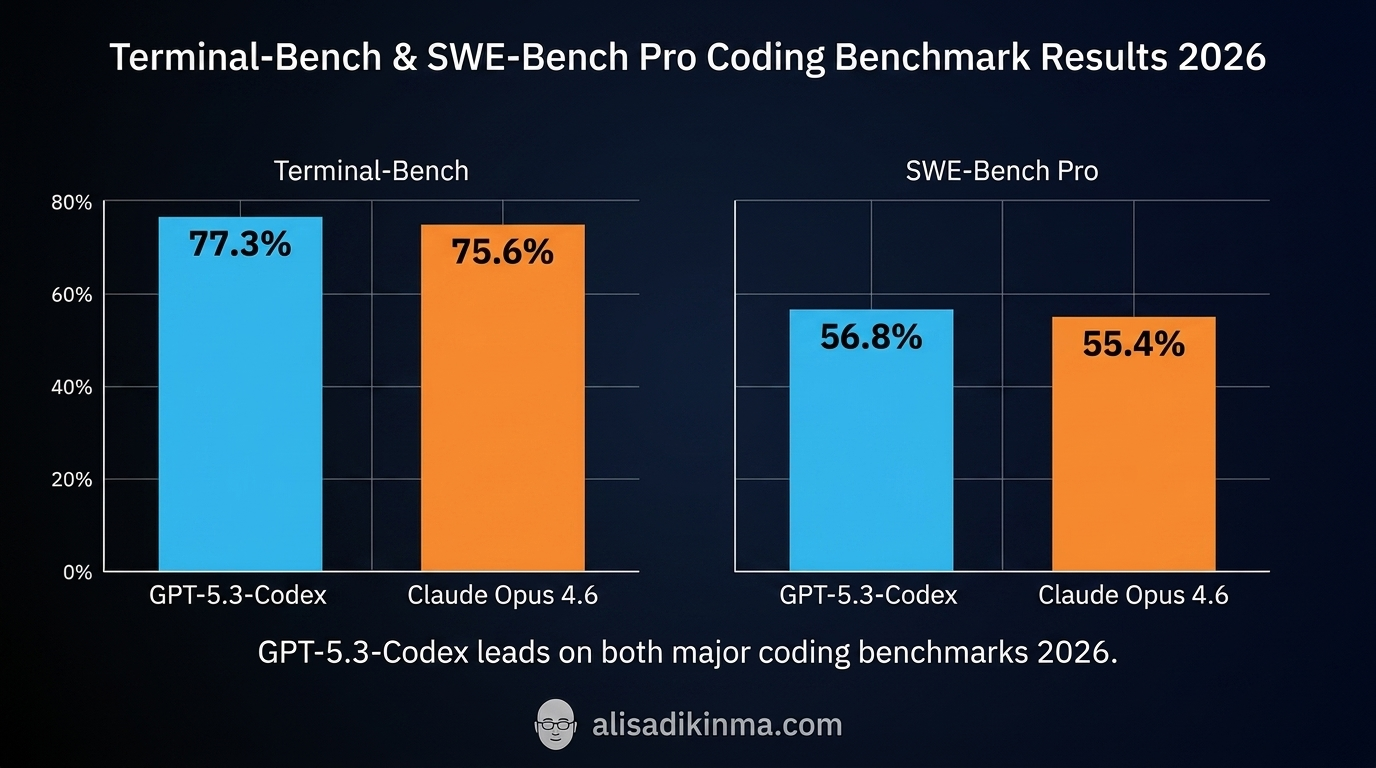
GPT-5.3-Codex scored 77.3% on Terminal-Bench — the highest score ever achieved by any AI coding model tested. On SWE-Bench Pro, the real-world software engineering benchmark, Codex got 56.8% vs Claude Opus 4.6 at 55.4%. This is the first time Codex has passed Claude on the most rigorous benchmark, according to official OpenAI data and morphllm.com 2026.
A 1.4-point gap. Not a chasm. But this is the first time Codex has been ahead — and that alone is enough to shift the conversation.
What matters even more:
GPT-5.3-Codex runs at 240+ tokens per second. That's 2.5x faster than Claude Opus under similar conditions. For workflows using parallel agents or requiring fast iteration, this speed difference isn't a minor detail — it changes the entire experience of using an AI coding agent.
Three concrete things changed with this update:

1. Execution speed is now a real competitive advantage
This isn't just a number on paper. GPT-5.3-Codex produces output 2.5x faster than Claude Opus under similar conditions, according to official OpenAI benchmark data 2026. In the developer world, speed isn't a luxury — it's a multiplier for your entire workflow.
How it plays out in practice: for tasks that need multiple iterations — debug loops, generate-test-fix cycles, repetitive refactoring — higher speed means you can run more cycles in the same hour. Not twice as smart, but twice as many attempts in the same time. And in software development, more attempts almost always win.
Imagine a team that normally ships one PR a day. With a tool that's 2.5x faster on iteration loops, they could potentially move to two PRs a day — not because the AI understands code better, but because wait time at every step from generate to review drops dramatically. Those small friction points that multiply across every step are what's been slowing them down.
Developers who've switched to Codex for speed-critical tasks report immediate productivity gains, especially for scaffolding new components and boilerplate generation in large codebases. This isn't anecdotal — it's a pattern that shows up repeatedly in 2026 reviews.
2. Terminal-Bench 77.3% — the number most relevant to your daily work
Terminal-Bench isn't some academic benchmark divorced from reality. It measures AI performance on real terminal tasks — actual operations developers do every day: running scripts, debugging command-line tools, setting up automated pipelines, working with file systems and environment variables.
A score of 77.3% from GPT-5.3-Codex means the model successfully completed 77 out of 100 real terminal tasks correctly — a range previously dominated by Claude. This isn't a lab score optimized for the benchmark. OpenAI confirmed this as the highest score ever achieved by any AI coding model tested on this benchmark.
The concrete use cases Terminal-Bench measures: debugging complex bash scripts with nested conditions, automated environment setup for deployment, running multi-step pipelines that need to work without manual intervention, and orchestrating multiple CLI tools simultaneously. These aren't rare edge cases — this is what terminal-heavy developers do every day.
If most of your work time is in the terminal, this benchmark is directly relevant to the tool decisions you're making today — not as supplementary data, but as the primary signal.
3. SWE-Bench Pro: the first time Codex has surpassed Claude on real-world engineering
SWE-Bench Pro is the benchmark that's hardest to game. It measures an AI's ability to resolve real GitHub issues from active open-source projects — not practice problems, not synthetic tasks, but issues that existed in actual production code.
GPT-5.3-Codex scored 56.8%. Claude Opus 4.6 scored 55.4%. A 1.4-point gap — slim, but the shift is historic. This is the first time since Codex existed that an OpenAI model has surpassed Claude on a benchmark measuring real-world software engineering capability.
What SWE-Bench Pro concretely measures: assigning the AI to GitHub issues that require multi-file context understanding, changes spanning multiple modules at once, and output that must pass the automated tests already in the repository. This is the closest scenario to actual developer work.
This isn't something that can be dismissed as hype or benchmark gaming. For the first time, there's a model that has surpassed Claude on the most rigorous measure of real-world software engineering. That's a milestone that changes the conversation.
What the Best Developers Are Actually Doing — And What You Should Do
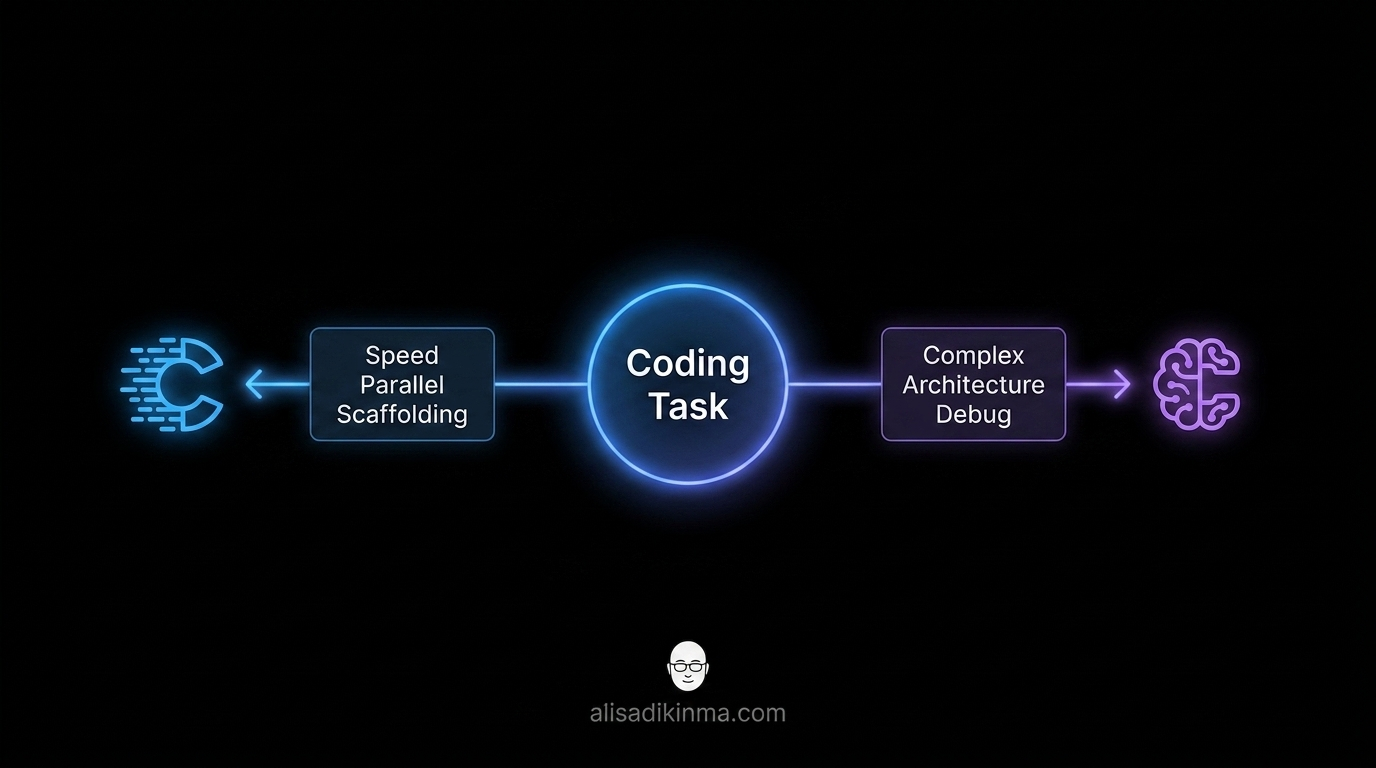
The most productive developers in 2026 aren't picking one tool. They're picking per task. According to morphllm.com's review of 15 AI coding agents in 2026, the most consistent pattern among top-performing developers is using Codex for speed-critical work and parallel agents, and Claude Code for complex reasoning and deep debugging that requires long context.
Here's how it works in practice:
1. Define the task type before opening any tool
Before you start coding, ask one simple question: does this task need speed or depth? It sounds simple, but it's the decision most developers skip — and that's exactly what makes them frustrated with tools that are actually right for different tasks.
Speed tasks are a fit for Codex: scaffolding new features, generating boilerplate, quick bug fixes, creating multiple parallel branches for experiments, generating test suites for existing code. Depth tasks are a fit for Claude Code: debugging complex and subtle logic, architecture review in an unfamiliar codebase, analyzing trade-offs between approaches, or understanding someone else's code with long context.
Several engineering teams across various 2026 reviews reported the same pattern: use Codex in the first sprint for fast feature scaffolding, then switch to Claude Code in the second sprint for code review and refactoring that needs deep reasoning. Not picking one forever — using both in the right place within the same lifecycle.
The result: time per feature goes down not because one tool is objectively better, but because you're using the right tool at the right moment. That's the difference between a productive developer and one who wastes time arguing about tools.
2. Test both on your own codebase first — don't just trust the benchmarks
Terminal-Bench and SWE-Bench Pro are valid, but they're measured in conditions that might differ from your work patterns. A developer working in a large legacy codebase will have a very different experience from one building greenfield projects. The only way to know which fits you better is to test it directly.
It's simple: take one task you do regularly this week. Run it in Codex. Save the results. Run the identical task in Claude Code. Compare three things: the quality of the first output before you edit it, how much editing you need to do, and the total time from prompt to usable output.
A backend developer who regularly debugs microservices might find Claude Code better for long, multi-file context — but Codex is faster and good enough for generating test boilerplate or setting up a new config. That's an insight you won't get from any benchmark.
In a single 30-minute testing session, you'll have personalized data that's far more immediately useful than Terminal-Bench or SWE-Bench Pro for the tool decisions you make every day. Those 30 minutes are worth it.
The One Factor That Decides the Real Winner
Remember that 5% to 40% number?
That's not just a nice growth metric for a slide deck. It's a sign that 90% of Fortune 100 companies already using OpenAI products — according to the OpenAI developer report 2025 — now have an existing distribution path to adopt Codex into their internal workflows without starting from scratch.
Claude Code wins on developer grassroots — community, engagement, GitHub stars. Codex wins on the enterprise distribution pipeline already installed at thousands of large companies.
And enterprise distribution is the real battleground in the AI coding war. Not GitHub stars. Not lab benchmarks.
Here's what that means for you:
If you're an individual developer or at a startup — you have the freedom to pick the best tool per task without internal politics. Use that freedom. Don't lock yourself into one tool out of habit when two tools together could make you far more productive.
If you're at a large company — the tool decision may not be entirely yours to make. But understanding these trade-offs means you can argue with data and concrete numbers, not just personal preferences that are hard to defend in a meeting.
The OpenAI Codex vs Claude Code battle isn't over. But the terrain has shifted. Developers who understand the difference now will be far better prepared for the next shift.
Which tool are you betting on for your next sprint — and have you actually tried the other one on the same task?
FAQ: OpenAI Codex vs Claude Code in 2026
Is GPT-5.3-Codex now better than Claude Code?
It depends on the metric. On Terminal-Bench (77.3%) and SWE-Bench Pro (56.8%), GPT-5.3-Codex now edges out Claude Opus 4.6 at 55.4%. On speed, Codex is 2.5x faster. But Claude Code leads on developer engagement — 4x more discussion — and GitHub stars: 112,297 vs 74,468. There's no single answer — it all depends on the task you're working on.
What makes GPT-5.3-Codex different from previous versions?
GPT-5.3-Codex is the first time OpenAI has surpassed Claude on a real-world software engineering benchmark (SWE-Bench Pro: 56.8% vs 55.4%). It also scored Terminal-Bench 77.3% — the highest score ever for any AI coding model. Output speed is 240+ tokens per second, 2.5x faster than Claude Opus. This is a real competitive shift, not an incremental update.
Should developers switch from Claude Code to Codex right now?
You don't have to pick one. The most productive developers in 2026 use both based on the task — Codex for speed-critical work and parallel agents, Claude Code for complex reasoning and deep debugging. Try both on your own codebase for 30 minutes. The results will be more reliable than any lab benchmark for your specific work patterns.
Try Codex for free today — compare it with Claude Code on your own codebase before committing to one tool.
Save this article before your next sprint planning — the AI coding tools landscape just changed, and your team needs to know.