OpenAI Codex AI Coding Agent in ChatGPT: What's Changed
By Ali Sadikin Ma · · Updated
Category: AI Vibe Coding
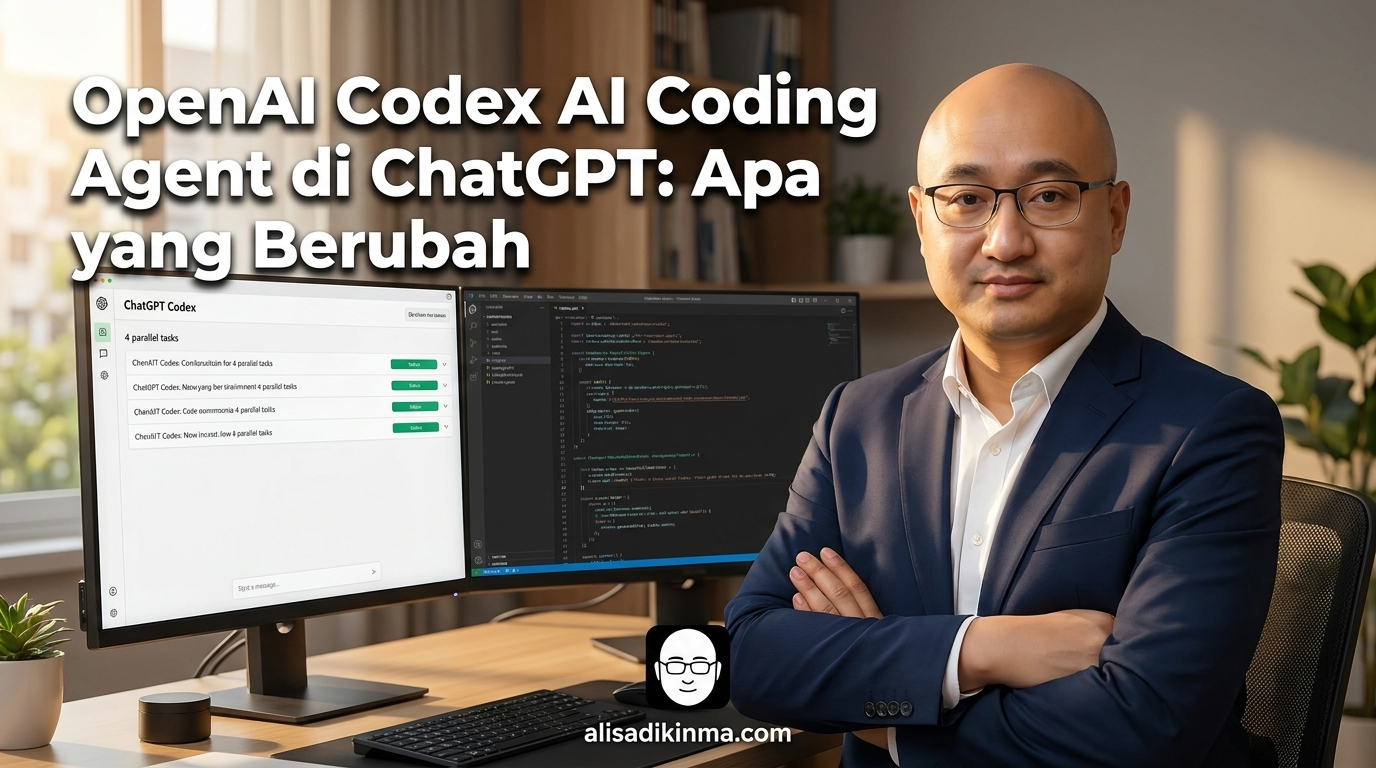
OpenAI Codex is a cloud-based AI coding agent integrated into ChatGPT for Plus and Pro subscribers, powered by codex-1 (a specialized o3 variant). It runs tasks in isolated sandboxes — writing code, debugging errors, reviewing PRs, generating tests — in parallel and in the background without user supervision. Key data: 75% benchmark accuracy (vs. 70% for standard o3), 1–30 minute task completion, 3.5 PRs/engineer/day at Harness over 5 months, and 50% code review time reduction at Cisco. Workplace adoption reached 18% in January 2026, up 6x from 3% the prior year. Human review remains the final gatekeeper, with teams reporting only 10–20% effort needed to approve Codex output before merging.
OpenAI just launched the OpenAI Codex AI coding agent — now living right inside ChatGPT. Your pull requests will never be the same.
Not an exaggeration.
If you're a developer — or you work with developers — there's one question you need to answer before your next sprint kicks off:
Does your team know how the OpenAI Codex AI coding agent actually works?
Because as of March 2026, more than 2 million developers are actively using this tool every week (OpenAI / Wikipedia). And most of them have only scratched the surface of what it can do.
There's one number from an engineering team that'll make you rethink the way your team works right now. We'll get there.
But first — you need to understand what makes Codex different from every AI coding tool you've tried before.
The AI Writing Your Code While You Sleep
As of March 2026, more than 2 million developers are actively using Codex every week according to OpenAI and Wikipedia data. This isn't a chatbot that answers syntax questions. The OpenAI Codex AI coding agent can write code, debug errors, review PRs, and push changes — in parallel, in the cloud, without you having to babysit it.
OpenAI launched the Codex preview in ChatGPT on May 16, 2025. Powered by codex-1, a specialized version of the o3 model fine-tuned specifically for software engineering.
The fundamental difference from previous AI coding tools:
Codex runs in an isolated sandbox environment. You can give it one task — or 10 at once — and let it work in the background. Tasks typically complete in 1 to 30 minutes (OpenAI Introducing Codex).
And that's just the beginning.
This Is How Software Gets Built Now (and Why It's Stressing Teams Out)
Between May and September 2025, GitHub logged more than 1 million pull requests created by AI coding agents — not humans (OpenAI Introducing Codex, 2025). That's a clear signal that the way code gets written is changing much faster than most engineering teams anticipated.
But before we get there, let's be honest about where things stand right now:
Productive developers spend most of their time not writing new features. They're reviewing other people's code. They're debugging the same errors over and over. They're writing boilerplate. They're waiting on approval from busy reviewers.
That's not a skill problem. It's a workflow structure problem that hasn't changed much in 20 years.
That's where OpenAI Codex comes in — not as an assistant that answers questions, but as an agent that handles the repetitive work so developers can focus on the architecture and problem-solving that actually needs a human brain.
But before we dig into what Codex can do:
Cisco has already proven it. And the results were more dramatic than anyone expected.
Why the Old Way of Writing Code Is No Longer Relevant
JetBrains Research 2026 data is blunt: 57% of developers were already aware of Codex in January 2026, up from 31% in April–June 2025. Workplace adoption? 18% are actively using Codex — a 6x increase from just 3% the year before.
That means:
In one year, the share of engineering teams using AI coding agents grew 6x. This isn't a gradual trend. It's a shift that's happening right now, across every industry.
What makes this even more significant:
OpenAI Codex hits a 75% accuracy rate on OpenAI's internal benchmarks — beating the most powerful version of o3 by 5% (IntuitionLabs). This isn't a generic model that happens to write code. It's a model built from the ground up specifically for software engineering.
If you're still working the same way you did in 2023 — one task, one developer, one PR a day — you're playing at a growing disadvantage every single month.
But this isn't bad news. It's an opportunity — as long as you know the 5 things the OpenAI Codex AI coding agent can do right now.
5 Things the OpenAI Codex AI Coding Agent Can Do Right Now
The OpenAI Codex AI coding agent hits 75% accuracy on internal benchmarks and completes tasks in 1–30 minutes, according to OpenAI and IntuitionLabs 2025 data. This isn't a feature list — it's a concrete playbook you can start applying in your next sprint.
1. Run Multiple Tasks in Parallel Without Context-Switching

What: Codex can handle multiple tasks simultaneously in separate environments. Not a queue that processes one at a time — truly parallel, each in its own isolated sandbox.
How: In ChatGPT Plus or Pro, open the Codex panel. Assign several different tasks at once — for example: write unit tests for the auth module, debug an error in the payment endpoint, and refactor the input validation function. All three tasks run simultaneously. You can monitor each one's progress and review the results after they're all done.
Real example: The engineering team at Harness gave Codex batches of bug fixes, test writing, and refactoring tasks — all running in parallel at the same time. The result? Three engineers averaged 3.5 PRs per engineer per day over 5 months (OpenAI Harness Engineering, 2026). Normally, one PR a day is considered productive for a senior engineer.
Outcome: If your team has 5 backlog tasks that can be worked on independently, Codex can finish all of them in the same time it takes to complete one manually. Sprint velocity goes up without adding headcount.
2. Run Automated Code Reviews Before a PR Is Opened
What: Codex can review code in a connected repository and give structured feedback — before the PR ever enters the human review queue.
How: Connect your GitHub or GitLab repository to Codex. Build a standard team prompt template: Review the changes in this branch. Check for logic errors, potential security issues, and alignment with the style guide. Codex generates a per-file report that developers can review before officially opening a PR.
Real example: Cisco used the OpenAI Codex AI coding agent to automate pre-reviews in their engineering pipeline. The result: code review time dropped 50% and project timelines that previously took weeks were cut down to days (getpanto.ai, 2026). Human reviewers only spent time on issues that had already been filtered and prioritized by AI — not starting from scratch.
Outcome: Shorter review cycles. Less back-and-forth in PR threads. Senior engineers focus on the judgment calls that actually require human experience — not the nitpicks that can be automated.
3. Generate a Test Suite from Specs or User Stories
What: Codex can read specs or acceptance criteria and generate complete test cases — including edge cases that often get missed when writing tests manually.
How: Give Codex your spec document or user story from Jira or Notion. Ask Codex to generate a comprehensive test suite, covering unit tests, integration tests, and at least three non-obvious edge cases. Codex generates ready-to-run test files that can be dropped straight into your CI pipeline.
Real example: In OpenAI's internal benchmarks, Codex hit 75% accuracy on coding tasks that include test generation — higher than standard o3's 70% (IntuitionLabs, 2025). Codex is more reliable for this specific task than its own generic model, because it was trained specifically for software engineering workflows.
Outcome: Test coverage goes up without developers needing to carve out dedicated sprint time to write tests. More bugs get caught in CI before they hit production.
4. Systematically Refactor and Document Legacy Codebases
What: Codex can refactor legacy code while generating inline documentation — two tasks that often get avoided because they don't feel urgent but always show up in sprint retrospectives.
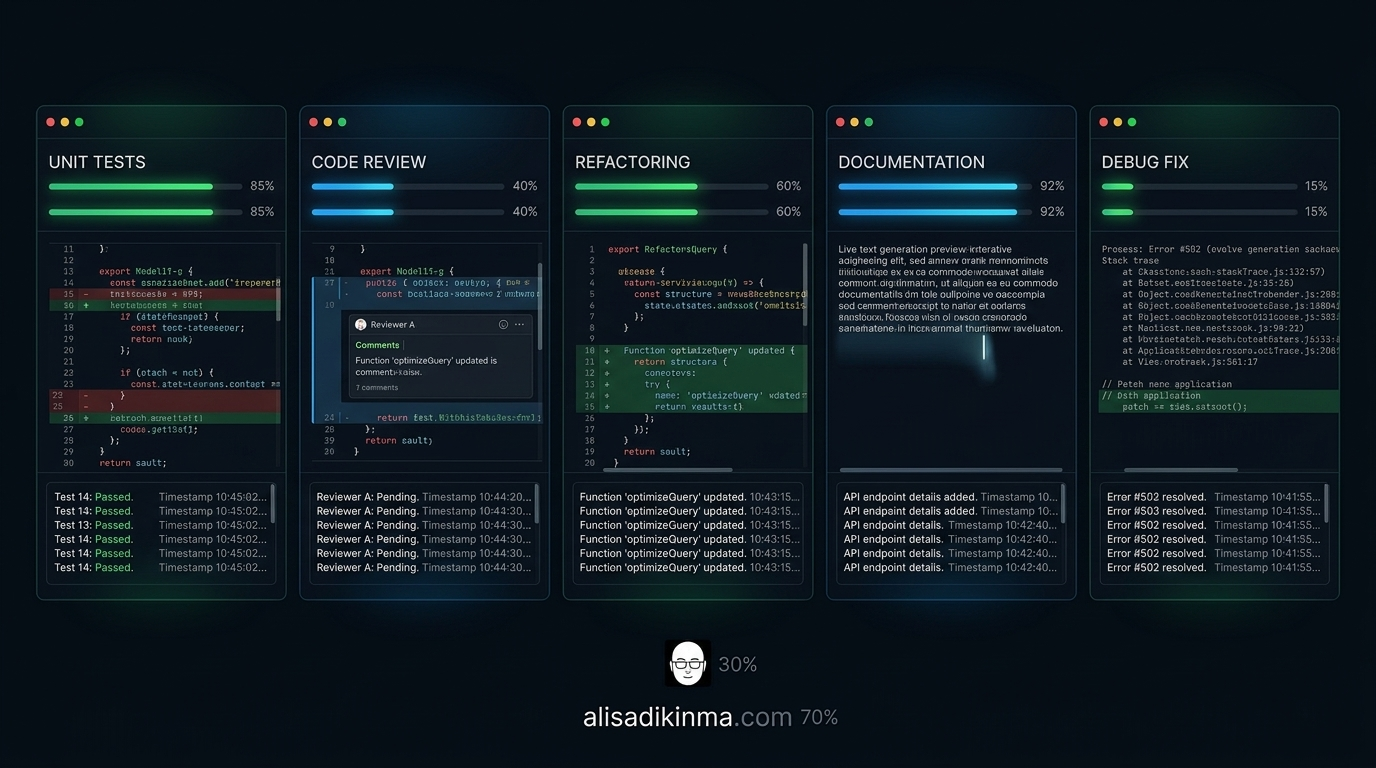
How: Pick a module or file that's overdue for a cleanup. Ask Codex to refactor it for readability and performance, and add inline documentation for every function in JSDoc format. Codex proposes changes as a diff that you can review and approve before merging — you stay in full control.
Real example: The Harness Engineering team built more than 1 million lines of code over 5 months through 1,500 merged pull requests — with just 3 engineers (OpenAI Harness Engineering, 2026). Much of that work included refactoring and maintenance that would normally require a much larger team.
Outcome: Cleaner codebase, documentation that stays up-to-date. Developers no longer have to sacrifice sprint velocity for long technical debt cleanup sessions.
5. Debug and Propose Fixes for Existing Errors
What: Codex can read error logs, trace stacks, and propose complete solutions — not just explain what's wrong, but hand you the actual fix.
How: Paste an error log or link to a failing test into Codex. Ask Codex to analyze the error, identify the root cause, propose a fix with an explanation, and write a regression test to make sure the bug doesn't come back. Codex generates the analysis and fix code ready for review.
Outcome: Teams using Codex for debugging report only needing 10–20% human effort to review and approve the solutions Codex generates (AllAboutAI, 2026). 80–90% of the analysis and code-writing work is already done by AI before a developer ever opens the PR.
Real Teams. Real Numbers. Real Codex Results.
Cisco cut code review time by 50% and accelerated project timelines from weeks to days after adopting the OpenAI Codex AI coding agent, according to getpanto.ai 2026 data. This wasn't a small pilot project — it was a production deployment at an enterprise-scale engineering team with a large codebase and high security standards.
But the most striking numbers come from Harness:
Three engineers. Five months. 1,500 merged pull requests. Over 1 million lines of code.
Average: 3.5 PRs per engineer per day (OpenAI Harness Engineering, 2026).
Compare that to the industry baseline: a productive senior developer typically merges 1–2 PRs per day under ideal conditions with a normal workload. OpenAI Codex wasn't replacing engineers at Harness — it worked as an additional agent within the same team, handling assigned tasks and waiting for human review before merging.
And the most important part to understand:
Humans stay in control. Teams report only needing 10–20% effort to review and refine Codex's output before merging (AllAboutAI, 2026). That means 80% of the coding work is already done before a senior developer even opens the file.
This isn't AI replacing developers. It's AI making developers work like a team 5x their size — on the same budget.

What This Means for Your Next Sprint (and Your Career)
Workplace adoption of the OpenAI Codex AI coding agent has hit 18% and grown 6x in one year according to JetBrains Research 2026 — from 3% in April–June 2025 to 18% in January 2026. That number will keep climbing as more teams prove the ROI firsthand.
Remember the question at the start:
Your pull requests will never be the same.
This isn't about learning new tools. It's about a fundamental shift in how work gets done.
Sprint planning will change. Tasks that were previously too small to prioritize can now be run in parallel by Codex while the team focuses on bigger problems. A backlog full of technical debt can be cleaned up without cannibalizing main sprint velocity.
And for your career:
Developers who can effectively direct and review AI agents — who can write clear prompts, critically evaluate output, and integrate AI into team workflows — will have a significantly stronger output position than those who can't. Not because AI replaces the others, but because their output becomes incomparable.
The question now isn't whether Codex will change the way your team works.
The question is: how many tasks in your next sprint can the OpenAI Codex AI coding agent handle while you sleep?
FAQ: OpenAI Codex in ChatGPT — Your Questions Answered
Is OpenAI Codex available to all ChatGPT users?
The OpenAI Codex AI coding agent is currently available to ChatGPT Plus and Pro subscribers. The cloud preview launched on May 16, 2025 (OpenAI Introducing Codex). Free tier users don't have full access yet, but OpenAI has indicated a gradual rollout as the model proves stable at scale.
How accurate is Codex compared to writing code manually?
In OpenAI's internal benchmarks, OpenAI Codex hits 75% accuracy — beating standard o3 by 5% (IntuitionLabs, 2025). Production teams report needing 10–20% human effort to review and refine output before merging (AllAboutAI, 2026). High accuracy means less rework, not zero rework — human review remains the final gatekeeper.
How long does it take Codex to complete a task?
Task completion typically takes 1 to 30 minutes, depending on complexity (OpenAI Introducing Codex, 2025). Simple tasks like writing unit tests can finish in 1–3 minutes. Refactoring a large module can take 20–30 minutes. Because Codex runs in the background, those tasks don't block whatever else you're working on.
Try Codex inside ChatGPT today — available now for Plus and Pro subscribers.
Or save this article before your next sprint planning session — Codex changes what's realistic to ship in a single sprint.