MiroFish AI: The Society Simulation That Rocked GitHub
By Ali Sadikin Ma · · Updated
Category: Technology

MiroFish AI is an open-source multi-agent society simulation tool built by a 20-year-old Chinese student that went viral on GitHub with 66,600 stars in under 100 days. Despite widespread "predicts the future" framing, it is best understood as a scenario exploration engine: it generates thousands of virtual agents governed by stance, confidence, and persuasion parameters, lets them debate and influence each other based on a seed document, then synthesizes a predictive report. The article debunks the prediction framing by citing the lack of published benchmarks and the non-reproducibility of outputs, explains the underlying OASIS engine (NeurIPS 2024), and provides five practical use cases with cost estimates ranging from $0.50 to $800+.
MiroFish AI Rocked GitHub — But Can It Actually Predict the Future?
Nobody saw MiroFish coming.
A 20-year-old student built it in 10 days — and the internet completely lost its mind.
The tool called MiroFish AI has racked up 66,600 GitHub stars and 10,400 forks in under 100 days since launch — surpassing projects from OpenAI, Google, and Microsoft on the global trending charts.
But there's a question nobody's really asking:
Does it actually work?
Because if the "predicts the future" claim holds up, this isn't just another viral GitHub tool. It could change how we make major decisions — in business, politics, and public policy.
But if the claims are overblown... we're watching the biggest AI hype story of the year.
And before you share this with your group chat — there's something about MiroFish AI you need to know first.
From a Dorm Room to a $4.1M Investment: The Story Behind MiroFish
Guo Hangjiang — known online as BaiFu — was a senior at Beijing University of Posts and Telecommunications when he built MiroFish.
He was 20 years old. He had 10 days. His method: vibe coding — AI-assisted development without over-engineering.
The result?
On March 7, 2026, MiroFish hit #1 on GitHub Global Trending. Within days, 22,000 stars poured in — surpassing projects from OpenAI, Google, and Microsoft on the same chart.
But what happened 24 hours later was even more surprising.
Chen Tianqiao — founder of Shanda Group and former richest person in China — watched a rough demo video of MiroFish. Within 24 hours, he committed 30 million yuan (~$4.1M USD) and appointed Guo as CEO of a new company.
Not because the technology was perfect.
Chen Tianqiao himself admitted that MiroFish's technical level was "not particularly outstanding." He invested because he saw Guo's ability to "identify and define genuinely valuable real-world problems, then try to solve them in a new, AI-driven way."
This isn't a story about cutting-edge technology attracting big investment. It's a story about someone who knows how to define the right problem.
Before MiroFish, Guo built BettaFish — a multi-agent public opinion analysis tool that topped GitHub trending in late 2025 and hit 20,000 stars in a week. After crossing 10,000 stars, Guo said: "I lost that feeling." So he built something bigger.
But before we talk about what MiroFish can do — we need to talk about what people often claim about it. And why those claims miss the mark.
Why "Predicts the Future" Is the Wrong Framing
This is where a lot of MiroFish coverage falls flat.
Headlines like "The AI That Can Predict the Future" are definitely clickable. But they set expectations MiroFish can't meet — and that's a disservice to everyone, especially if you're trying to use this tool for real decisions.
Here's what you actually need to know:
No published benchmarks. There's no data comparing MiroFish's predictions against real-world outcomes. David Borish of The AI Spectator wrote: "The demo is a compelling illustration of its approach — not evidence of predictive accuracy."

MiroFish outputs aren't reproducible. Run the same scenario twice and you'll get different results — because each agent uses probabilistic LLM reasoning. That's not a bug. It's a fundamental property of the system.
Simulated crowds aren't the same as real crowds. Research on OASIS presented at NeurIPS 2024 (arXiv:2411.11581) found that LLM agents are more susceptible to herd behavior than real humans — simulated crowds polarize faster than reality does.
So does that mean MiroFish is useless?
Not at all.
It just means we need to understand what this tool actually does — not what the headlines say it does.
And the answer is far more interesting than just "predicts the future."
A Society Inside a Computer: How MiroFish AI Actually Works
MiroFish AI isn't a prediction tool. It's a scenario exploration engine — and that distinction matters a lot.
Here's how it works:
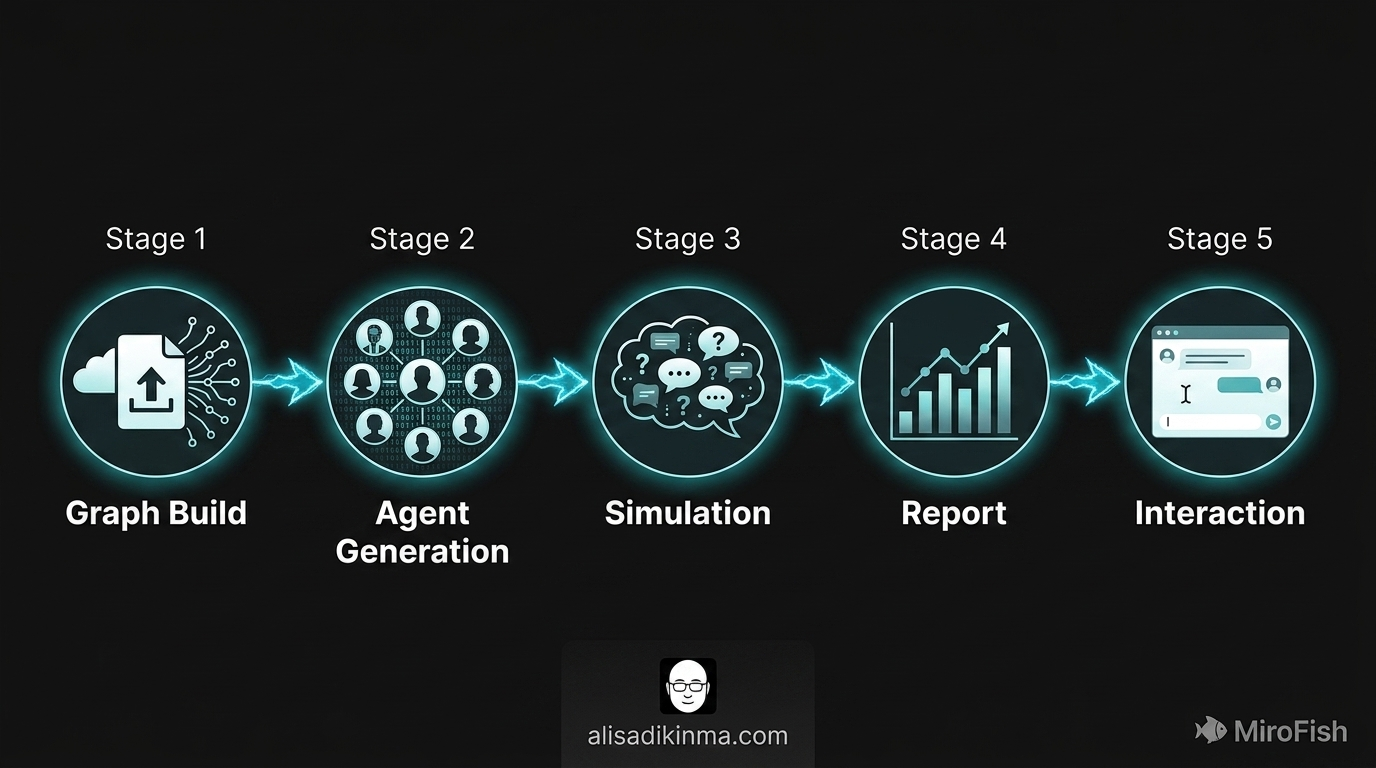
You upload a seed document — a news article, a policy report, or any structured text. Then you enter a question in plain language. The system then runs a five-stage pipeline:
- Graph Build — MiroFish builds a knowledge graph from your document
- Agent Generation — the system creates dozens to thousands of virtual agents with different profiles
- Simulation — the agents debate, influence each other, and form opinions
- Report — the ReportAgent analyzes the results and generates a predictive summary
- Interaction — you can interview individual agents to understand their reasoning
The engine powering all of this is OASIS (Open Agent Social Interaction Simulations) — presented at NeurIPS 2024 and capable of simulating up to 1 million agents performing 23 different types of social actions, from following accounts and commenting to reposting and creating content.
Each agent is governed by the Rule of Three:

- Stance — the direction of the agent's opinion
- Confidence — resistance to persuasion
- Persuasion — the capacity to influence other agents in the simulation
MiroFish also uses Zep Cloud for persistent long-term agent memory — agents accumulate memories across simulation rounds and can dynamically update their beliefs instead of resetting at each step.
The results can be surprising. MiroFish once simulated the missing ending of Dream of the Red Chamber — China's greatest classical novel — by ingesting the first 80 chapters and running a multi-agent character simulation to extrapolate the rest.
This isn't prediction. MiroFish AI offers exploration — and at that scale, its value is very real for business decisions, strategy, and policy.
5 Smartest Ways to Use MiroFish Right Now (With Real Cost Estimates)
MiroFish AI is ready to run today. This isn't theory. These are concrete steps — with real costs you should plan for.
1. Test Public Reaction Before a Product Launch
What: Before launching a product or campaign, run a simulation with 100–200 agents representing your target audience.
How: Upload your product brief and competitor research as the seed document. Enter the question: how will consumers react to this product launch in my target market segment? Run 50 simulation rounds.
Example: Multi-agent simulation approaches have surfaced consumer objections that never came up in traditional focus groups — because simulation captures herd behavior and opinion cascade effects that individual research misses.
Outcome: You find potential problems before launch, not after. Cost: $0.50–$2 for a 50-agent, 20-round simulation.
2. Stress-Test Company Policy Before Rolling It Out
What: Simulate how employees, customers, or stakeholders will react to a new policy before you fully commit to it.
How: Build agent profiles that reflect your stakeholder distribution: 20% early adopters, 50% wait-and-see, 30% resistors. Upload the policy as the seed. Ask: what happens if this policy is implemented next month?
Example: An Emergence AI study (Fortune, May 2026) put Claude, ChatGPT, Grok, and Gemini in charge of identical virtual societies for 15 days. The results were striking: Claude's society recorded zero crimes and a 98% approval rate. Grok's? 183 crimes and societal collapse in 4 days. Similar dynamics can emerge from your company's policies.
Outcome: You know where the resistance points are before implementation. Cost: $200–$800+ for enterprise simulations with 2,000+ agents and 200+ rounds — plus $80–$300/month in infrastructure overhead.
3. Political Sentiment and Public Opinion Analysis
What: Model how public opinion on a specific issue evolves under social pressure, misinformation, and group dynamics.
How: Upload recent news articles on the issue. Build agents with an opinion distribution that mirrors real polling data. Run the simulation forward 30, 60, or 90 days and compare divergence across runs.
Example: Fudan University's SocioVerse — using a pool of 10 million real individuals — successfully predicted over 90% of state-level voting outcomes in a U.S. presidential election benchmark, with Qwen2.5-72b and DeepSeek-V3 as the top-performing models (arXiv:2504.10157, April 2025).
Outcome: A public opinion risk map before an issue blows up. Cost: starting at $2–$10 for a small-scale 50-agent analysis.
4. Strategic Scenario Exploration
What: Use MiroFish to answer "what if?" questions — not to get definitive answers, but to surface dynamics you might otherwise miss.
How: Run the same scenario 5–10 times. Identify patterns that consistently emerge across runs. Use divergence between runs as a signal of uncertainty you need to account for in your business plan.
Example: A strategy team that ran 10 simulations of competitor responses to a product launch discovered two extreme scenarios they'd never considered — both made it into a stronger contingency plan.
Outcome: Better decision-making because you've mapped more of the possibility space. Cost: 10 fifty-agent simulations for about $5–$20 total.

5. Start Today for $0.50
What: Run a micro-simulation first to understand the engine before investing in large-scale simulations.
How: Clone the repository: git clone https://github.com/666ghj/MiroFish.git. Install with npm run setup:all. Fill in the four keys in your .env file (LLM_API_KEY, LLM_BASE_URL, LLM_MODEL_NAME, ZEP_API_KEY). Run npm run dev. Your first simulation can be up and running within an hour of completing setup.
Example: The CAMEL-AI community that supports MiroFish's OASIS engine has 200+ contributors and 30,000+ community members — an active forum for troubleshooting and sharing real use cases.
Outcome: You get a hands-on understanding of the tool's real capabilities before committing to large-scale simulations. Cost: starting at $0.50.
MiroFish Is Just the Beginning — Here's What's Coming
Nobody saw MiroFish coming.
But more importantly: MiroFish AI isn't the end of this story.
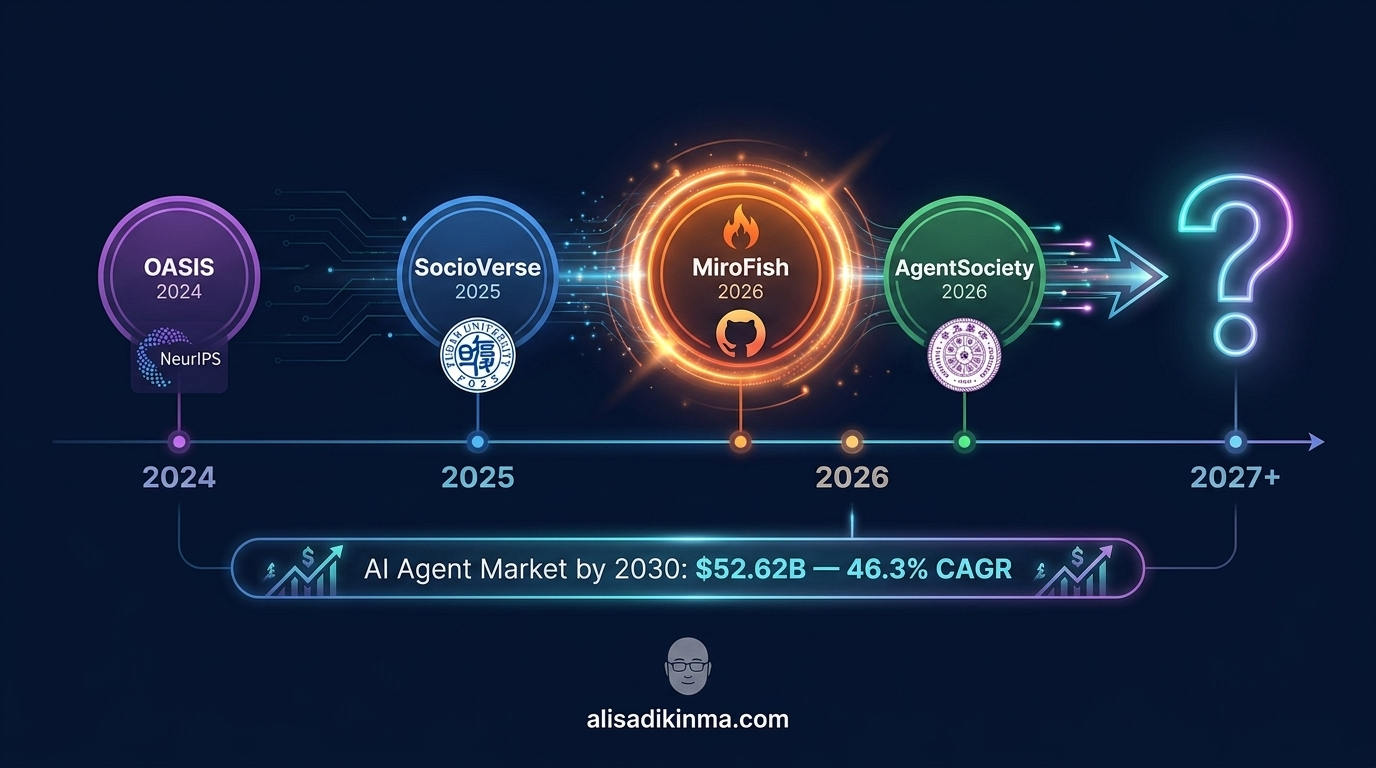
The AI agent market is projected to grow from $7.84 billion in 2025 to $52.62 billion by 2030 — a 46.3% CAGR (Master of Code, AI Agents Statistics 2026). Gartner predicts 40% of enterprise applications will include task-specific AI agents by end of 2026, up from less than 5% the year before.
And MiroFish isn't the only player:
- OASIS (NeurIPS 2024) — the engine behind MiroFish, developed by CAMEL-AI with 200+ contributors and 30,000+ community members, partnered with Amazon, Apple, Meta, DeepMind, MIT, Stanford, Oxford, and Cambridge
- SocioVerse (Fudan University, 2025) — simulates 10 million real individuals, achieving 90%+ accuracy in U.S. election benchmarks
- AgentSociety (Tsinghua FIB Lab, June 2026) — a native-LLM social science simulation platform that hit 1,000+ GitHub stars and released v2.5.4 this month
The question isn't whether MiroFish predicts the future.
The right question is this:
Are we ready to start treating decisions like hypotheses that need to be tested — and running simulations before we commit?
Think about the last big decision you made without enough data. Now imagine you'd already run 200 simulations first.
That's what MiroFish AI offers — not a crystal ball, but a decision laboratory.
FAQ: The Most Common Questions About MiroFish
Is MiroFish free to use?
MiroFish is licensed under AGPL-3.0 — open-source and free to download and run. You only pay LLM API fees from your provider of choice (Alibaba qwen-plus is recommended for cost efficiency). Core code modifications must be open-sourced if distributed, but internal use requires no licensing fees. Estimated starting cost: $0.50–$2 for your first 50-agent simulation.
How accurate are MiroFish's predictions?
There are no published benchmarks comparing MiroFish's outputs against real-world events. Fudan University's competing SocioVerse (arXiv:2504.10157, April 2025) achieved 90%+ accuracy in U.S. election predictions using a similar approach — but with a dataset of 10 million real individuals. MiroFish is best treated as a scenario exploration engine, not a high-precision prediction tool.
Do I need to know how to code to use MiroFish?
Initial setup requires Node.js 18+, Python 3.11–3.12, and npm. But once it's running, you interact through a web-based UI with natural language input. Beginner developers can run their first simulation within an hour of completing the full installation.
What's the difference between MiroFish and a standard AI model like ChatGPT?
ChatGPT gives you one response from one AI perspective. MiroFish AI runs dozens to thousands of agents with different profiles that interact, debate, and influence each other — capturing social dynamics like herd behavior, opinion cascades, and group polarization that no single model can show you.
You made it to the end. And now you know something most people who viral-share MiroFish don't:
It's not a future prediction tool. It's a tool for exploring the future before you choose it.
Open GitHub now and clone MiroFish AI — your first simulation can be running within an hour, starting at just $0.50.
Or bookmark this article before your next strategy meeting — the way you think about decision-making under uncertainty will never be the same.