Google Anthropic's $40 Billion Investment: The Real Reason
By Ali Sadikin Ma · · Updated
Category: Technology
Google Anthropic's $40 billion investment just got officially announced — committing to a company they already control.
If you think that sounds weird — you're right.
And if you think you already understand why this Google Anthropic $40 billion investment happened, you're probably wrong.
The Google Anthropic $40 Billion Investment That Shouldn't Make Sense (But Actually Does)
According to Bloomberg, Alphabet will inject $10 billion cash directly into Anthropic at a $350 billion valuation, plus an additional $30 billion conditional on Anthropic hitting certain targets. Total Google Anthropic $40 billion investment: $40 billion potential. In a company where Google already holds around 14% — contractually capped at a maximum of 15%.
There are three questions that no headline has fully answered.
Why is Google investing in a company they already partially own? What does $40 billion mean for whoever ends up controlling global AI infrastructure? And is a number this big actually the clearest signal that a bubble is forming?
All three answers are connected in the context of this newly announced Google Anthropic $40 billion investment. And once you see the connection, you won't be able to read AI investment headlines the same way again.
What Everyone Thinks Is Happening
The popular narrative is easy to digest: Google is afraid of being left behind.
OpenAI has reached a $850 billion valuation (Crunchbase, March 2026). Amazon moved first — announcing $5 billion cash plus $20 billion contingent to Anthropic, four days before Google came out with their own deal. If you're in a race and the person ahead just accelerated, you accelerate too. That's what everyone assumes is happening.
On paper, the data supports this story.
Anthropic is in a momentum that's rare even by tech industry standards. Their annualized revenue run rate hit $30 billion in April 2026 — up from $9 billion at end of 2025, a 233% surge in four months (Anthropic Press Release, 2026). Claude now holds 32% of the enterprise LLM API market, beating OpenAI's GPT-4o at 25%. Eight of Fortune 10 are already customers. Claude Code alone has surpassed $2.5 billion ARR (The Next Web, 2026).
All these numbers support one simple story: Google is buying a ticket to the winner before the price goes up again. And that's why this Google Anthropic $40 billion investment looks reasonable on the surface.
But there's a part that doesn't fit that narrative. And that's the most important part.
Why the Simple Story Is Wrong
Let's look at the bigger picture.
Venture funding into foundational AI startups in Q1 2026 reached $178 billion — in just 24 deals. That's double the entire year 2025 total of $88.9 billion (Crunchbase, 2026). But on the flip side, an MIT Media Lab study from August 2025 found that 95% of organizations investing in enterprise GenAI haven't seen any return at all. The AInvest 2025 survey found 54% of global fund managers see AI stocks as already in bubble territory.
So capital is flooding into AI — but who's actually capturing the returns?
Here's where the story starts to feel off.
In the Google-Anthropic deal structure, most of the investment comes as Google Cloud credits. That means Anthropic uses Google Cloud for training and inference — and Google effectively gets their own money back as infrastructure revenue. The Next Web says it plainly: not an "investment thesis, but a defensive necessity wrapped as a strategic partnership — and $40 billion is the price of making sure the world's best AI company keeps running on your chips."
J.P. Morgan Asset Management offers the sharper question in their analysis: not whether these deals resemble the dot-com era, but whether the fundamentals are actually the same. Not an easy question to answer.
If you look at this pattern across all the 2026 AI mega-deals — Amazon, Microsoft, Google all "investing" in AI companies that then use their infrastructure — you start seeing something different from conventional investment. The Google Anthropic $40 billion investment is the clearest example of this circular financing pattern.
So why is everyone still signing those checks?
The Real Picture: This Isn't a Bet on Anthropic — It's a Tax to Stay in the Game
Gadjo Sevilla from eMarketer puts it directly: "Google doesn't need the best model, but they need to own the dominant infrastructure that every other model relies on."
That sentence changes everything.
To properly understand the Google Anthropic $40 billion investment, you need to know three things:
1. Watch who's providing the compute — not who's "investing"
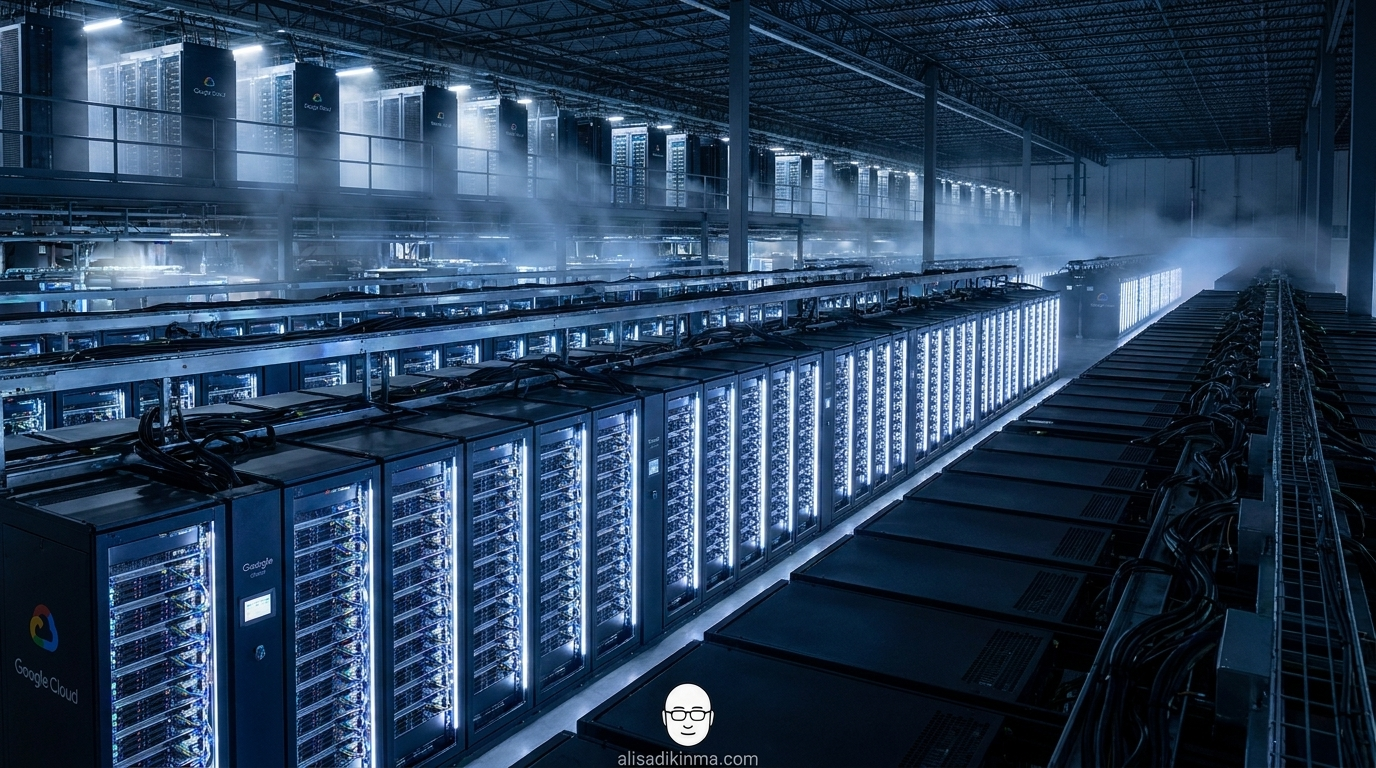
Google Cloud is committing to provide 5 gigawatts of computing capacity to Anthropic over the next five years, including access to around 1 million seventh-generation Ironwood TPU chips (The Next Web, 2026). This isn't a freebie — it's the largest cloud contract in AI industry history.
How to read this deal in practice: when you see an AI company announce an "investment" from a cloud provider, check the breakdown. If most of the deal is cloud credits, what's actually happening is that AI company is becoming a long-term customer — with locked-in pricing and very deep technical dependency.
A real example you can see right now: Anthropic trains all their models on Google's infrastructure. Models trained on Google TPUs get deeply optimized for that architecture. Migrating to other infrastructure in the future isn't just expensive — it's technically very complex. Total US Big Tech AI capex in 2026 is projected to exceed $650-700 billion (Deecon Consulting, 2026), with data center utilization already at 80% and vacancy rates at a record low of 1.6% in North America (J.P. Morgan, 2025). Compute is already scarce.
The result: whoever controls the chips and compute capacity controls the direction of AI model development. Not through equity ownership, but through infrastructure dependency.
2. See who's getting locked in as the long-term infrastructure vendor
The FTC in their January 2025 6(b) report warned: cloud provider investments in AI developers risk locking in market dominance for big tech incumbents. Anthropic, trained on Google TPUs with architecture optimized for Ironwood chips, will be very expensive to migrate away from — even if they wanted to.
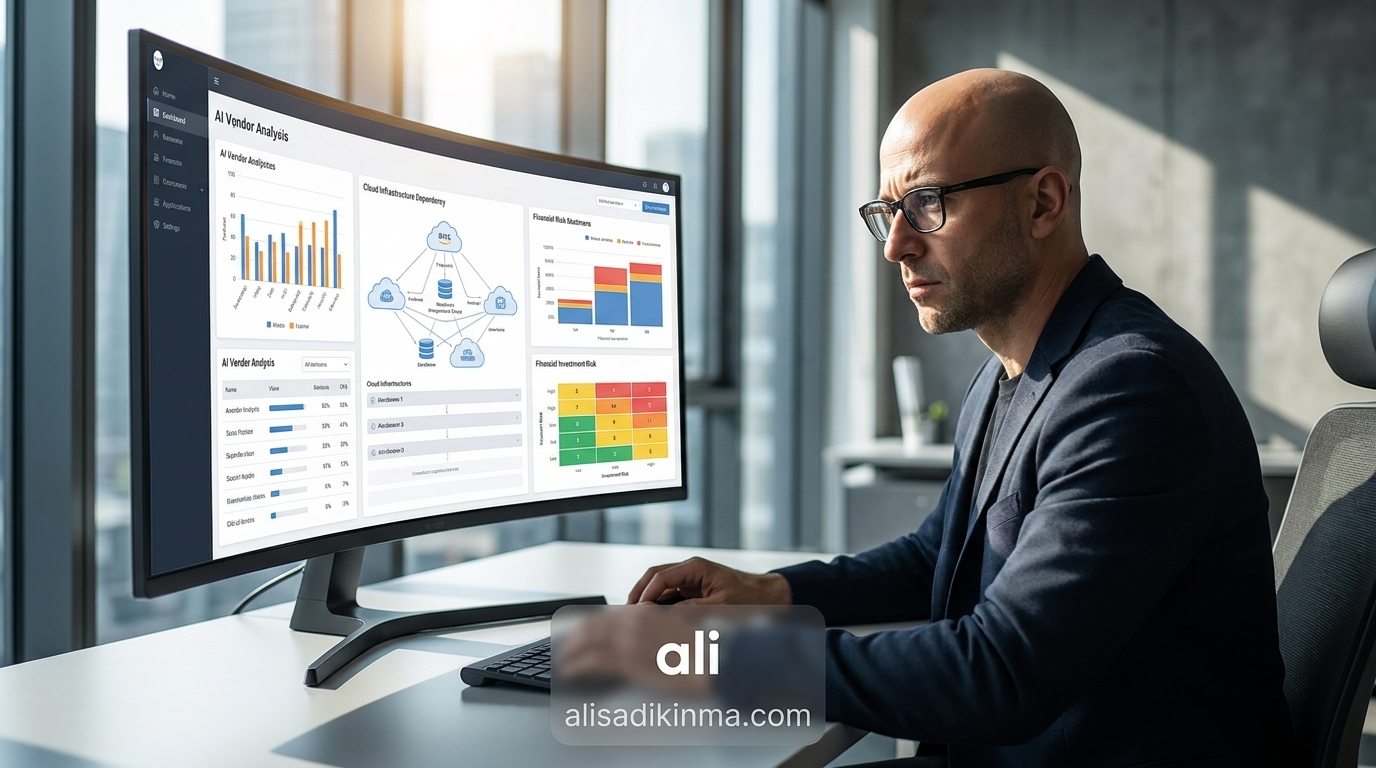
How to apply this today: evaluate every AI vendor your team uses based on where they're trained and hosted. Ask directly: if Google Cloud raises prices 30%, what happens to your pricing? If the answer isn't clear, you already know there's a dependency they haven't admitted.
This isn't a hypothetical scenario. When enterprise leaders evaluate AI vendors for critical operations, the top priority shouldn't just be model performance — but portability and resilience against infrastructure relationship changes that can happen at any time.
The result: vendor lock-in at the infrastructure layer is more dangerous than vendor lock-in at the application layer because it's invisible until you're deeply dependent and need to get out.
3. Calculate the real infrastructure tax being paid
$40 billion sounds massive until you compare it to what Google gets back: lock-in from a company with $30 billion annualized revenue growing 233% in four months, with 8 of Fortune 10 as customers — all dependent on Google Cloud. For perspective: $40 billion is just one-third of Alphabet's annual operating cash flow (Bloomberg, 2026).
This isn't a venture bet. It's the largest customer acquisition cost in cloud computing history, neatly wrapped as a "strategic investment."
Krishna Rao, Anthropic's CFO, calls it "a continuation of our disciplined approach to scaling infrastructure." For Google, it's the most profitable long-term contract they've ever signed.
What the Google Anthropic $40 Billion Investment Means for Enterprise Leaders
Think about the AI tools your team has evaluated in the last three months. How many are built on AWS, Google Cloud, or Azure? How many are indirectly funded by the same company that provides their infrastructure?
These are real questions — not rhetorical ones.
Anthropic is currently trading at a 27x EV/Revenue multiple — a number that's never existed for pre-profitability enterprise software. This gap between price and fundamentals — partly created by the Google Anthropic $40 billion investment pushing valuations higher — will affect the roadmap and pricing decisions of the AI vendors you use, sooner or later. Their gross margin is currently at 40%, while 77% is needed by 2028 to justify the valuation (Shanaka Anslem Perera, Substack analysis 2026).
Anthropic's valuation trajectory reflects the scale of this pressure: $61.5 billion in March 2025, to $183 billion in September 2025, to $380 billion in February 2026 — 6x in under 12 months (CNBC, 2026).
Abhivyakti Sengar from Everest Group warns that enterprise clients could face "uncertainty around service continuity" if the Google-Anthropic infrastructure relationship gets disrupted — for example due to ongoing antitrust pressure.
One question you can use today before committing to a major AI vendor: who's providing their infrastructure, and what happens to your pricing and availability if that relationship changes?
Three Signals to Watch in the Next 90 Days
All the questions about the Google Anthropic $40 billion investment from the start of this article now have answers.
Google investing in a company they already control? Because it's the most efficient way to lock in a frontier AI company as a long-term infrastructure customer without a full acquisition that triggers regulation.
What $40 billion actually means? The price paid to become the default infrastructure for the world's largest AI company for the next decade.
And about the bubble — three concrete signals you need to watch:
First, Anthropic's IPO in October 2026. Forge Global reports Anthropic is exploring an initial public offering targeting a raise of over $60 billion at a $400-500 billion valuation. If institutional markets absorb this, fundamentals are still trusted. If not, brace for a major correction across the entire AI sector.
Second, the Google-Anthropic antitrust decision. The Department of Justice is considering whether Google should sell its Anthropic stake. Charlie Dai from Forrester warns that forced divestiture would create immediate uncertainty for the entire enterprise customer base relying on Claude.
Third, Q3 2026 market share data. Claude is already at 32% of the enterprise LLM API market, ahead of OpenAI at 25%. If this trend holds in Q3, the winner-take-all thesis underpinning all these ecosystem valuations gets stronger — and Google's $40 billion decision looks increasingly visionary.
Next time you read "$10 billion investment in AI," you'll know exactly what's actually being bought.
FAQ
Why can Anthropic's valuation hit $380 billion when they're not profitable yet?
Anthropic closed a $30 billion Series G in February 2026 with a $380 billion post-money valuation — the second largest in private tech financing history (CNBC, 2026). The valuation justification is based on extreme revenue growth: annualized from $9 billion at end of 2025 to $30 billion+ in April 2026, plus more than 1,000 enterprise customers spending over $1 million per year, with 8 Fortune 10 companies among them.
Is Google at risk of losing its Anthropic stake due to antitrust?
The risk is real and actively being evaluated by regulators. Abhivyakti Sengar, Senior Analyst at Everest Group, stated in Computerworld that forcing Google to sell its Anthropic stake "throws a wrench into one of the AI industry's most significant partnerships." Enterprise clients could face immediate service uncertainty if ownership and infrastructure access suddenly change due to a regulatory decision.
Does the Google Anthropic $40 billion investment benefit companies using Claude?
In the short term, this deal guarantees Anthropic has compute access to keep scaling. Dario Amodei, Anthropic's CEO, emphasizes that collaboration with cloud partners enables them to "continue advancing AI research while delivering Claude to customers, including the more than 100,000 building on AWS." Short-term stability is assured — but long-term infrastructure dependency remains a risk factor that enterprise leaders need to monitor.
Subscribe for weekly AI investment intelligence — before your competitors find out.
Save this article before your next board meeting — this infrastructure tax framework applies to every AI investment decision you'll face in 2026.