Gemini 3 vs GPT-5: Google Finally Won — Here's the Data
By Ali Sadikin Ma · · Updated
Category: Technology
There's one number that proves Google just beat OpenAI in Gemini 3 vs GPT-5 — and it's not the benchmark you think.
Not about who's smarter on exam questions. Not about Humanity's Last Exam or GPQA Diamond, even though Gemini 3 wins there too.
The number is $13,500.
That's what you could save per year by switching to Gemini 3.1 Pro from GPT-5.4 right now. For developers processing 100 million tokens per month, the cost is $625 vs $1,750 — data from NxCode/BenchLM 2026.
And almost nobody's talking about it.
But there's something even more surprising.
ChatGPT lost 24 percent market share in the last 12 months. From 69.1% in January 2025 to 45.3% in January 2026 — according to Fortune. And this shift happened quietly, without big drama, without big announcements.
Where did it go? And when exactly did this start?
If you're still loyally paying for ChatGPT Plus, this article might make you rethink — not about who "wins", but about how much you're throwing away without realizing it.
The Current State: Why Everyone Still Thinks OpenAI Is Winning
Google Gemini recorded 750 million monthly active users as of Q4 2025, compared to ChatGPT's 810 million — the gap is already thin, according to Fortune 2026. Gemini even crossed 2 billion monthly visits for the first time in January 2026. But most developers and product teams around you still default to ChatGPT, and there are strong reasons behind that which can't just be dismissed.
That's fair. Google embarrassed itself with the early Gemini versions.
Botched demos, weird outputs, the name change from Bard to Gemini that confused the market. ChatGPT has a strong first-mover advantage — and the trust built during 2023-2024 doesn't vanish just because there's a new press release.
Enterprise tells the same story.
OpenAI is still the default name at a lot of companies. When someone says "we're using AI," it usually means "we're using ChatGPT." That's real brand equity, and brand equity is hard to shift with just benchmark numbers from a lab.
But there's data almost nobody's paying attention to:
The question isn't "who's more well-known?" anymore. The question is — how long can this narrative hold up when the numbers are already pointing in the opposite direction?
Why It's Wrong: The Data Proving the OpenAI Narrative Has Shifted
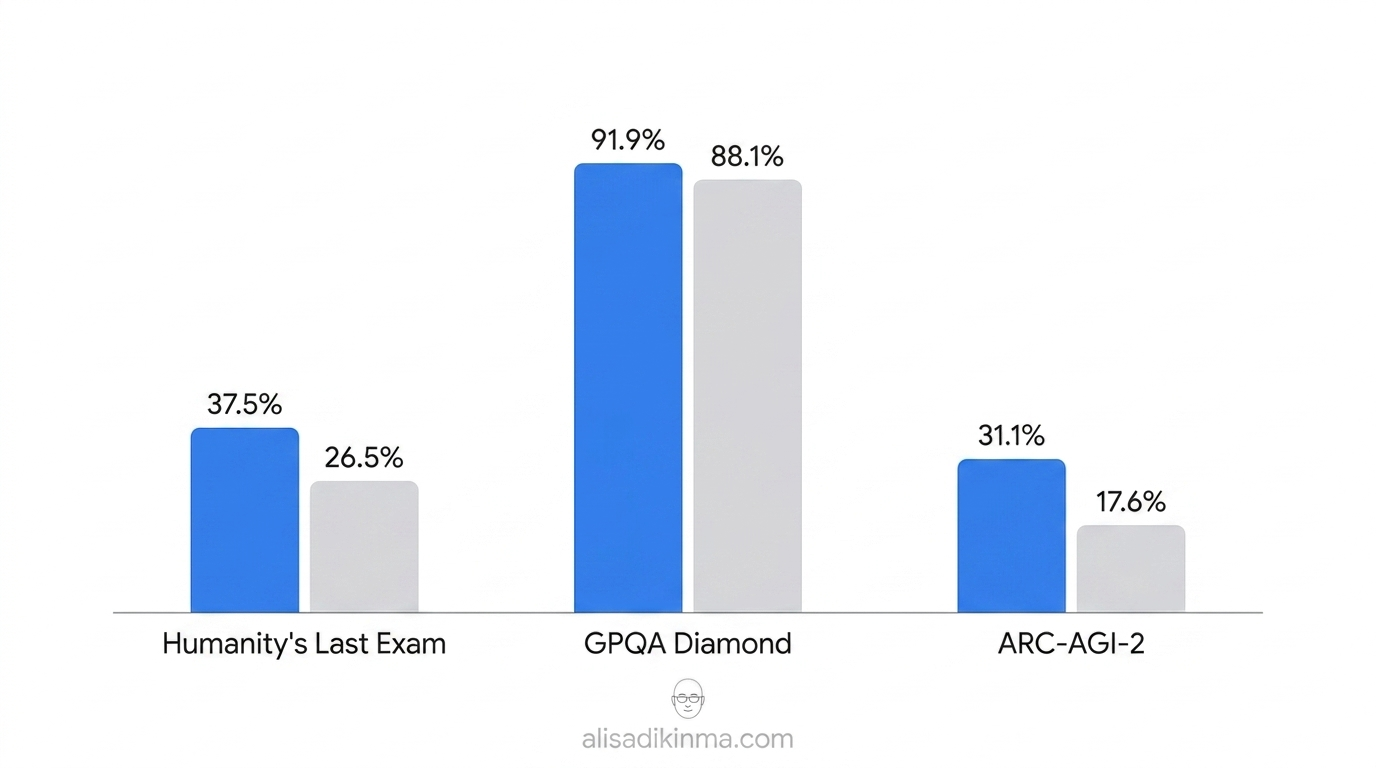
Gemini 3 Pro scored 37.5% on Humanity's Last Exam — the hardest benchmark around right now — compared to GPT-5.1 at 26.5%, according to Vellum AI 2025. On GPQA Diamond, Gemini 3 Pro hit 91.9% vs GPT-5.1's 88.1%. On ARC-AGI-2, it's 31.1% vs 17.6% — almost double. This isn't a single benchmark fluke — it's consistency across three categories at once, showing a clear pattern.
Now look at what's happening on technical benchmarks:
On Vending-Bench 2 — a benchmark for agentic real-world tasks, not just lab exams — Gemini 3 Pro recorded a mean net worth of $5,478. GPT-5.1 trailed 272% below that figure, according to Vellum AI 2025. This is about AI that can run real tasks autonomously, not just answer questions correctly.
And this doesn't even touch on the enterprise side.
The Big Technology 2026 data is pretty dramatic: OpenAI's enterprise LLM share dropped from 50% in 2023 to 27% in 2025. Google climbed to 21%. Anthropic, which was barely on the enterprise radar two years ago, is now at 40%. Big companies don't switch because of media trends — they switch because they've done the math.
That's not a slowdown. That's systematic erosion.
And this doesn't even touch on pricing — which is probably the most important part of this story...
The Real Picture: What Gemini 3 Actually Brings — and What the Media Doesn't Tell You
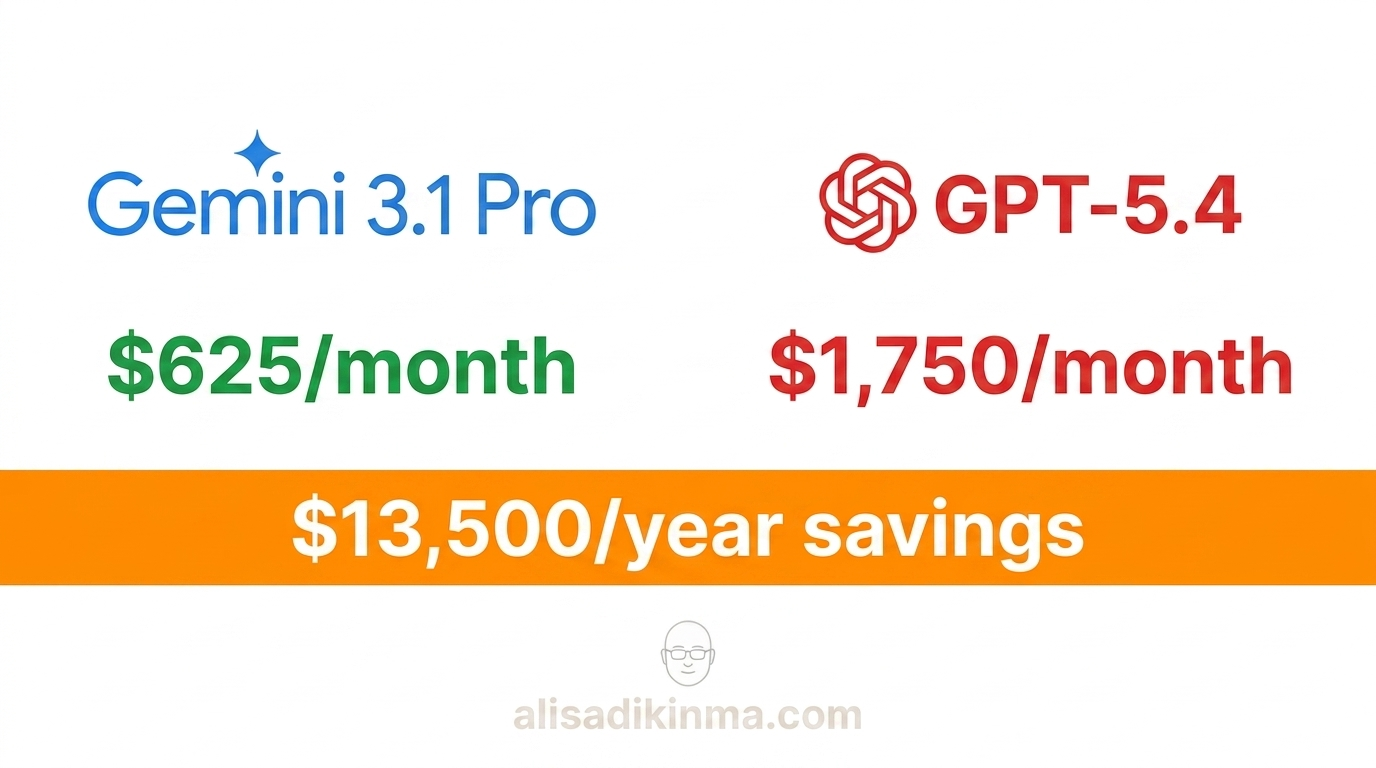
Gemini 3.1 Pro comes with a 2 million token context window — double GPT-5.4's 1 million — and API pricing 2-3x cheaper per token according to NxCode/BenchLM 2026. Developers processing 100 million tokens per month pay around $625 with Gemini 3.1 Pro, compared to $1,750 with GPT-5.4. That's a $13,500 difference per year per developer — and that's a conservative number for teams with higher volume.
This isn't about who wins on benchmarks.
It's about how much is bleeding from your cash flow every month for staying loyal to a brand that no longer has a justification for its premium pricing.
Then there's the part the media almost always skips:
Deep Think mode. Quoc Le, researcher at Google DeepMind, described it with a phrase you rarely hear from academics: "Deep Think was the engine behind our gold medal-level wins at IMO and ICPC, and now powers an even stronger version of Gemini 3. SOTA above SOTA." — InfoQ, 2025.
SOTA above SOTA.
It means more than just state-of-the-art. Deep Think mode goes beyond the standard that was previously considered state-of-the-art. Kevin Roose from NYT Hard Fork responded with a question that cuts right to the core: "Is this them taking their crown back?" — InfoQ, 2025. Not rhetoric. A genuine question from someone who follows this space closely.
What the media doesn't tell you:
A 2 million token context window means you can feed in your entire codebase, full legal documents, or hundreds of pages of research in a single prompt — no chunking, no losing context between sections. GPT-5.4 with 1 million tokens can't do this at the same scale.
What does this mean for your stack right now?
What This Means for You: 3 Real Implications for Developers and Product Teams
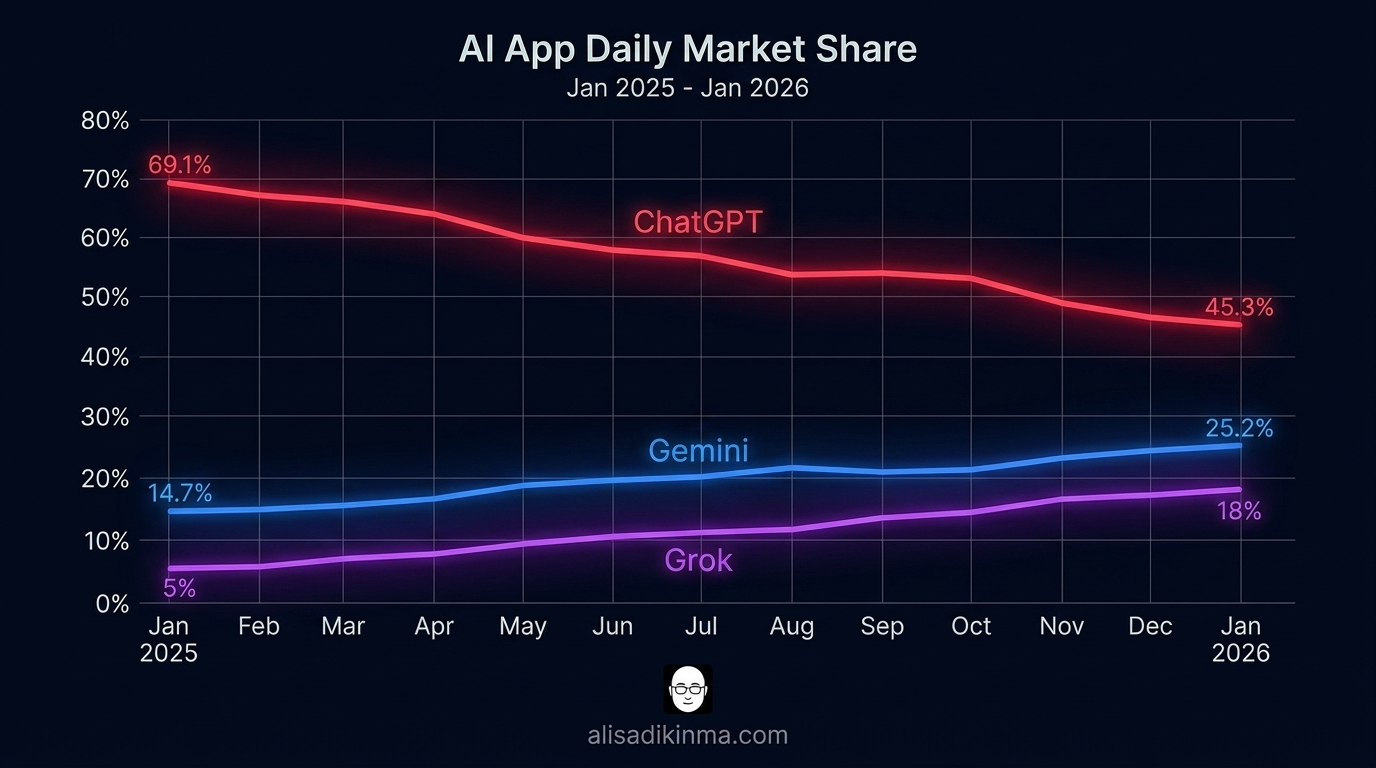
These three implications are directly relevant to developers and product teams currently using GPT-4 or GPT-5 in their products — not just casual AI testers. ChatGPT's market share among daily users in the US has already dropped from 69.1% to 45.3% in one year, while Gemini climbed from 14.7% to 25.2% according to Fortune 2026. This shift isn't a future plan — it's already happening.
1. Recalculate your API costs — don't put it off
What: Switching to Gemini 3.1 Pro for production can save $13,500 per developer per year, based on API comparison data from NxCode/BenchLM 2026.
How: Open last month's API billing. Count total tokens processed. Multiply by Gemini 3.1 Pro's rate ($6.25 per million input tokens, $18.75 output) then compare with GPT-5.4's rate ($17.50 input, $52.50 output). A simple spreadsheet in Google Sheets can settle this in 10 minutes.
Real example: A team of 5 developers each processing 50 million tokens per month pays around $15,625 with Gemini vs $43,750 with GPT-5.4. That's a $28,125 difference per month — or $337,500 per year. For a startup looking for longer runway, that's not a number you can ignore.
Outcome: You don't need to pitch investors for longer runway. You just need to switch platforms and recalculate one line in your billing dashboard.
2. Test agentic capability in one workflow this week
What: Vending-Bench 2 data shows Gemini 3 Pro is 272% more effective on real-world agentic tasks — but lab numbers aren't the same as your team's specific production conditions.
How: Pick one task that currently takes 3-5 manual steps on your team. For example: summarize + categorize + route support tickets, or scrape + analyze + draft a weekly report. Run the same workflow on Gemini 3 Pro and GPT-5 side by side with identical prompts, then measure accuracy and speed.
Real example: A DevOps team using GPT-4 for incident report triage typically needs 2-3 prompt iterations due to context window limits. With Gemini 3 Pro and its 2 million token context window, the entire log fits in one pass — no chunking, no losing context between events separated by hours.
Outcome: You'll have your own internal data — not benchmarks from a vendor's lab. That's what's easiest to justify to management and most relevant for your product.
3. Re-evaluate the "ChatGPT = industry standard" assumption
What: Brand recognition isn't a performance metric. In 2023, "industry standard" really was ChatGPT. In 2026, it's far more complex — and more expensive if you don't review it.
How: Ask your team this: "Are we using OpenAI because of benchmarks, price, or habit?" An honest answer to that question will immediately clarify whether your platform decision is data-driven or just inertia.
Real example: Big Technology 2026 reported that enterprise OpenAI share dropped from 50% to 27% in two years. Those companies didn't switch because of media trends — they switched because they sat down and seriously did the math.
Outcome: Your team will have a clear stance on AI platforms — not "we use the most famous one," but "we use what makes the most sense for our current use case and budget."
The Path Forward: What You Should Do This Week
This isn't about who wins the AI war.
Remember the number from the start? ChatGPT dropped from 69.1% to 45.3% in one year. Not because of some big scandal. Not because ChatGPT suddenly got bad. But because a cheaper alternative with better performance finally matured enough for production — and the market follows data, not logos.
That's what's happening right now. Quietly, without drama.
And most important:
Gemini 3.1 Pro already has a 2 million token context window — double GPT-5.4 — at 2-3x cheaper per token according to NxCode 2026. These numbers aren't future promises. They're available right now, via API, for anyone who's willing to open their billing dashboard and run the numbers.
You don't need to do a full switch right away.
What you need to do is stop assuming your team's AI spending is already optimized. Because chances are, it's not.
Which AI platform are you going with — and have you actually done the math?
FAQ: Gemini 3 vs GPT-5 — The Most Common Questions
Is Gemini 3 available globally?
Yes, Gemini 3 Pro is available globally via Google AI Studio and the official API. As of 2026, Gemini API access is open to developers worldwide, including paid tiers at lower rates than GPT-5.4. For individual users, Gemini is accessible at gemini.google.com with a regular Google account — no VPN or extra configuration needed.
Should I switch from ChatGPT to Gemini right away?
You don't have to do a full switch. The most sensible approach is hybrid: test Gemini 3 Pro on one production workflow first — like summarization or document analysis — while keeping GPT-5 for use cases that are already proven. Your own internal test data is far more relevant than benchmarks from any vendor's lab.
What use cases is ChatGPT still more competitive for?
ChatGPT still leads in its more mature plugin ecosystem and third-party integrations. If your team is heavily dependent on the GPT Store or tools built specifically for the OpenAI API, migration takes more effort. But for pure LLM tasks — coding, document analysis, reasoning — 2025-2026 benchmark data consistently shows Gemini 3 Pro is more competitive and more affordable.
Try Gemini 3 Pro now — link in the first comment.
Or save this article before your team's AI strategy meeting this month.