Claude Code Pro Plan Almost Vanished — But This Isn't Over
By Ali Sadikin Ma · · Updated
Category: Technology
One Afternoon. One Pricing Change. And Everything Developers Believed About the Claude Code Pro Plan Shifted.
On April 21, 2026, Anthropic quietly removed Claude Code from the Claude Code Pro plan at $20/month — no email, no announcement, no explanation. The tool that had become a staple of developer workflows disappeared from the official pricing page, replaced by a new requirement: pay for the Max plan at $100/month, or no access.
No notice. No release notes. Not a single sentence.
Only after Reddit, Hacker News, and X blew up — after developers compared page archives from April 10 and April 21 — did Anthropic finally speak up.
And the question that couldn't be silenced is this: if it can happen once without warning, what guarantees it won't happen again?
To understand the answer, you need to know what actually happened behind this change — not the version Anthropic wants you to believe.
And if the answer isn't satisfying, you need to know where to go next.
'Just a Test.' (That's What They Always Say)
Amol Avasare, Anthropic's Head of Growth, called the April 2026 change a "small test on ~2% of new prosumer users." Within hours of the massive backlash on Reddit, Hacker News, and X, the change was reversed and the pricing page was restored. But there's one detail in Avasare's statement about the Claude Code Pro plan that should still have you on alert.
Here's what Anthropic wants you to conclude:
Small experiment. Leaked too fast. Already fixed. Move on.
But Avasare also said something different: the Max plan is "designed for intensive chat usage — that's it." Meaning the current plan architecture isn't built for heavy agentic users — developers who use Claude Code for CLI workflows, long automations, or coding sessions that burn a lot of tokens.
Not a bug. Not an oversight. That's a design decision moving in one direction.
Before you feel relieved that the change got reversed — remember this:
Companies running real A/B tests don't change their public pages. They flip flags on the server. What you change on a page that every user reads is intent — and that intent doesn't disappear just because the pricing page got rolled back.
There's one data point from April 2026 that answers a deeper question. And it's not about the pricing page change.
The '2% Test' That Changed Every Public Page. That's Not a Test. That's a Signal.
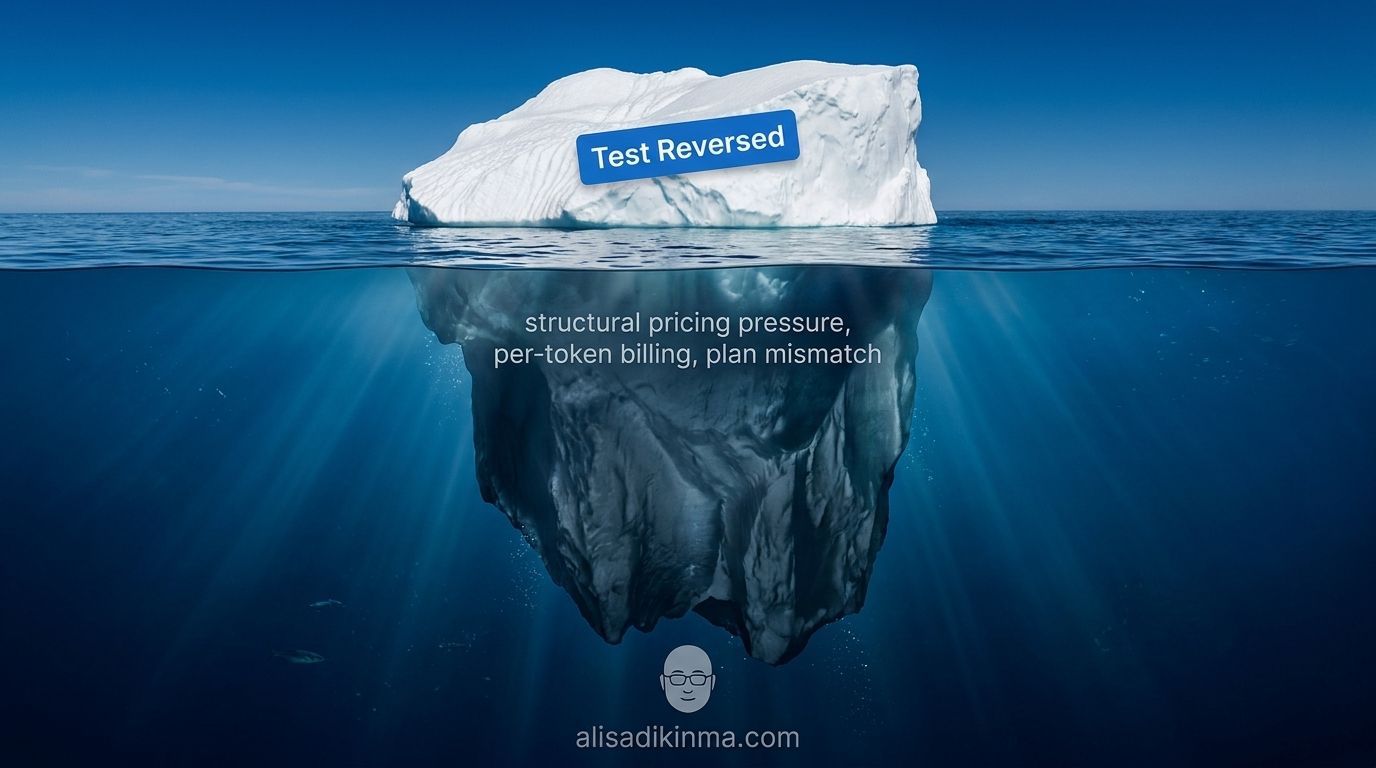
On April 10, 2026, Anthropic's support docs read: "Using Claude Code with your Pro or Max plan." On April 21, that line changed to: "Using Claude Code with your Max plan." Not in internal systems — on a public page that every subscriber reads every day. Real A/B tests don't work like that.
Picture yourself as an engineering team running a feature test on 2% of users.
What do you do? You set a feature flag on the server. You don't change the public pricing page. You don't update support docs that every subscriber reads. You don't remove explicit mentions from subscription plans in the FAQ.
But that's exactly what Anthropic did.
Support docs changed globally. The pricing page changed globally. Not for 2% of Claude Code Pro plan users — for 100% of users reading it.
The distinction matters, and it's more specific than it looks.
According to The Information, Anthropic is shifting enterprise users to a per-million-token billing model — moving away from flat-rate subscriptions. For users who use Claude Code intensively, token consumption can get very high in a single agentic session. A flat $20/month isn't financially sustainable for that segment.
And here's the connection:
The enterprise billing change isn't a separate decision from the Claude Code Pro plan pricing page change. It's part of one structural move — Anthropic is building a business architecture that segments users by token usage intensity, not by their plan label.
Not a mistake. Not a leaked experiment. This is the direction being taken — and you're in it, for now.
But here's the biggest consequence of that direction — and the one that hasn't been talked about much.
No Developer Is Paying $100 to Evaluate a Tool — and That's the Problem
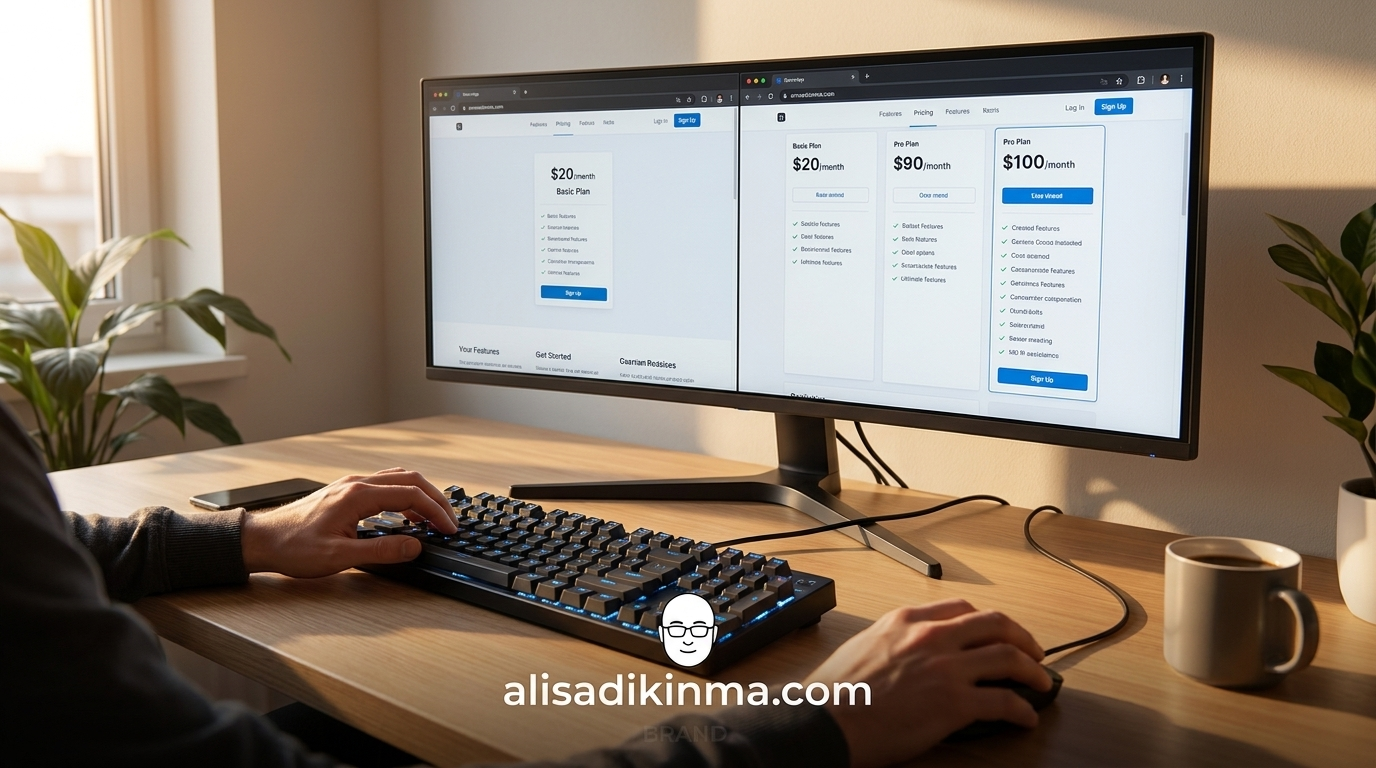
XDA-Developers summed it up right after April 2026: "At $20, Claude Code is an easy recommendation. At $100+, it becomes a hard one." Not because $100 is too expensive for developers who are already productive with it. But because no new developer is going to drop $100 to evaluate a tool they've never tried before.
The biggest problem with this pricing change isn't about existing users' wallets.
It's about how new developers discover Claude Code — and why that discovery pipeline is now in serious danger.
Picture yourself as a developer just starting to explore AI coding tools. Limited budget. You don't want to commit big before knowing the results. You open Anthropic's pricing page and see: Claude Code access requires the Max plan at $100/month.
You don't try it.
Not because Claude Code isn't good. But because nobody spends $100 to evaluate a tool they don't know — especially when competitors offer a much easier entry: OpenAI Codex is free, GitHub Copilot has a 30-day trial with no credit card required.
At $20/month, the Claude Code Pro plan spread through organic recommendations:
- Senior developers would recommend it to juniors — "just try it for a month, it's cheap."
- Developers on Discord and Slack naturally shared their workflows because the tool was affordable.
- Low barrier to entry meant fast adoption, and word-of-mouth took care of itself.
At $100+/month, that mechanism breaks. Senior developers won't recommend something that immediately bills their juniors $100 before they even know if the tool fits their workflow. The community stops talking about it as "a tool worth trying" and starts talking about it as "a tool for the serious."
"A tool for the serious" is a category that kills discovery.
What's really at stake here isn't just revenue from existing users. It's the entire pipeline of new developers who will — or won't — discover Claude Code over the next two to three years.
The generation of developers who don't discover Claude Code today is the generation that won't recommend it tomorrow.
So the question gets very concrete: if you're a Claude Code Pro plan user right now, what should you do before the next change?
3 Things Claude Code Pro Plan Users Should Do Before the Next Pricing Change
The April 2026 change could happen again — and maybe without a reversal next time. These three steps can be done today, each under 15 minutes, to make sure you're not stuck without options if the Claude Code Pro plan pricing changes again.
1. Screenshot and Save the Pricing Page Today
What to do: Open claude.com/pricing right now and take a full-page screenshot with an active timestamp.
How to do it: Use a browser extension like GoFullPage or Fireshot for a full-page screenshot — not just the visible area. Save it to a dedicated folder in Google Drive or Notion, and name the file with today's date: claude-pricing-2026-05-04.png. Set a monthly reminder to update the screenshot regularly.
Why it matters: The April 2026 change was first caught not from an official announcement — but because users compared page archives from April 10 and April 21. You can do the same, but only if you have a historical snapshot to compare against.
The result: You're not depending on Reddit or Hacker News to find out about changes. You've got solid proof and can react within minutes, not hours after everyone else has already started panicking.
After that, there's a step that's even more important than documentation:
2. Have at Least One Alternative You've Actually Tried — Not Just Bookmarked
What to do: Activate an account on at least one alternative AI coding tool and use it for one real task, not just initial setup.
How to do it: Sign up for OpenAI Codex (free tier available for individual developers) or activate GitHub Copilot (30-day free trial, direct integration with VS Code and JetBrains). Pick one real bug or small feature to solve with that tool. One hour of real usage is worth more than two hours reading other people's reviews.
Why it matters: When your favorite tool changes pricing or loses access, you need an option you're already familiar with — not starting a learning curve from scratch under a deadline or in a panic.
The result: Developers who've used alternatives before don't panic when their main tool changes. They switch, evaluate, and come back — or don't — from a position of leverage, not desperation.
And the last one, the easiest to do but the most often skipped:
3. Set Up Automatic Alerts for Anthropic's Pricing Page Changes
What to do: Automatically monitor claude.com/pricing so you know about changes before they go viral.
How to do it: Use Visualping or Distill Web Monitor — both have free tiers that are enough for basic monitoring. Set alerts to your email or Slack channel. Target specific elements: the Pro plan feature list section and the headings for what's included in the subscription. Daily check frequency is enough.
The result: You'll know within hours if anything changes — not after it's trending on X and everyone's already making emotional decisions first.
Anthropic Can Rebuild This Trust. Here's Exactly What's Needed.
The biggest problem with April 2026 wasn't the pricing — it wasn't the business decision to move agentic tools to a higher tier. The problem was the silence. No prior email. No notice. No roadmap you could hold onto. And trust broken by silence doesn't automatically heal just because the pricing page got rolled back.
Remember that $20 tool that almost disappeared overnight?
Prices can go up. That's understandable in the context of a changing business. What's not easy to recover from — what leaves the longest mark — is not knowing when the next change is coming.
If Anthropic wants to rebuild that trust, one step is enough to start: a pricing roadmap you can actually hold onto. Not a postmortem after backlash. Not a reversal because of public pressure. But a proactive commitment: "Claude Code stays on the Pro plan until [date]. If that changes, you'll know [X days] in advance."
That's not a high bar. That's the minimum standard for a tool that's already baked into a developer's daily workflow.
The real question isn't whether Claude Code is worth $100/month.
The question is: will Anthropic make a commitment clear enough that you don't need to screenshot their pricing page every week?
Your answer to that question is the data Anthropic needs — and probably has never directly asked for.
FAQ: Claude Code, Pro Plan, and What Happens Next
Is Claude Code still available on the Pro plan right now?
As of April 2026, Claude Code is back on the Claude Code Pro plan at $20/month after Anthropic reversed the change following developer community backlash on Reddit, Hacker News, and X. This status isn't permanently guaranteed — the pricing page and support docs have changed before without prior notice. Actively monitor the pricing page and use automatic monitoring tools as a precaution.
Should Pro users upgrade to Max to protect their Claude Code access?
Upgrading to the Max plan ($100–200/month) gives more stable access for intensive agentic usage, but it's not a requirement right now. The smarter move: stay on the Claude Code Pro plan while setting up at least one alternative you've actually tried — OpenAI Codex or GitHub Copilot — so you have leverage when deciding whether to upgrade, instead of being forced to because you have no other options.
What are the best Claude Code alternatives if Anthropic changes pricing again?
The two most mature alternatives right now: OpenAI Codex is free for individual developers, and GitHub Copilot offers a 30-day free trial with direct integration into VS Code and JetBrains. Neither is as strong as Claude Code for complex agentic tasks — but both are solid enough as a transition and enough to give you leverage when negotiating with team budgets or management.
Subscribe to stay ahead of AI pricing changes that affect your developer workflow — before the next silent update.
Not sure which AI coding tool to trust right now? Save this article before your next subscription renewal.