How AI Builds Itself — Here's What's Actually Happening
By Ali Sadikin Ma · · Updated
Category: Technology
80% of Anthropic's production code last month was written by AI.
Something fundamental just changed.
Not because AI got better at solving benchmark quizzes. Not because the graphs went up and to the right in investor decks. There's a different mechanism running inside the labs — and most people, including those working in the industry, haven't seen it clearly yet.
But before we get into that:
There are two big camps arguing about this right now. The first camp says this is the biggest change in tech history since the internet. The second camp says it's just another hype cycle — benchmarks go up, but real work doesn't change.
They're both half wrong.
And there's one data point from the most skeptical people out there — from inside the AI labs themselves — that'll change how you see all of this.
The Number That Rewrites Everything
According to a report from the Anthropic Institute released in June 2026, more than 80% of the code that went into Anthropic's production codebase in May 2026 was written by Claude — not humans. Not in a test environment. Not a prototype. Production code used by millions of people every day.
This isn't a marketing claim. It's an internal metric published via an official whitepaper. And the implications are bigger than they look at first glance.
This isn't about AI helping engineers type faster. AI is building the infrastructure used to train and run the next AI.
How AI builds itself isn't a theory about the future. This is what's happening in Q2 2026 — and there are three separate tracks running in parallel.
What Everyone Thinks They Know (And Why Both Camps Are Half Wrong)
Here's the thing:
The optimists focus on benchmark charts. SWE-Bench went from 2% at the end of 2023 to nearly 94% in 2026 in three years. And they're right about the numbers.
The skeptics focus on real-world experience. Internal benchmarks haven't moved much since Claude 3.5 Sonnet. AI code still needs close supervision and often fails at edge cases. And they're right about that too.
What both camps miss:
Public benchmarks and real productivity measure different things. SWE-Bench measures whether AI can resolve a bug report that's already been well-defined. Real-world use — where AI has to understand ambiguous context, make architectural decisions, and maintain consistency across a large codebase — that's a completely different metric.
According to data compiled by the ML community on LessWrong 2026, frontier model resolution on SWE-bench coding went from 33% in August 2024 to nearly 81% in December 2025. But the internal benchmarks used by real engineering teams have barely moved since Claude 3.5 Sonnet.
Here's the reality:
There are two parallel realities running at once. And both are real. The important thing is knowing which one you're talking about — because they have very different implications.
Data Even the Skeptics Can't Dismiss
But there are numbers that can't be explained away with "benchmark optimization."
The loudest one:
METR — an independent model evaluation organization — tracks one simple metric: how long AI can work autonomously on a single task before needing human help. In 2022, the answer was 30 seconds. In 2026, it's 12 hours. A 1,440x increase in four years, according to data published by Jack Clark in Import AI issue 455.
This isn't a benchmark you can game with prompt engineering. This is real work duration.
The second one:
SWE-Bench frontier jumped from 2% (Claude 2, end of 2023) to 93.9% (Claude Mythos Preview, 2026) — more than 40x in two and a half years, according to Import AI 455. For context: that speedup is equivalent to one AI model solving coding problems that used to take 50 senior engineers.
The third is a measurable personal shift:
Andrej Karpathy — former head of AI at Tesla, one of OpenAI's co-founders — reported on the No Priors podcast with Sarah Guo (March 2026) that his ratio of writing code himself versus delegating to AI agents shifted from 80-20 to 20-80 in December 2025, and keeps moving toward full delegation.
And the fourth:
The average engineer at Anthropic is merging 8x more code per day in Q2 2026 compared to all of 2024. Not 8%, not 80% — eight times more code per day, according to the Anthropic Institute.
In a moment we'll look at the system that just broke a 56-year-old math record. But first — we need to map the three concrete tracks for how all of this actually works.
3 Ways AI Is Building Better AI Right Now
There are three distinct tracks where how AI builds itself is happening in parallel. Not one mechanism — three. And each one is already producing measurable output.
Track A: Code-Level Improvement
AI writing code to train better AI.
This is what's happening at Anthropic. Claude Code — an AI-based coding tool launched in February 2025 — wrote more than 80% of the production code used to run Claude itself in May 2026. Human engineers weren't replaced. They're merging 8x more code per day. The difference: the bottleneck is no longer writing code — it's deciding what to write and why.
GitHub Copilot and Cursor are doing similar things at the scale of millions of engineers outside Anthropic. But the most direct effect on the self-improvement cycle happens when AI-written code enters the next model's training pipeline.
The loop is simple: Claude writes code → code enters the production codebase → codebase is used for training the next Claude → better Claude writes better code → repeat. Today's iteration still needs humans at every major decision point. But the gap is getting shorter every quarter.
Track B: AI Research Automation
AI running experiments to improve the next AI.
Andrej Karpathy built AutoResearch — an AI agent system that runs machine learning experiments autonomously. In 2 days, the system ran 700 ML experiments and found 20 different optimizations that improved model performance, according to a Fortune report from March 2026.
At a bigger scale:
OpenAI acknowledged that GPT-5.3-Codex helped debug training runs, manage deployments, and analyze evaluation results during the process of building itself — reported by IEEE Spectrum 2026. AI helping build the next version of itself.
And from the funding side: Recursive Superintelligence — co-founded by Azalia Mirhoseini and Anna Goldie, two ex-Google DeepMind researchers with a track record in chip layout optimization — closed a $500 million round specifically to automate the entire AI research cycle, according to Import AI 455. One goal: a system that can run the full loop from hypothesis to experiment to publication without a human in the middle.
Track C: Algorithm Discovery
AI finding algorithms better than anything humans could find.
AlphaEvolve from Google DeepMind is the most concrete example available right now. It's a Gemini-based agent that uses evolutionary search to automatically optimize programs.
The results are real and measurable. AlphaEvolve found an algorithm for multiplying two 4x4 complex-number matrices in 48 scalar multiplications — breaking the Strassen record that had stood since 1969 for 56 years without change, according to Google DeepMind's official announcement in 2025. Matej Balog, a computer scientist at Google DeepMind who worked on AlphaEvolve, called it "a collaborative process between humans and machines — you often learn from what the system finds."
Beyond that: AlphaEvolve optimized the FlashAttention kernel for Transformer-based models, delivering a 32.5% speedup. And most practically — AlphaEvolve recovered 0.7% of Google's global compute capacity through optimization of Borg data center scheduling, savings that have been running for more than a year.
Open-source versions are already available. OpenEvolve achieved a 2.8x speedup on Apple Silicon Metal attention kernels. ShinkaEvolve from Sakana AI — accepted at ICLR 2026 — achieved 5-10x speedup over comparable evolutionary frameworks via an asynchronous architecture.
What This Means for You — Whether You Write Code or Not
There's a more practical question than all those numbers above:
Is this different from previous hype cycles or not?
The most honest answer comes from one data point outside Google: FM Logistic — a global logistics company based in France — became the first company outside Google to deploy AlphaEvolve to optimize worker movement in their large warehouses, reported by IEEE Spectrum 2026. Not an internal proof-of-concept. Operational deployment in the real world.
Hype cycles usually take 3-5 years to reach non-tech enterprises. This happened within months of the public release.
Tyler Cowen wrote in Marginal Revolution in February 2026: AI doing most of the programming could potentially deliver a 5-10x increase in software release speed. OpenAI has already compressed the Codex update cycle from more than 6 months to under 2 months.
So what does this mean practically?
If you're an engineer: the bottleneck is shifting from writing code to designing systems and making trade-off decisions. The most valuable skill isn't syntax memorization — it's the ability to define problems precisely and evaluate AI output critically.
If you're not an engineer: AI agent-based tools are already available without needing to code. According to data from the ICLR 2026 Workshop on Recursive Self-Improvement, AI coding agent users reported a 20-40% improvement in development speed. Karpathy calls the 20-80 ratio his new baseline — and this pattern is starting to show up outside software engineering.
One important note: ProgramBench — a new benchmark testing complex FFmpeg and SQLite tasks — shows frontier models still resolve 0% of the hardest tasks. Speed is going up. The capability ceiling still exists. Both things can be true at the same time.
What You Should Be Watching — And One Question Worth Answering
Back to that 80% number at the start.
Anthropic's engineers weren't replaced. They're merging 8x more code. This isn't a threat signal — it's a leverage signal. AI isn't replacing human output; it's multiplying capacity.
But there's a bigger question that hasn't been answered yet:
Jack Clark — co-founder of Anthropic — puts 60% probability on autonomous AI R&D (where frontier models train their replacements independently) happening before the end of 2028, with 30% probability before the end of 2027, according to analysis published on the Claude API Blog 2026.
This isn't speculation. It's a risk assessment from the person building the systems from the inside.
In an essay released in June 2026, Clark wrote: "The AI industry currently has accelerators but no braking mechanism."
Anthropic itself released an official position on June 4, 2026 — co-authored by Marina Favaro and Jack Clark: "Recursive self-improvement isn't inevitable. But it could arrive faster than most institutions are ready to handle."
That's not fear marketing. That's a warning from the people building the systems.
One question worth answering today:
What's your ratio right now? What percentage of your work do you do yourself versus delegate to AI?
Karpathy called December 2025 the point where his ratio "flipped permanently." For some people that point has already passed. For others it hasn't arrived yet.
What makes the difference isn't the tools — it's whether you're actively shifting that ratio, or waiting until there's no other choice.
FAQ: How AI Builds Itself
Is AI recursive self-improvement dangerous right now?
According to the official position of the Anthropic Institute (June 2026), recursive self-improvement hasn't fully occurred yet and isn't inevitable. The same document notes it could arrive faster than most institutions are ready to handle. The risk is real but it's not a crisis happening right now — it's more accurately described as a preparation window that's still open.
How is this different from previous AI hype cycles?
Previous hype cycles were dominated by benchmarks that could be gamed. The METR metric — which measures how long AI can work autonomously without human help — went from 30 seconds (2022) to 12 hours (2026). This is a real work duration metric from an independent evaluation organization, not a number put out by AI companies for marketing purposes. The FM Logistic deployment also shows the transition to non-tech enterprise has already happened in 2026, not just a lab pilot.
Can I experiment with AI self-improvement tools myself?
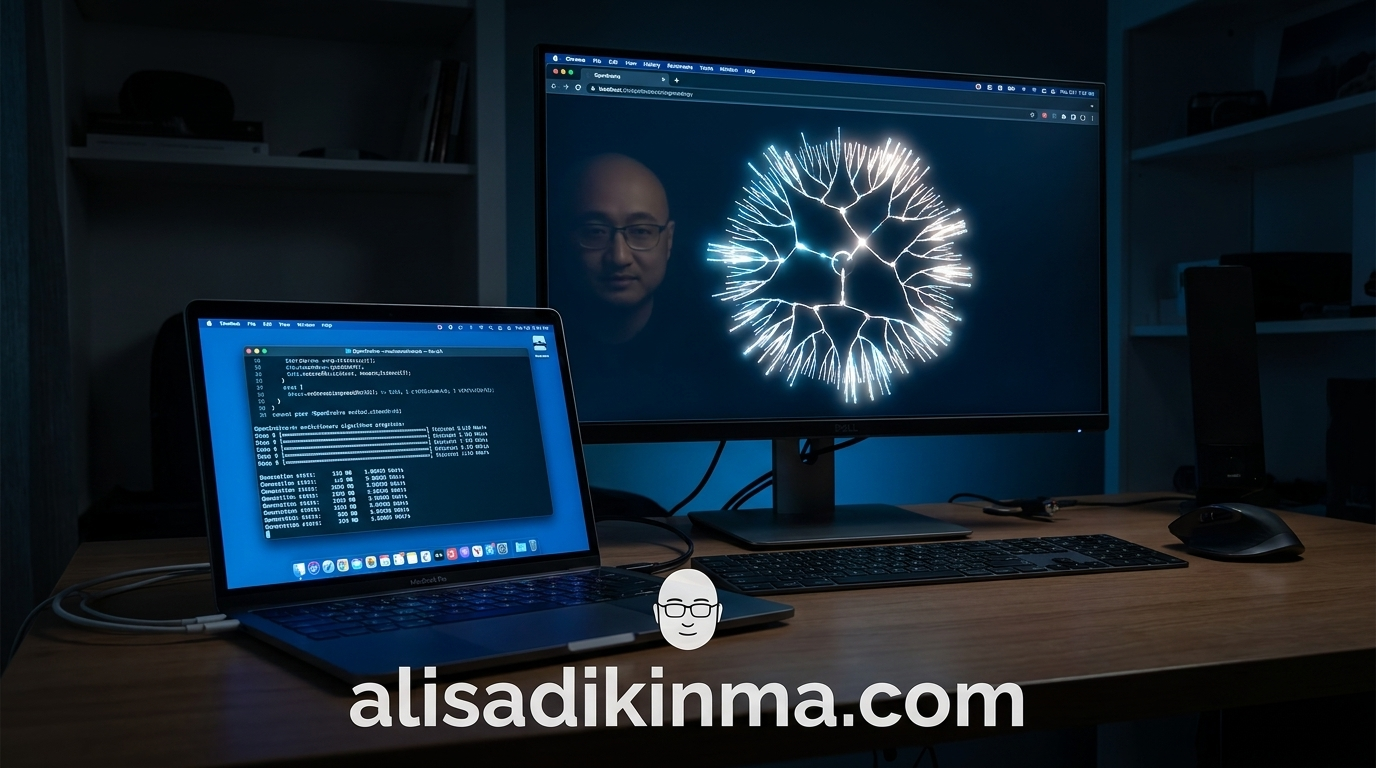
Yes, and it's pretty accessible. OpenEvolve is available via pip install openevolve and can be run on a local laptop in under 5 minutes. You need a starting program, an evaluation function, and an AI model API key. The system runs the evolutionary loop and displays a genealogy tree in a built-in web UI. Copy one of the examples from its GitHub repository as the fastest starting point.
Try OpenEvolve now — install via pip install openevolve, run in under 5 minutes, free. See for yourself how the evolutionary loop works on your local machine.
Or save this article before your team's next planning session — the RSI story is moving faster than most roadmaps have accounted for.