Anthropic + SpaceX: AI Heads to Orbit via Compute Deal
By Ali Sadikin Ma · · Updated
Category: Technology
This doesn't make sense — but it actually happened.
Anthropic just signed the Anthropic SpaceX compute deal with Elon Musk's company. The AI company backed by Google and Amazon — which openly clashes with Musk — is now using SpaceX infrastructure to run Claude.
But that's not what I'm here to talk about.
I'm talking about the part almost everyone skips — and what makes this deal one of the most important moments in AI infrastructure history.
Why does a company that already has access to hundreds of gigawatts of compute from Amazon, Google, and Microsoft still need SpaceX?
What does "space development" actually mean in this agreement — and is it for real?
And most importantly: is this a sign that Anthropic is getting squeezed competitively, or is it actually the most calculated bet they've ever made?
To answer that, you need to know the current state of global AI compute. And it's way worse than what you've been reading.
The AI Compute Crisis Is Worse Than You Think
Earth's data center infrastructure is hitting its capacity limits. Northern Virginia — the world's largest data center hub — has a grid connection waiting list of up to 7 years, according to EnkiAI 2026 research. Lead time for new transformers: 2 to 4 years. The premium data center market has effectively closed for new megawatt-scale builds in 2026.
This isn't a capital problem. It's not an engineering problem.
It's a power problem — and the power simply isn't there.
But here's what almost every headline misses:
This isn't a crisis hitting every AI company equally. It's a filtering crisis — the ones who survive are the ones fast enough and creative enough to find a way out.
Anthropic already has a massive compute portfolio. According to Bloomberg May 2026: 5 GW with Amazon, 5 GW with Google and Broadcom (scheduled for 2027), $30 billion in Azure capacity with Microsoft and NVIDIA, plus $50 billion with Fluidstack.
But even that isn't enough.
The next generation AI models — the ones being trained right now — need scalability that Earth's resources can't deliver in any competitively relevant timeframe.
SpaceX has something that Amazon, Google, or anyone else in the industry doesn't have. And you're about to find out why that's more important than just 220,000 GPUs in Memphis.
Why the Anthropic SpaceX Compute Deal Isn't About Memphis
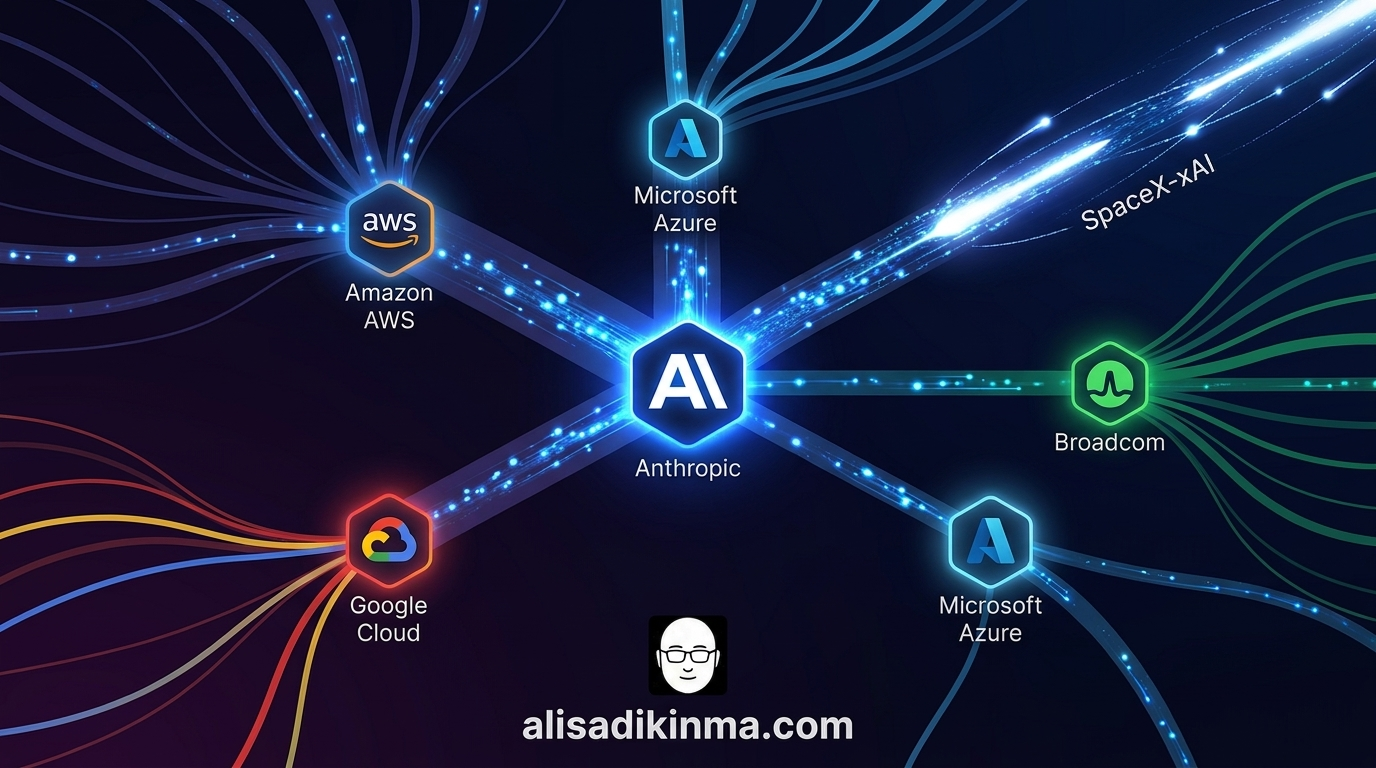
Colossus 1 — SpaceX's data center in Memphis, Tennessee — gives Anthropic direct access to over 300 MW of compute capacity and 220,000 NVIDIA GPUs (a mix of H100, H200, and GB200), according to the official Anthropic announcement reported by CNBC in May 2026. For context: 300 MW is equivalent to the electricity consumption of about 275,000 American households.
But that's still an Earth story.
Remember the SpaceX-xAI merger from early 2026? After SpaceX acquired xAI — Elon Musk's AI division — the company is no longer just a rocket company. SpaceX is now an AI infrastructure player with two assets nobody else has: the Starlink satellite network already in orbit, and the most mature orbital launch capability in the industry.
That's why the "space development" clause in this agreement isn't just legal filler.
Anthropic explicitly stated interest in developing several gigawatts of compute capacity in space with SpaceX, according to the official Anthropic website. Gigawatts. In orbit.
And who benefits most if orbital compute actually becomes a reality?
The market data will answer that — and the numbers will make you stop for a second.
AI Compute in Orbit: The $105 Billion Projection That Isn't Sci-Fi
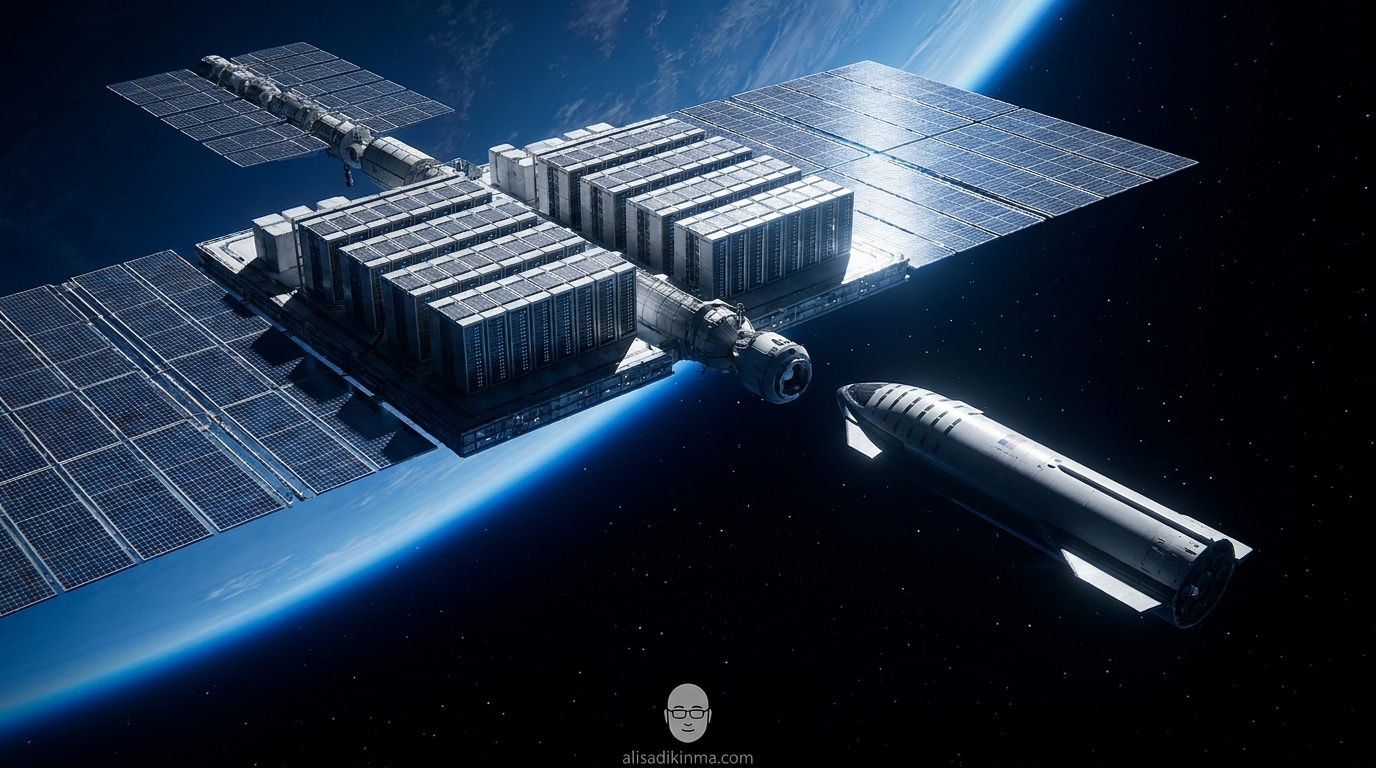
The orbital data center and space-based AI computing market was valued at $1.77 billion in 2025. The projection: $105.4 billion by 2034, with a compound annual growth rate of 67.4%, according to Marketintelo's report on the Orbital AI Data Center Infrastructure Market. That 67.4% CAGR is more than double the average growth rate of even the most aggressive cloud computing sectors.
And this isn't a projection from an overly optimistic think tank.
Venture capital is already in: $2.3 billion invested cumulatively into orbital data center startups through early 2026, according to EnkiAI. Investors don't put $2.3 billion into a sector they think is science fiction.
The traction is real on the technical side too:
In 2021, there were only 3 orbital computing payloads launched or in active development. By 2025, that number was already 47 — a 15x jump in four years, based on EnkiAI 2026 data.
The proof-of-concept existed before this deal.
Starcloud — a startup building an NVIDIA H100 GPU-based compute platform in orbit — has already proven that this isn't just possible, it's technically efficient. According to Marketintelo 2025, AI Compute-as-a-Service holds 36.2% of total orbital service revenue, with each node capable of generating up to 50 TFLOPS of sustained AI inference.
50 TFLOPS per node. In orbit.
This is the answer to the earlier question: Anthropic benefits most from orbital compute because they already have a formal agreement with the only company that can launch hardware to orbit routinely and cost-effectively.
Now you know why Anthropic chose SpaceX for this orbital dimension — not Amazon, not Google.
There's just one question left: what does all this actually mean for you, concretely?
3 Implications That Are Directly Relevant to You Right Now
This deal touches three concrete things that matter for how you plan AI adoption over the next 18 months. This is a shift that's already happening — not theory.
-
Claude's capacity is going up, and you'll feel it
Anthropic officially stated that this Anthropic SpaceX compute deal increases usage limits for Claude Pro and Claude Max subscribers. This isn't an ambiguous promise — it was communicated directly in their official announcement.
Here's how it works: 220,000 new GPUs in the system means more concurrent requests can be processed. Users who regularly hit rate limits — especially during peak usage hours — will feel the difference right away.
Real example: If you use Claude for intensive coding workflows, research, or content production, the limits that used to frustrate you start shrinking. This isn't an incremental improvement — it's a large-scale infrastructure addition in a single deal. Think of it as your internet bandwidth suddenly multiplied by ten.
The result: fewer interruptions, more output per session. For teams relying on Claude as a daily work tool, this is a real operational change in the next 90 days.
-
The AI compute race has a new dimension: who has access to orbit
Earth's infrastructure limits are pushing the biggest players toward orbit. This isn't a long-term plan — it's already happening, with $2.3 billion in VC investment and 47 active orbital payloads as of 2025.
Here's how it works: Orbital compute has one advantage that can't be replicated on Earth — 24/7 solar power without grid constraints, without a seven-year waiting list. This market grows 67.4% per year. Anthropic is the first tier-1 AI company to explicitly include orbital compute in a formal infrastructure agreement.
Real example: OpenAI, Google DeepMind, and Meta haven't announced similar orbital compute partnerships. Anthropic moved first. First-mover advantage in this category isn't just PR — it's a structural advantage you can't buy later with more money.
The result: whoever secures access to orbital compute first has an advantage that's simply not available in the market after that point.
-
The "AI race" framing you know is no longer relevant
This deal isn't a competitive concession from Anthropic. They didn't choose SpaceX because they ran out of other options. They chose them because SpaceX is the only entity that can provide orbital infrastructure and massive-scale terrestrial compute in a single package — post the SpaceX-xAI merger of 2026.
Here's how it works: The relevant AI dominance question now isn't "whose model is the smartest?" — it's "who has enough compute to keep training the next generation of models?" Infrastructure and model dimensions now carry equal weight in any evaluation.
Real example: If you're evaluating AI platforms for long-term adoption in your organization, infrastructure factors — who has access to orbital compute, who has secured grid capacity — now matter just as much as model benchmarks.
The result: how you read and evaluate AI news will change once you understand this dimension. And now you have the framework.
The Next 18 Months: What You Need to Watch
Remember the two rivals I mentioned in the first paragraph?
Anthropic needs SpaceX not because they're losing competitively. They need SpaceX because SpaceX is the only company on this planet — literally — with the capability to launch hardware to orbit routinely and access to massive-scale terrestrial compute in a single entity.
And that's the most important insight from this entire deal.
The real AI competition isn't about Anthropic vs. OpenAI vs. Google anymore. It's about who can scale compute beyond what this planet can provide. The relevant competitive line is no longer between companies — it's between compute that's limited on Earth and compute that's (in theory) unlimited in orbit.
There are three signals you need to watch in the next 18 months:
First, will Google, Amazon, or Microsoft announce their own orbital compute partnerships — and how fast?
Second, how quickly does Anthropic's "interest" in orbital compute go from press release language to actual gigawatts in orbit?
Third, does the Claude Pro capacity increase actually make a difference in the next 90 days — as proof that this deal isn't just a headline?
The answers to those three questions will determine whether this deal becomes the foundation of the next AI era — or a large experiment that takes longer to prove itself.
Frequently Asked Questions
What is the Anthropic SpaceX compute deal?
Anthropic signed an agreement with SpaceX to access over 300 MW of compute capacity and 220,000+ NVIDIA GPUs (H100, H200, GB200) at Colossus 1, Memphis. The deal also includes a mutual statement of interest to develop several gigawatts of compute capacity in orbit — making it more than just a standard infrastructure lease agreement. Source: CNBC and Anthropic News, May 2026.
Why does AI compute in space matter?
Earth's data centers face serious constraints: grid connections in Northern Virginia take up to 7 years, transformer lead times hit 2–4 years. Orbital compute offers 24/7 solar power without grid constraints. This market is projected to grow from $1.77 billion in 2025 to $105.4 billion in 2034, a 67.4% CAGR according to Marketintelo 2025.
Does this deal directly affect Claude users?
Yes. Anthropic officially stated that this deal increases usage limits for Claude Pro and Claude Max subscribers. Adding 220,000 GPUs to Anthropic's system directly increases concurrent request capacity — meaning fewer rate limits for intensive users who rely on Claude for their daily work.
Save This Before Your Next AI Strategy Meeting
The compute landscape just shifted — and most people haven't realized it yet.
Save this article before your next AI strategy meeting. The framework you just read will change the questions you ask — about which platforms are worth investing in, about which trends are real signals and which are just noise.
Or, follow along for weekly breakdowns on AI infrastructure that actually affects how you work — not just headlines that come and go in 24 hours.